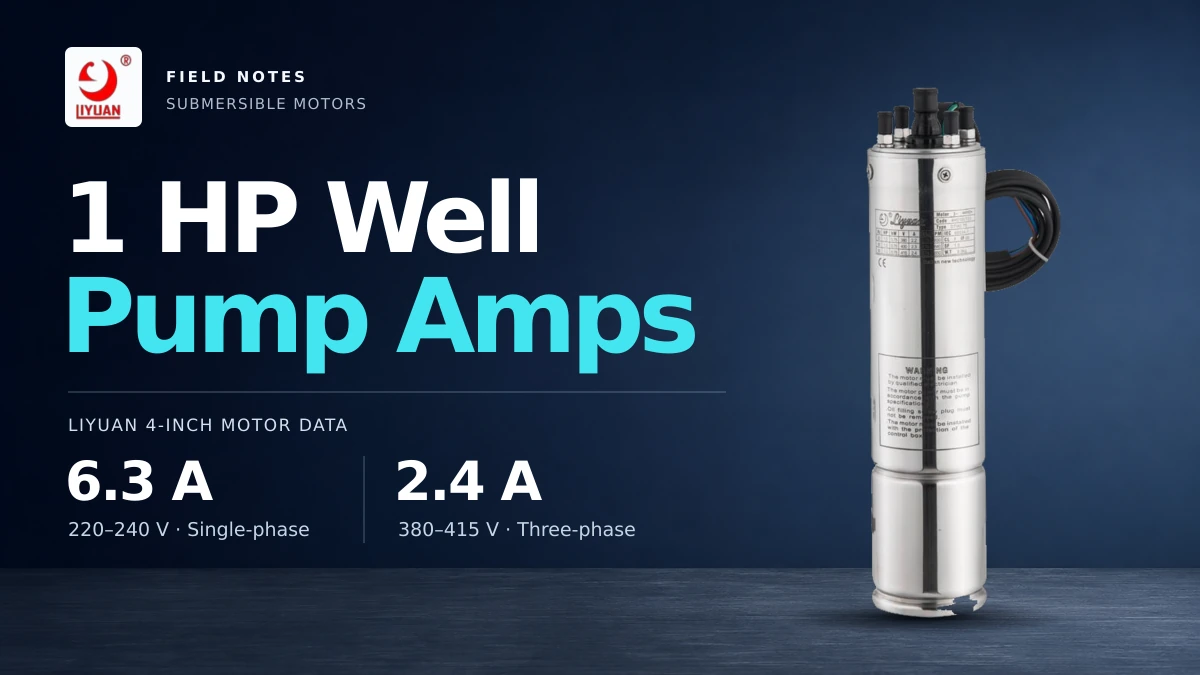
Liyuan’s 4-inch oil-cooled motor catalog gives two answers for 1 HP well pump amps: 6.3 A for the 220–240 V single-phase motor and 2.4 A for the 380–415 V three-phase motor. Both rows say 1 HP (0.75 kW). Neither row gives starting amps. If you have a 230 V single-phase well, the 6.3 A row is the relevant one to check, but only if you have that Liyuan motor.
Which number matters depends on the purchase. For a replacement, start with the old motor’s model and nameplate. For a backup generator, ask for starting data. Fors a lower electricity bill, compare energy used to deliver the same amount of water. An amp figure answers none of those questions by itself.
1 HP Well Pump Amps by Voltage and Phase
The Liyuan 4-inch submersible motor data sheet calls the column CURRENT (A). Here are the 1 HP row and its neighboring sizes from the two oil-cooled motor tables. Read across to compare supply types and down to compare motor sizes on the same supply.
| Motor output | 220–240 V, single-phase | 380–415 V, three-phase |
|---|---|---|
| ½ HP / 0.37 kW | 3.6 A | 1.3 A |
| ¾ HP / 0.55 kW | 4.8 A | 1.9 A |
| 1 HP / 0.75 kW | 6.3 A | 2.4 A |
| 1½ HP / 1.1 kW | 8.6 A | 3.3 A |
| 2 HP / 1.5 kW | 10.6 A | 4.3 A |
| 3 HP / 2.2 kW | 15 A | 6.0 A |
The table lists motor current, not a breaker rating or a promise that a meter will always show that number. Its headings mention both 50 Hz and 60 Hz, but it does not give separate current readings for every voltage and frequency combination. Confirm the exact motor, voltage and frequency on the order. If your pump says 115 V, or 230 V three-phase, neither column applies.
Why Does Another 230 V, 1 HP Well Pump Say 10.4 A?
Consider a real replacement decision. A distributor offers a 1 HP Liyuan motor, but the pump already in the well is a Red Lion RL12G10-2W2V. Red Lion’s RL-series specification table lists that exact two-wire, 230 V, 1 HP model at 10.4 A. Which figure belongs on the replacement worksheet?
Keep both, on separate lines. Put 10.4 A beside the existing Red Lion model and 6.3 A beside the proposed Liyuan motor, with the model and supply beside each value. The manufacturers label those columns “Amps” and “Current”; neither heading establishes identical test conditions. The gap does not prove the old pump has a fault or the proposed one costs less to run.
Then check what you are actually buying. A motor only must fit the retained pump end and work with the starting controls. A complete pump and motor must also deliver the water you need. Use the guide to 1 HP pump flow at different heads if the old and new units have the same horsepower but different flow ratings.
Are Three Wires the Same as Three-Phase?
No. On a conventional single-phase submersible motor, “three-wire” describes a starting arrangement that uses an external control box. It does not mean the motor takes a three-phase supply. This matters when an installer sends a photo of a control box marked 230 V, 1 HP and the purchasing team picks the lower three-phase amp figure.
Read the phase marking on the motor or matching documentation: 1 PH and 3 PH identify different supply requirements. If the question is whether you can keep the old control box, identify its model and the proposed motor together. The two-wire vs. three-wire well pump guide explains which starting components stay above ground. Matching horsepower alone does not establish compatibility.
Can a Generator That Supplies 6.3 A Start This Pump?
The catalog does not tell you. Supplying current after the motor reaches speed and starting the motor from rest are different jobs. An owner in the OutBack Power user forum described exactly this problem: a battery-backup system with a 240 V output could not start a roughly 1 HP deep-well pump. The useful question was not “How many amps is one horsepower?” but “What must this power source deliver while this motor starts?”
| If you need to know… | Ask for… |
|---|---|
| What the motor draws once it is up to speed | The exact motor’s rated current and, for an installed pump, its steady reading under a known load |
| Whether backup power can start it | Starting-current data for the specified motor and starter, plus the generator or inverter’s surge capacity and how long it can sustain it |
| Which breaker, cable or overload protection to use | The installation manual for the exact motor and controller, circuit details and a qualified electrical installer’s selection under local rules |
If the motor maker supplies locked-rotor amps (LRA), keep that label. It describes current with the rotor stationary under specified conditions; it is not a continuous operating rating or a complete start profile. Liyuan’s table above gives no LRA. Don’t invent one by multiplying 6.3 A by a rule of thumb. For a backup-power purchase, take the motor and starter details to the well pump generator sizing guide.
Does the 2.4 A Motor Use Less Electricity?
Not necessarily. The 2.4 A figure describes a line on a higher-voltage, three-phase supply. It does not mean the motor uses 2.4 ÷ 6.3 of the electricity. And dividing the catalog’s 750 W by 230 V gives about 3.26 A, not the listed single-phase current. That shortcut treats shaft output as electrical input and ignores power factor.
For example, if a conventional single-phase motor actually operates at 230 V, 6.3 A and a power factor of 0.90 at the same moment, its electrical input is approximately 230 × 6.3 × 0.90 = 1.30 kW. This illustrates the calculation; it is not a measured Liyuan operating point or a guaranteed consumption figure. Grundfos explains the single-phase and three-phase input-power formulas.
For an irrigation purchase, ask each supplier for input kW at the same flow and total head. For an existing farm, a more useful measure is kWh per cubic meter delivered: record the electricity and water used over the same pumping interval. Compare like conditions. Filling a ground-level tank and supplying pressurized sprinklers are different jobs, even when both motors say 1 HP.
What If My Installed Pump Draws More Than the Chart?
First check whose chart you are reading. A current above 6.3 A on a different motor does not diagnose a fault. If a qualified installer has already taken readings, ask them to note the exact model, supply voltage under load, whether the reading came from startup or steady operation, and what the pump was doing at the time. For a drive-controlled pump, also note whether the reading came from the drive input or motor output.
If the steady reading exceeds that motor’s permitted current or protection keeps tripping, don’t raise the trip setting to make it run. Have the installer investigate. Liyuan’s high submersible pump current guide covers that fault; the buying chart above does not set a diagnostic threshold.
What Should I Send for a 1 HP Motor Quote?
Send a photo of the motor nameplate if you have one, not just the pump-end label. If the motor is down the well, start with the original invoice, installation record or control-box model. Say what you cannot verify: a pressure-switch photo alone cannot identify the motor. This short request gives the supplier enough context to answer without guessing:
I need a 1 HP submersible [motor only / complete pump]. My supply is [voltage, phase, Hz]. My existing motor and control box are [models or photos]. The pump must deliver [flow] at [total head]. I use [utility / generator / inverter, model]. Please identify the proposed motor, confirm its rated current, and provide starting data for the specified starting arrangement.
Send those details to Liyuan’s pump team. With the motor model and supply beside the amp figure, you can tell whether a quote answers your question—or merely repeats “1 HP.”
Email:Liyuan@liyuan-pump.com
WhatsApp:+86 181-2828-2767