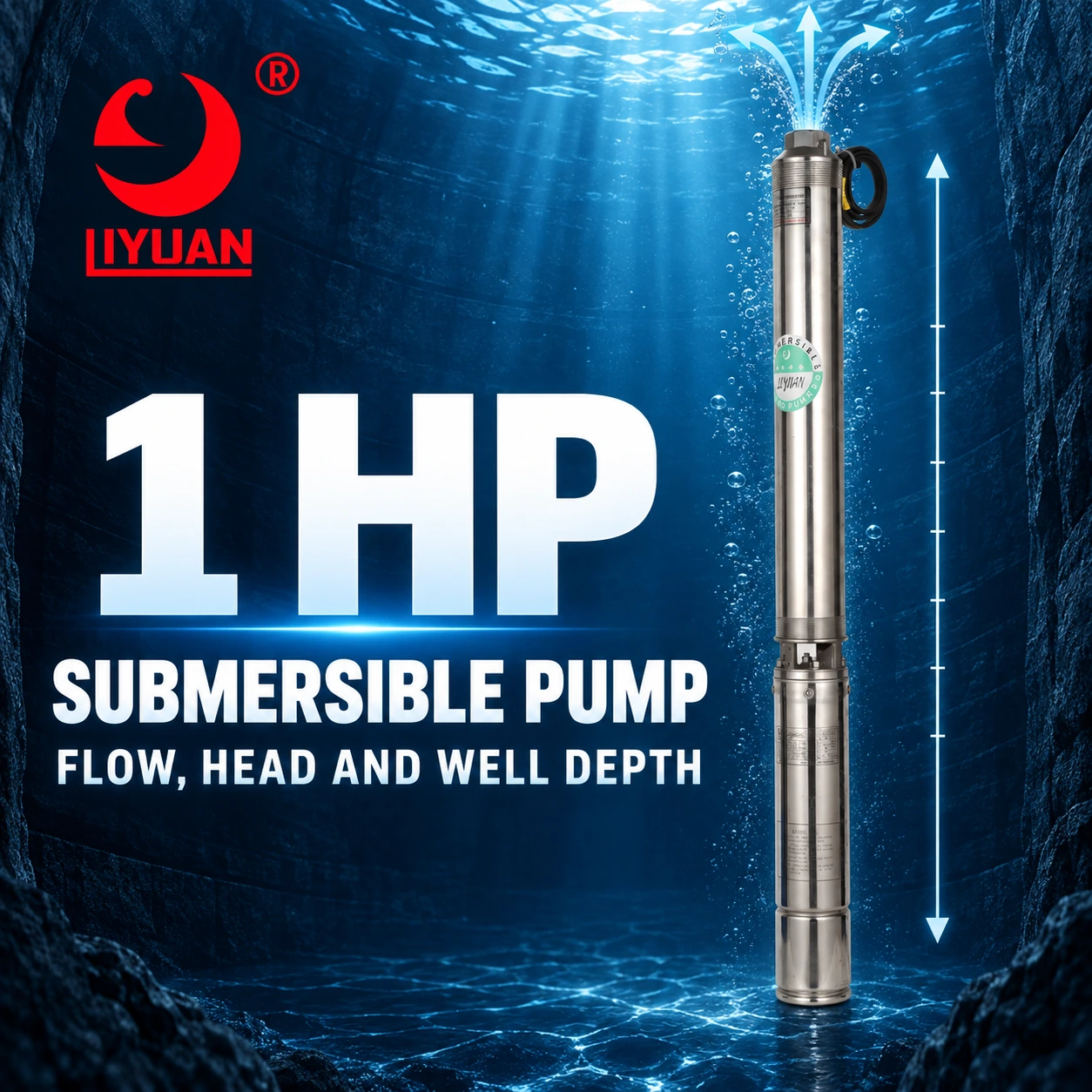
1 HP Submersible Pump: Flow, Head And Well Depth
A 1 HP Submersible Pump Can Deliver Different Amounts Of Water Depending On Its Hydraulic Design And The Head It Must Overcome. The 1 HP Rating Identifies Motor Output, Commonly Listed As 0.75 kW; It Does Not Establish One Universal Flow Rate Or Maximum Well Depth.
To Choose A Model, Match Required Flow And Total Dynamic Head On Its Performance Curve. Then Confirm Well Yield, Physical Fit, Electrical Supply, And Controls.
This Article Covers Clean-Water Submersible Well Pumps. A 1 HP Sump, Sewage, Or Drainage Pump Has A Different Purpose And Cannot Be Selected As An Equivalent Borehole Pump By Horsepower Alone.
How Much Water Can A 1 HP Submersible Pump Deliver?
There Is No Single Liters-Per-Minute Or GPM Rating For Every One-Horsepower Pump. A Useful Answer Must State Flow And Head Together.
The Liyuan 100QJ Pump Catalog Lists These Three Models With 1 HP / 0.75 kW Motors:
| Liyuan Model | Published Head At 3 m³/h | Another Published Flow–Head Point |
|---|---|---|
| 100QJ2-70/13 | 55 Meters | 2 m³/h At 70 Meters |
| 100QJ3-52/10 | 52 Meters | 4 m³/h At 41 Meters |
| 100QJ4-40/8 | 47 Meters | 4 m³/h At 40 Meters |
At The Same 3 m³/h Flow, Their Available Head Differs. Meanwhile, Each Model’s Head Changes As Flow Changes.
These Are Published Catalog Points, Not New Test Results. Request The Current Curve, Operating Frequency, And Permitted Flow Range For The Offered Assembly Before Ordering.
For Unit Comparison:
3 m³/h = 50 L/min ≈ 13.2 US GPM.
Consequently, A Listing That Says “1 HP, 50 L/min” Is Incomplete Unless It Also States The Head At That Flow.
Why Maximum Flow And Maximum Head Are Different Ratings
Maximum Head For A Typical Centrifugal Well Pump Is Associated With Shutoff, Where Flow Is Zero. Maximum Flow Occurs At A Different Point Near The Low-Head End Of The Curve.
Therefore, You Cannot Combine The Two Maximum Values Into One Operating Promise. For Example, “Maximum Head: 80 Meters” Does Not Establish That A Pump Will Deliver Its Advertised Maximum Flow At 80 Meters.
Use The Submersible Pump Performance Curve To Find The Flow Available At Your Required Head.
How Deep Can A 1 HP Submersible Pump Work?
Separate Three Measurements:
| Measurement | What It Describes | Why It Matters |
|---|---|---|
| Total Well Depth | Distance From Ground Level To The Well Bottom | Defines Well Geometry |
| Pump Setting Depth | Distance From Ground Level To The Installed Pump | Affects Installation, Cable, Pipe, And Submergence Checks |
| Pumping Water Level | Water-Surface Depth While Pumping At A Specified Flow | Establishes The Starting Level For Hydraulic Lift |
A Pump Installed At 70 Meters Does Not Necessarily Lift Water Through 70 Meters Before Reaching Ground Level. If The Pumping Water Level Is 25 Meters Below Ground, The Vertical Lift To Ground Level Is Approximately 25 Meters.
However, The Calculation Must Also Include Delivery Elevation, Required Outlet Pressure, And Friction. The Full Riser Length Still Matters When Calculating Pipe Losses.
For A Well Open To Atmospheric Pressure:
TDH = Lift From The Pumping Water Surface To The Delivery Point + Required Delivery Pressure Head + Hydraulic Losses.
Grundfos Uses Required Flow And Head, Including The Dynamic Water Level And Delivery Pressure, As The Basis Of Its Groundwater Pump-Sizing Method.
A 100-Meter Well Does Not Automatically Require 100 Meters Of Head
The Relevant Question Is: Where Will The Water Level Stabilize At The Required Flow, And What Pressure Must Remain At The Outlet?
Two Wells With The Same Total Depth Can Require Different Pumps Because Their Pumping Levels, Delivery Heights, Pipe Losses, And Demand Differ. Also, The Pump And Motor Must Be Approved For The Actual Installation Depth And Submergence.
Worked Example: Is A 1 HP Pump Enough?
Consider This Hypothetical System. The Site Values Are Illustrative; They Are Not Measurements From A Liyuan Installation.
| Design Input | Assumed Value |
|---|---|
| Required Flow | 3 m³/h |
| Pumping Water Level At That Flow | 25 Meters Below Ground |
| Delivery Elevation | 3 Meters Above Ground |
| Required Outlet Pressure | 2 Bar |
| Pipe And Equipment Losses At 3 m³/h | 6.6 Meters |
For Clean Water, 2 Bar Is Approximately 20.4 Meters Of Pressure Head.
Required TDH = 25 + 3 + 20.4 + 6.6 = 55 Meters.
Comparing This Requirement With The Published Points Above, 100QJ2-70/13 Matches 3 m³/h At 55 Meters. The Other Two Models Provide Less Head At That Flow.
That Makes The First Model A Candidate For Further Review. Final Selection Still Requires The Full Curve, Motor Loading, Well Yield, Cooling, And Expected Operating Range.
What Happens When The Water Level Falls?
Suppose The Seasonal Pumping Level Falls To 35 Meters Below Ground At The Same Required Flow. Keeping The Other Design Inputs Unchanged:
Revised TDH = 35 + 3 + 20.4 + 6.6 = 65 Meters.
None Of The Three Listed Points Meets 3 m³/h At 65 Meters. Reassess The Selection For That Duty. A Different Hydraulic Configuration, A Different Motor Rating, Or A Revised Water-Supply Arrangement May Be Necessary.
This Example Shows Why Matching A Single Favorable Water-Level Measurement Can Leave A System Short Of Water Later.
Can A One-Horsepower Well Pump Supply A House And Irrigation?
It Can If Its Curve Meets The Combined Operating Demand And The Well Sustains That Flow.
First, Identify Which Outlets Operate Together. Then Check Their Required Pressure. A Sprinkler Zone And Household Fixtures May Need Different Pressure And Flow Conditions.
Where The Well Yield Is Limited, Storage Can Help Separate Slow Water Collection From Short Periods Of High Demand. However, Storage Does Not Increase The Well’s Sustainable Daily Supply.
A Pressure Tank Has A Different Role: It Provides Drawdown Between Pump Cycles. It Cannot Correct A Pump That Fails To Produce The Required Pressure. Size The Submersible Pump Pressure Tank Around Actual Pump Delivery And The Motor’s Cycling Requirements.
How Much Electricity Does A 1 HP Submersible Pump Use?
One Mechanical Horsepower Is Approximately 746 Watts Of Shaft Output. Motor Losses Mean Electrical Input Is Higher Than Shaft Output At The Same Operating Point.
Also, A Motor Does Not Necessarily Deliver Its Full Rated Output Throughout Every Pumping Cycle. Use Measured Electrical Input Or Manufacturer Input-Power Data At The Actual Duty.
For An Illustrative Calculation Only, Assume:
- Actual Shaft Output: 0.75 kW.
- Motor Efficiency At That Load: 70%.
- Operating Time: Eight Hours.
Motor Electrical Input = 0.75 ÷ 0.70 ≈ 1.07 kW.
Energy Over Eight Hours ≈ 1.07 × 8 = 8.6 kWh.
The Assumed Efficiency Is Not A Liyuan Product Specification. Cable And Controller Losses May Add To The Electricity Measured At The Supply.
For Cost Estimates, Multiply Measured kWh By The Applicable Tariff. The Submersible Pump Energy Consumption Guide Explains How To Account For Operating Time And System Losses.
What Voltage And Control Box Does A 1 HP Pump Need?
Use The Exact Motor Nameplate. The Same Horsepower Can Be Available With Different Voltages, Frequencies, Phases, And Starting Arrangements.
For Conventional Single-Phase Well Motors:
- A Two-Wire Design Commonly Contains Its Starting Components Within The Motor.
- A Three-Wire Design Requires A Compatible External Control Box.
- The Protective Ground Conductor Is Additional To Those Motor-Lead Counts.
Three-Wire Does Not Mean Three-Phase. Furthermore, “No External Starting Box” Does Not Mean “No Protection Or Water-System Controls Required.”
Franklin Electric’s Motor Application Manual Distinguishes These Motor Arrangements And Requires Matching Control Equipment. Follow The Instructions For The Specific Motor Supplied.
Ask The Installer To Verify Cable Sizing For The Complete Route, Starting Conditions, And Voltage Drop. There Is No Universal Cable Size Or Running Current For Every 1 HP Pump.
Should You Choose 1 HP Or 1.5 HP?
Compare Complete Pump Curves At The Required Duty. A Higher Motor Rating Does Not By Itself Guarantee A Better Match.
| Situation | Selection Decision |
|---|---|
| A 1 HP Assembly Meets The Full Operating Range | Evaluate Its Efficiency, Controls, And Installed Cost |
| The Selected 1 HP Model Misses Required Flow Or Head | Compare Other Hydraulic Configurations And Motor Ratings |
| A Larger Pump Would Exceed Well Yield | Reduce Demand, Revise Controls, Or Consider Storage |
| Replacing An Existing 1 HP Pump | Match Its Required Duty And Interfaces Before Choosing Horsepower |
Check Maximum System Pressure And Low-Head Operation As Well As The Most Demanding Duty. An Upgrade That Supplies Enough Water At The Lowest Water Level May Deliver Excessive Flow Under Easier Conditions.
What Should A 1 HP Submersible Pump Quote Include?
Specify Whether You Need A Pump End, A Pump With Motor, Or A Complete Supply Package. These Scopes Produce Different Prices.
Request The Model, Current Curve, Motor Rating, Maximum Assembly Diameter, Overall Length, Materials, Cable Length, And Included Controls. For Replacement Work, Attach Photos Of Both Pump And Motor Nameplates.
Also, Confirm Whether A Quoted Stainless Steel Construction Refers To The Casing, Hydraulic Components, Or Both. Material Descriptions Should Identify The Relevant Parts.
Compare Offers With The Same Duty, Supply Scope, And Delivery Terms. Use The Submersible Pump Price Checklist If One Supplier Includes Cable And Controls While Another Quotes Only The Assembly.
Request A Model Matched To Your Well
Send Liyuan Your Required Flow, Pumping Water Level And Seasonal Range, Delivery Pressure, Pipe Details, Well Diameter, Water Quality, And Electrical Supply.
Ask For A Selection From The Liyuan Submersible Pump Range With The Duty Marked On The Curve. The Result Should Show Whether A 1 HP Submersible Pump Meets Your Conditions And Which Exact Configuration Is Appropriate.
Email:Liyuan@liyuan-pump.com
WhatsApp:+86 181-2828-2767