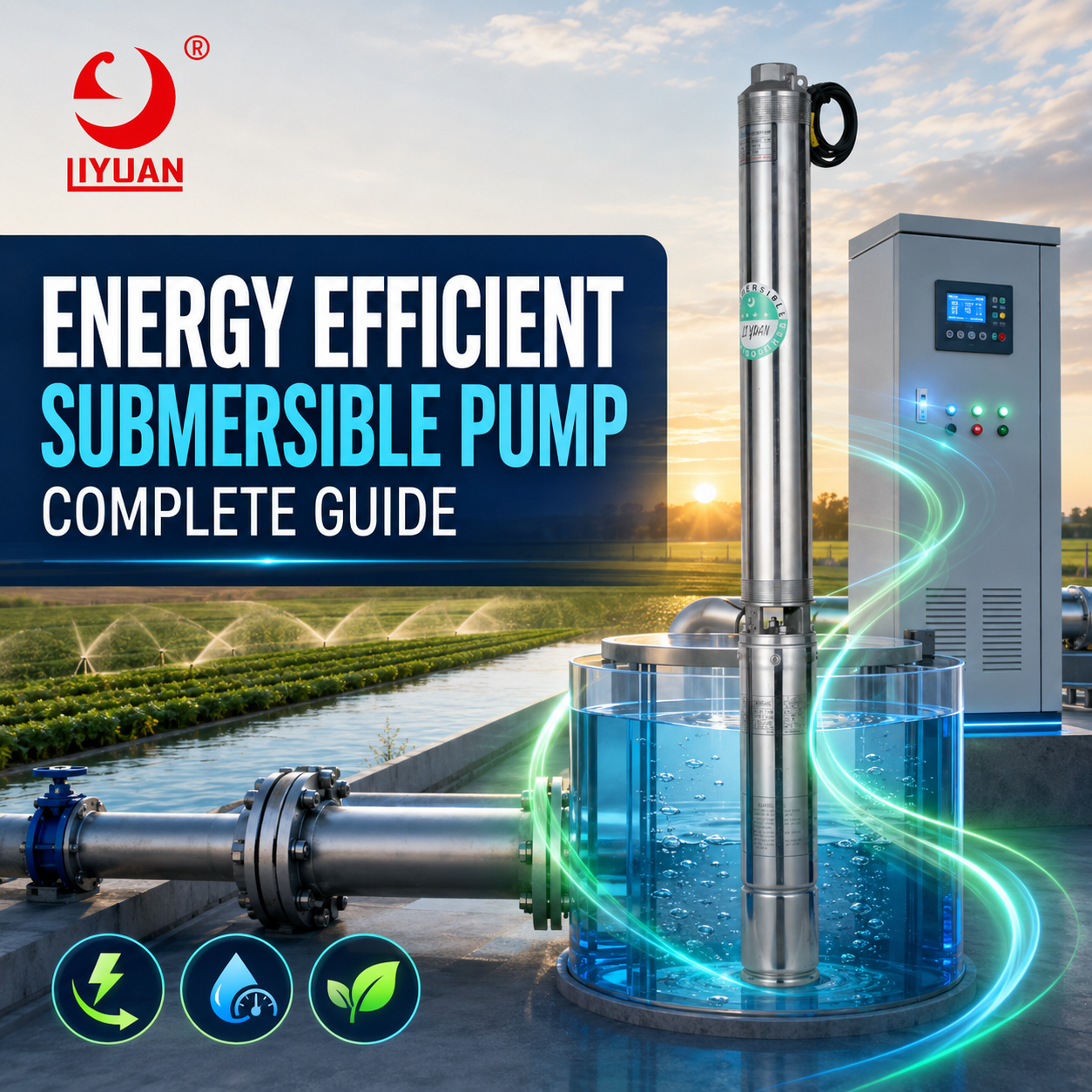
An Energy Efficient Submersible Pump Must Deliver The Required Flow And Pressure Near Its Best Efficiency Point Without Wasting Power Through Oversizing Or Pipe Friction.
However, Energy Performance Depends On The Entire Pumping System. Buyers Must Evaluate The Pump, Motor, Pipeline, Controls, Water Level, Operating Hours, And Maintenance Condition.
What Is An Energy Efficient Submersible Pump?
An Energy Efficient Submersible Pump Converts Electrical Energy Into Hydraulic Energy With Minimal Loss.
The Pump Operates Below The Water Level And Pushes Water Through A Drop Pipe. Meanwhile, A Sealed Electric Motor drives multiple impellers.
Efficient Performance Requires Correct Hydraulic And Electrical Matching. Therefore, A High-Efficiency Motor Cannot Correct An Oversized Pump Or Poorly Designed Pipeline.
Buyers Can Review Liyuan Pump’s Complete Range Of Submersible Pumps For Different Flow, Head, And Power Requirements.
Why Pump Efficiency Matters
Electricity Often Represents A Large Part Of A Pump’s Lifetime Cost.
A Small Efficiency Improvement Can Produce Meaningful Savings When A Pump Operates For Thousands Of Hours Each Year.
Higher Efficiency Can Provide:
- Lower Electricity Consumption
- Reduced Operating Costs
- Lower Motor Temperature
- Longer Bearing Life
- Reduced Mechanical Stress
- More Stable Performance
- Lower Carbon Emissions
- Better Return On Investment
Therefore, Buyers Should Compare Lifecycle Cost Instead Of Purchase Price Alone.
What Determines Pump Energy Consumption?
Pump Energy Consumption Depends On Several Connected factors:
- Required Flow Rate
- Total Dynamic Head
- Pump Efficiency
- Motor Efficiency
- Operating Hours
- Pipe Friction
- Voltage Quality
- Pump Condition
- Control Method
- Number Of Starts
A Pump Cannot Save Energy If The System Forces It To Operate Far From Its Designed Duty Point.
Hydraulic Power Formula
The Basic Hydraulic Power Formula Is:
Hydraulic Power = ρ × g × Q × H
Where:
- ρ = Water Density
- g = Gravitational Acceleration
- Q = Flow Rate In Cubic Meters Per Second
- H = Total Dynamic Head In Meters
A Practical Formula For Clean Water Is:
Hydraulic Power (kW) = 9.81 × Q (m³/s) × H (m)
Electrical Input Power Is Higher Because The Pump And Motor Create Energy Losses.
Input Power = Hydraulic Power ÷ Pump Efficiency ÷ Motor Efficiency
Energy Calculation Example
Consider A System With:
- Flow Rate: 30 m³/h
- Total Dynamic Head: 100 Meters
- Pump Efficiency: 75%
- Motor Efficiency: 90%
First, Convert The Flow:
30 m³/h ÷ 3,600 = 0.00833 m³/s
Calculate Hydraulic Power:
9.81 × 0.00833 × 100 = 8.17 kW
Calculate Electrical Input:
8.17 ÷ 0.75 ÷ 0.90 = 12.10 kW
If The Pump Runs 4,000 Hours Annually:
12.10 × 4,000 = 48,400 kWh Per Year
This Example Shows Why Pump And Motor Efficiency Matter In Long-Duty Applications.
Start With The Correct Duty Point
The Duty Point Combines The Required Flow And Total Dynamic Head.
For Example, A Project May Require:
- Flow: 25 m³/h
- Total Dynamic Head: 120 Meters
The Pump Must Deliver 25 m³/h At 120 Meters. Maximum Flow And Maximum Head Do Not Represent This Actual Operating Point.
Therefore, Buyers Should Request A Performance Curve Before Selecting A Model.
How To Calculate Total Dynamic Head
Use This Simplified Formula:
Total Dynamic Head = Vertical Lift + Outlet Pressure + Elevation + Friction Loss
For Example:
- Dynamic Water Level: 75 Meters
- Tank Elevation: 15 Meters
- Required Pressure: 25 Meters
- Pipe Friction: 10 Meters
Therefore:
Total Dynamic Head = 75 + 15 + 25 + 10 = 125 Meters
The Pump Must Deliver The Required Flow At Approximately 125 Meters Of Head.
Static Water Level Vs Dynamic Water Level
Static Water Level Measures The Water Depth Before Pumping Starts.
Dynamic Water Level Measures The Water Depth During Pump Operation.
Pumping Creates Drawdown. Therefore, The Dynamic Level Usually Sits Lower Than The Static Level.
Use The Lowest Expected Dynamic Water Level In The Head Calculation. Otherwise, The Pump May Deliver Insufficient Water During Dry Seasons.
The U.S. Geological Survey Explains How Pumping And Seasonal Conditions Affect Groundwater Levels.
Select A Pump Near Its Best Efficiency Point
The Best Efficiency Point Represents The Area Where The Pump Converts Power Into Water Movement Most Effectively.
Operating Near This Point Usually Provides:
- Lower Energy Consumption
- Reduced Vibration
- Stable Hydraulic Performance
- Lower Bearing Load
- Reduced Internal Recirculation
- Longer Pump Life
Operating Too Far Left On The Curve Can Cause Recirculation And Heat. Meanwhile, Operating Too Far Right Can Overload The Motor.
Avoid Pump Oversizing
Oversizing Is A Common Cause Of Poor Pumping Efficiency.
An Oversized Pump May Produce More Flow Or Pressure Than The System Requires. Operators Then Use Throttling Valves To Control The output.
This Approach Wastes Energy Because The Pump Creates Pressure That The Valve Removes.
Oversizing Can Also Cause:
- Frequent Starting
- High Motor Current
- Excessive Water Velocity
- Pressure Surges
- Unstable Water Levels
- Higher Equipment Cost
- Rapid Component Wear
Select The Pump According To Measured Project Data Instead Of Adding An Excessive Safety Margin.
Choose The Correct Submersible Motor
The Motor Must Match The Pump’s Power Requirement At The Duty Point.
Important Motor Factors Include:
- Rated Power
- Motor Efficiency
- Voltage
- Frequency
- Power Factor
- Service Factor
- Insulation Class
- Cooling Conditions
- Starting Method
- Daily Operating Hours
A Motor Operating Near Its Designed Load Usually performs better than a heavily oversized motor.
Learn More About Motor Design In The Deep Well Submersible Motors Guide.
Single-Phase Vs Three-Phase Efficiency
| Feature | Single-Phase Motor | Three-Phase Motor |
|---|---|---|
| Typical Application | Homes And Small Farms | Agriculture And Industry |
| Common Voltage | 110V–240V | 380V–480V |
| Power Capacity | Lower | Higher |
| Starting Method | Capacitor Or Control Box | Contactor, Soft Starter, Or VFD |
| Efficiency | Suitable For Small Loads | Usually Higher |
| Continuous Operation | Model-Specific | Better For Large Systems |
Single-Phase Motors Remain Practical Where Three-Phase Power Is Unavailable.
However, Three-Phase Motors Usually Offer Smoother Torque And Better Performance In Larger Pumping Systems.
Reduce Pipe Friction Loss
Pipe Friction Forces The Pump To Produce Additional head.
Friction Loss Increases When:
- Flow Rate Increases
- Pipe Diameter Decreases
- Pipeline Length Increases
- Pipe Roughness Increases
- More Elbows Are Added
- Valves Restrict Flow
- Filters Become Blocked
A Larger Pipe Can Reduce Friction And Operating Cost. However, It Increases Initial Material Cost.
Compare The Pipeline Investment With The Expected Lifetime Energy Savings.
Avoid Excessive Water Velocity
High Water Velocity Creates Friction, Noise, Pressure Loss, And Water Hammer.
It Can Also Increase Wear On Valves, Pipe Joints, And Fittings.
Select A Pipe Diameter That Maintains Reasonable Velocity At The Required Flow. In Addition, Avoid Unnecessary Elbows And Sudden Pipe-Diameter Changes.
Can A VFD Improve Pump Efficiency?
A Variable Frequency Drive Adjusts Motor Speed According To Water Demand.
A VFD Can Provide:
- Adjustable Flow
- Stable Pressure
- Soft Starting
- Lower Starting Current
- Reduced Water Hammer
- Motor Protection
- Lower Mechanical Stress
- Potential Energy Savings
However, VFD Savings Depend On The System Curve.
Systems With High Friction And Variable Flow Often Offer Better Savings Potential. In Contrast, Systems With High Static Head Require Careful Minimum-Speed Settings.
The U.S. Department Of Energy Provides Pump System Efficiency Resources For Pump Selection, Variable-Speed Control, And Energy Management.
VFD Affinity Laws
For A Centrifugal Pump Operating Under Suitable Conditions:
- Flow Changes Proportionally With Speed.
- Head Changes Approximately With The Square Of Speed.
- Power Changes Approximately With The Cube Of Speed.
For Example, A Moderate Speed Reduction Can Create A Larger Power Reduction.
However, Static Head Changes The System Response. Therefore, Engineers Should Not Estimate Energy Savings From Affinity Laws Alone.
Constant Pressure Pumping
A Pressure Sensor And VFD Can Maintain Constant Outlet Pressure.
When Water Demand Falls, The Controller Reduces Pump Speed. When Demand Increases, It Raises Pump Speed.
Constant-Pressure Control Can Support:
- Residential Water Supply
- Irrigation Systems
- Commercial Buildings
- Municipal Networks
- Industrial Process Water
However, The Pump Must Remain Within Its Safe Operating Range At Every Speed.
Use Multiple Pumps For Variable Demand
Some Projects Experience Large Changes In Water Demand.
Using Several Smaller Pumps In Parallel Can Provide Better Control Than One Large Pump.
A Multi-Pump System Can Offer:
- Improved Redundancy
- Flexible Flow Control
- Better Part-Load Efficiency
- Easier Maintenance
- Lower Off-Peak Power
- Backup Pumping Capacity
However, The Pumps Must Have Compatible Curves. The Control System Must Also Sequence Them Correctly.
Storage Tanks Can Reduce Peak Power
A Storage Tank Allows The Pump To Operate At A Stable Flow While The system handles short peak demand.
Storage Can Provide:
- Reduced Pump Cycling
- Lower Peak Pump Capacity
- Emergency Water Supply
- Stable Distribution Pressure
- Better Solar Pump Integration
- Improved Well Recovery
Tank Size Depends On Daily Demand, Peak Flow, Pump Capacity, And Available Filling Time.
Control Pump Starting Frequency
Frequent Starting Creates Electrical And Mechanical Stress.
Each Start Can Increase:
- Motor Temperature
- Starting Current
- Shaft Stress
- Bearing Load
- Contactor Wear
- Pressure Surges
Use A Correctly Sized Pressure Tank, VFD, Or Storage System To Reduce Cycling.
Review The Electric Control Box For Submersible Pump For Common Protection And Control Functions.
Maintain Stable Voltage
Low Voltage Can Increase Current And Motor Temperature. Meanwhile, High Voltage Can Stress Motor Insulation.
Three-Phase Voltage Imbalance Can Cause Uneven Current And overheating.
Monitor:
- Supply Voltage
- Operating Current
- Phase Balance
- Frequency
- Power Factor
- Insulation Resistance
Correct Cable Sizing Also Reduces Voltage Drop In Deep Installations.
Select The Correct Power Cable
Long Submersible Cables Create Electrical Resistance.
An Undersized Cable Can Cause:
- Voltage Drop
- Difficult Starting
- Higher Motor Current
- Overheating
- Reduced Torque
- Energy Loss
- Premature Motor Failure
Select Cable Size According To Motor Current, Voltage, Installation Depth, And Local Electrical Standards.
Water Quality And Energy Efficiency
Sand And Sediment Increase Internal Wear. As Impellers And Diffusers Wear, The Pump May Deliver Less Water while consuming similar power.
Water Quality Factors Include:
- Sand Content
- Maximum Particle Size
- pH Value
- Chloride Concentration
- Water Temperature
- Mineral Content
- Total Dissolved Solids
- Chemical Composition
Select Appropriate Materials And Sand-Resistant Components For Difficult Water Conditions.
Material Selection
Stainless Steel
Stainless Steel Provides Strong Corrosion Resistance And Smooth Hydraulic Surfaces.
AISI 304 Suits Many Freshwater Applications. Meanwhile, AISI 316 Can Provide Better Resistance In Some Chloride-Containing Water.
Cast Iron
Cast Iron Offers Strong Mechanical Performance At A Competitive Cost.
However, Corrosion And Surface Roughness Can Increase Over Time Without Suitable Protection.
Engineering Polymers
Engineering Polymer Impellers Can Provide Smooth Surfaces And Corrosion Resistance.
However, Buyers Must Confirm Temperature, Pressure, And Wear Limits.
Solar Pump Energy Efficiency
Solar Water Pumping Systems Use Photovoltaic Electricity To Operate The Pump.
Correct System Matching Requires:
- Daily Water Demand
- Total Dynamic Head
- Peak Solar Hours
- Solar Panel Capacity
- Controller Efficiency
- Pump Efficiency
- Seasonal Solar Conditions
- Storage Tank Capacity
A Water Storage Tank Often Provides A More Practical Solution Than Large Battery storage.
Learn More About Liyuan Pump’s Solar Water Pump Solutions For Off-Grid Water Supply.
Monitor Energy Performance
Regular Monitoring Helps Identify Efficiency Losses.
Record:
- Flow Rate
- Discharge Pressure
- Input Power
- Operating Current
- Supply Voltage
- Dynamic Water Level
- Operating Hours
- Number Of Starts
- Energy Use Per Cubic Meter
A Rising Energy Cost Per Cubic Meter Can Indicate Pump Wear, Pipe Blockage, Falling Water Levels, Or Electrical Problems.
Energy Performance Indicator
A Useful System Indicator Is:
Specific Energy = Electrical Energy Used ÷ Water Volume Delivered
For Example:
Specific Energy = kWh ÷ m³
Track This Value Over Time Under Similar Operating Conditions.
A Significant Increase May Indicate:
- Falling Pump Efficiency
- Increased Dynamic Head
- Pipeline Blockage
- Impeller Wear
- Electrical Losses
- Incorrect VFD Settings
- Water Leakage
Preventive Maintenance
Regular Maintenance Protects Hydraulic And Electrical Efficiency.
Important Tasks Include:
- Inspect Control Panels
- Check Voltage And Current
- Measure Flow And Pressure
- Test Motor Insulation
- Clean Filters
- Inspect Check Valves
- Monitor Water Levels
- Check Pressure Tanks
- Review VFD Alarms
- Compare Current Data With Commissioning Records
Follow The Electric Submersible Pump Maintenance Guide To Improve Performance And Service Life.
Common Energy-Wasting Mistakes
Choosing The Lowest Purchase Price
A Low-Cost Pump May Use More Electricity During Its Operating Life. Therefore, Buyers Should Compare Efficiency, Reliability, And Lifecycle Cost.
Selecting Only By Horsepower
Horsepower Does Not Define Hydraulic Performance. Buyers Must Check Flow And Head At The Actual Duty Point.
Oversizing The Pump
An Oversized Pump Can Increase Pressure, throttling losses, cycling, and energy use.
Using A Small Pipe
An Undersized Pipe Creates High Friction And Forces The Pump To Work Against Additional Head.
Ignoring Dynamic Water Level
A Falling Water Level Increases Vertical Lift And Energy Consumption.
Delaying Maintenance
Worn Impellers, Blocked Filters, Leaking Pipes, And Faulty Valves Can Reduce System Efficiency.
Information Required For Efficient Pump Selection
Provide The Manufacturer With:
- Borehole Diameter
- Total Well Depth
- Static Water Level
- Dynamic Water Level
- Sustainable Well Yield
- Required Flow Rate
- Required Outlet Pressure
- Tank Elevation
- Pipeline Length
- Pipe Diameter
- Voltage And Frequency
- Daily Operating Hours
- Electricity Cost
- Water Quality
- Preferred Control Method
Complete Data Supports More Accurate Pump And Motor Selection.
Why Choose Liyuan Pump?
Liyuan Pump Has Manufactured Submersible Pumps And Motors Since 1992.
Available Capabilities Include:
- 3-Inch To 10-Inch Submersible Pumps
- High-Efficiency Hydraulic Designs
- Water-Filled And Oil-Filled Motors
- Single-Phase And Three-Phase Models
- 50Hz And 60Hz Options
- Customized Voltage
- Solar Water Pump Systems
- VFD And Control Solutions
- Pump Curve Matching
- OEM And Custom Engineering
Buyers Can Review Liyuan Pump’s China Factory Submersible Pump Manufacturer Guide Before Requesting A Customized Quotation.
Frequently Asked Questions
What Makes A Submersible Pump Energy Efficient?
Correct Pump Sizing, High Hydraulic Efficiency, An Efficient Motor, Low Pipe Friction, Stable Voltage, And Suitable Controls Improve Energy Performance.
Does A Larger Pump Save Energy?
Not Necessarily. An Oversized Pump Often Consumes More Energy And Operates Far From Its Best Efficiency Point.
Can A VFD Reduce Electricity Use?
Yes, When Water Demand Changes And The System Supports Variable-Speed Operation. However, High Static Head Can Limit Potential Savings.
Does Pipe Diameter Affect Pump Efficiency?
Yes. A Small Pipe Increases Friction Loss And Forces The Pump To Produce Additional Pressure.
How Can I Compare Two Pumps?
Compare Flow And Head At The Required Duty Point, Pump Efficiency, Motor Efficiency, Input Power, Materials, And Expected Maintenance Cost.
What Is Specific Energy Consumption?
Specific Energy Consumption Measures The Electricity Used To Deliver A Unit Of Water, Such As kWh Per Cubic Meter.
Can Maintenance Improve Pump Efficiency?
Yes. Cleaning Filters, Repairing Leaks, Replacing Worn Components, And Maintaining Electrical Quality Can Restore Performance.
What Information Does Liyuan Pump Need?
Provide The Well Diameter, Dynamic Water Level, Required Flow, Total Head, Pipeline Details, Voltage, Operating Hours, And Water Quality.
Conclusion
An Energy Efficient Submersible Pump Requires Accurate Flow And Head Calculations, Correct Pump Curve Selection, An Efficient Motor, Suitable Pipe Sizing, And Proper Control.
Therefore, Buyers Should Compare Lifecycle Energy Cost Instead Of Purchase Price Alone.
For Energy-Efficient Pump Selection, OEM Production, And Custom Engineering Support, Contact Liyuan Pump Through
Email:Liyuan@liyuan-pump.com
WhatsApp:+86 181-2828-2767