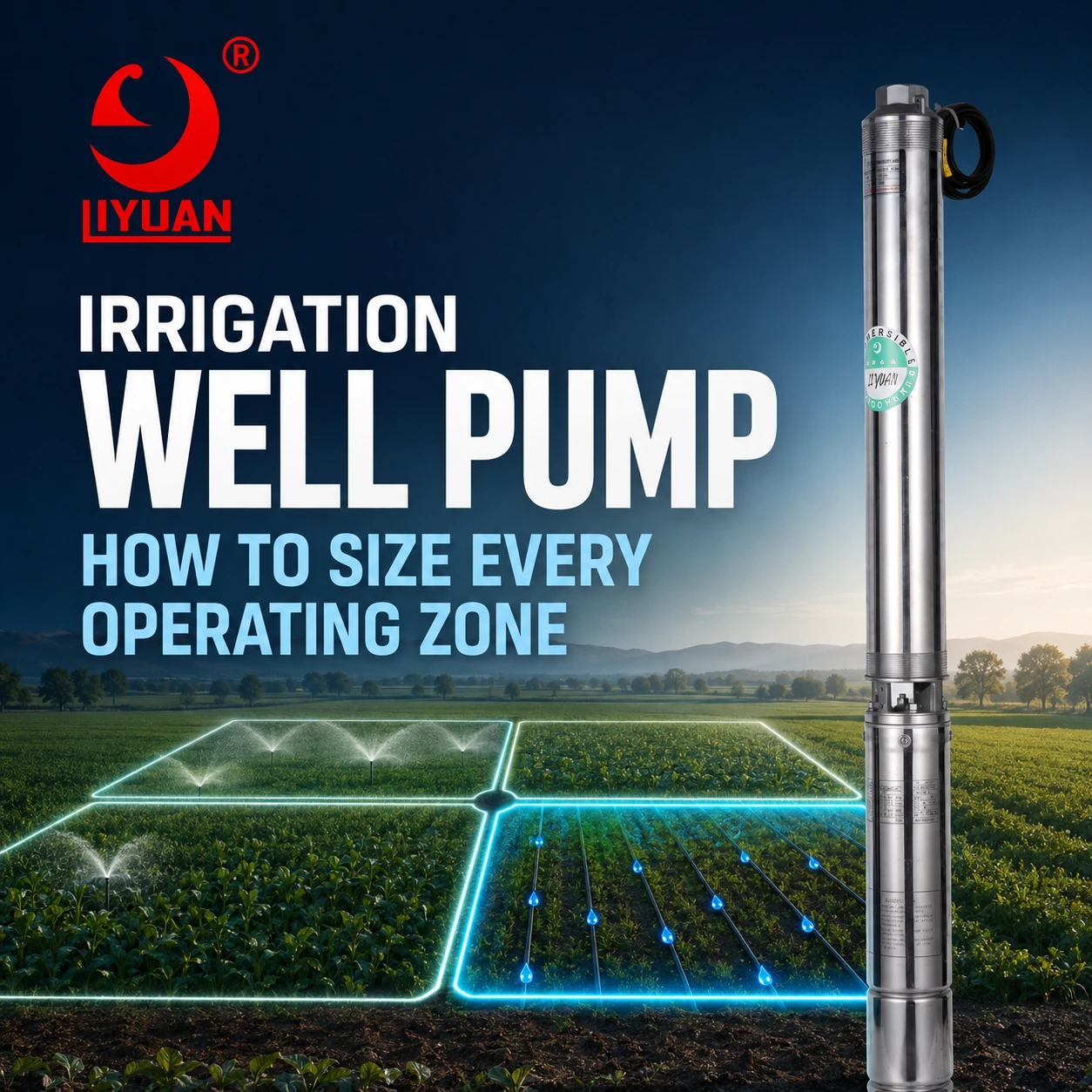
Irrigation Well Pump: How To Size Every Operating Zone
Size An Irrigation Well Pump By Calculating A Separate Flow And Total Dynamic Head For Every Zone, Then Checking All Required Operating Points On One Pump Curve. Do Not Combine The Highest Flow From One Zone With The Highest Head From Another Zone Unless Those Conditions Actually Occur Together.
The Well Must Also Sustain The Pumping Rate. If A Zone Requires More Water Than The Well Can Continuously Supply, A Larger Pump Will Not Solve The Problem. Split The Zone, Change The Emitters, Extend The Irrigation Time, Or Use A Storage Tank And Booster System.
Irrigation Well Pump Selection In Five Steps
First, Use This Sequence:
- Calculate The Flow Required By Each Operating Zone.
- Calculate TDH For Each Zone At That Zone’s Flow.
- Compare Every Zone Flow With Sustainable Well Yield.
- Plot Every Valid Duty Point On The Pump Curve.
- Check Power, Pressure, Pipe, Controls, And Seasonal Water Levels.
This Method Creates An Operating Envelope Instead Of One Artificial Design Point.
Build An Irrigation Zone Duty Matrix
First, Start With A Table That Describes How The System Will Actually Operate.
| Zone | Simultaneous Outlets | Zone Flow | Required Outlet Pressure | Elevation Change | Pipe And Equipment Loss | Dynamic Water Level | Calculated TDH |
|---|---|---|---|---|---|---|---|
| Drip Zone | |||||||
| Sprinkler Zone | |||||||
| Rotor Or Big-Gun Zone |
Next, Calculate Only Outlets That Operate At The Same Time. Do Not Add Every Sprinkler, Dripper, Hydrant, And Future Connection Unless The Control Schedule Allows Them To Run Together.
Moreover, The University Of Minnesota Extension Notes That Flow And Pressure Can Differ Between Fields Because Drip And Overhead Systems Use Different Pressure Regulation, Pipe Distance, And Elevation. It Also Recommends Measuring Flow And Pressure In The Operating System, Not Relying Only On Initial Estimates.
Review Liyuan’s Agricultural Submersible Pump Options After The Zone Requirements And Water Source Have Been Defined.
How To Calculate Irrigation Zone Flow
First, For A Zone With Identical Outlets:
Zone Flow = Number Of Simultaneous Outlets × Flow Per Outlet
For Example:
- 12 Sprinklers Operate Together
- Each Sprinkler Requires 1.5 Cubic Meters Per Hour
Therefore:
Zone Flow = 12 × 1.5
Zone Flow = 18 Cubic Meters Per Hour
However, If The Zone Uses Different Nozzles Or Emitters, Add Their Individual Design Flows. Use The Manufacturer’s Flow At The Intended Operating Pressure Rather Than A Nominal Flow From A Different Pressure.
Account For Pressure-Compensating Devices
For Example, A Pressure-Compensating Dripper Maintains Flow Within A Stated Pressure Range. However, It Still Needs Enough Inlet Pressure At The Most Unfavorable Point.
Therefore, Confirm:
- Minimum Operating Pressure
- Maximum Permitted Pressure
- Regulator Pressure Loss
- Filter Pressure Loss
- Flushing Flow
- Fertigation Equipment Loss
In Addition, Flushing Or Backwash Demand May Create A Separate Operating Condition. Do Not Add It To Normal Irrigation Flow Unless It Occurs During Irrigation.
Do Not Add Design Margin Twice
Moreover, Nozzle Tables, Zone Flow, And Pump Selection May Each Include A Margin. If Every Step Adds An Uncontrolled Percentage, The Final Pump Can Become Significantly Oversized.
Instead, Document Where The Margin Exists And What Uncertainty It Covers.
Use The Submersible Pump Flow Rate Method When Converting Between Daily Water Demand, Zone Flow, And Available Pumping Time.
How To Calculate TDH For Each Irrigation Zone
Next, Use:
Zone TDH = Pumping Lift + Elevation Change + Required Outlet Pressure Head + Friction And Equipment Loss
First, Calculate This Formula Separately At Each Zone’s Flow.
Washington State University’s Total Dynamic Head Calculator Includes Elevation, Required Outlet Pressure, Friction, And Any Existing Head At The Pump.
Pumping Lift
For A Well Pump, Pumping Lift Normally Begins At The Dynamic Water Level, Not At The Pump Setting Depth Or Total Well Depth.
However, The Dynamic Water Level Must Correspond To The Pumping Rate. A Water Level Measured At 8 Cubic Meters Per Hour Cannot Automatically Represent The Drawdown At 18 Cubic Meters Per Hour.
Required Outlet Pressure
Next, Use The Pressure Required At The Sprinkler, Drip Regulator, Pivot Inlet, Hydrant, Or Other Final Device.
For Clean Water:
Pressure Head In Meters ≈ Pressure In Bar × 10.2
Pressure Head In Feet ≈ Pressure In PSI × 2.31
For Example, 3.5 Bar Requires Approximately:
3.5 × 10.2 = 35.7 Meters Of Pressure Head
Elevation Change
Measure The Elevation Difference From The Hydraulic Reference Point To The Critical Outlet In That Zone. Use A Positive Value When The Outlet Is Above The Reference And A Negative Value Only When The System Design Safely Benefits From Downhill Pressure.
Friction And Equipment Loss
Finally, Include Loss Through:
- Riser Pipe
- Mainline
- Laterals
- Valves
- Check Valves
- Filters
- Pressure Regulators
- Fertigation Equipment
- Flow Meters
- Elbows And Tees
Friction Changes With Flow. Therefore, A Loss Calculated For A 9-Cubic-Meter-Per-Hour Drip Zone Cannot Be Reused For An 18-Cubic-Meter-Per-Hour Sprinkler Zone.
Use The Total Dynamic Head For Submersible Pump Method For The Complete Hydraulic Calculation.
Irrigation Well Pump Example With Three Zones
For Example, Assume A Farm Uses One Well For Three Irrigation Zones.
Zone A: Drip Irrigation
- Required Flow: 9 Cubic Meters Per Hour
- Dynamic Water Level At This Flow: 45 Meters
- Elevation Change: 4 Meters
- Required Pressure Head: 20 Meters
- Pipe, Filter, And Valve Loss: 8 Meters
Therefore:
Zone A TDH = 45 + 4 + 20 + 8
Zone A TDH = 77 Meters
The First Duty Point Is:
9 Cubic Meters Per Hour At 77 Meters TDH
Zone B: Sprinklers
- Required Flow: 18 Cubic Meters Per Hour
- Dynamic Water Level At This Flow: 48 Meters
- Elevation Change: 10 Meters
- Required Pressure Head: 35 Meters
- Pipe And Equipment Loss: 12 Meters
Therefore:
Zone B TDH = 48 + 10 + 35 + 12
Zone B TDH = 105 Meters
The Second Duty Point Is:
18 Cubic Meters Per Hour At 105 Meters TDH
Zone C: Distant Rotor Zone
- Required Flow: 12 Cubic Meters Per Hour
- Dynamic Water Level At This Flow: 50 Meters
- Elevation Change: 18 Meters
- Required Pressure Head: 40 Meters
- Pipe And Equipment Loss: 15 Meters
Therefore:
Zone C TDH = 50 + 18 + 40 + 15
Zone C TDH = 123 Meters
The Third Duty Point Is:
12 Cubic Meters Per Hour At 123 Meters TDH
What Is The Correct Design Point?
Therefore, There Is No Single Point Until The Pump Curve And Control Method Have Been Evaluated.
The Pump Must Be Checked At:
- 9 Cubic Meters Per Hour At 77 Meters
- 18 Cubic Meters Per Hour At 105 Meters
- 12 Cubic Meters Per Hour At 123 Meters
Do Not Automatically Select A Pump For 18 Cubic Meters Per Hour At 123 Meters. That Combination Does Not Occur In This Operating Schedule And May Add Unnecessary Stages, Power, Pressure, And Cost.
Compare Irrigation Demand With Well Yield
Next, Assume The Well’s Sustainable Yield Is 15 Cubic Meters Per Hour.
- Zone A Requires 9 Cubic Meters Per Hour: Direct Supply May Be Feasible.
- Zone C Requires 12 Cubic Meters Per Hour: Direct Supply May Be Feasible.
- Zone B Requires 18 Cubic Meters Per Hour: Direct Continuous Supply Exceeds The Tested Well Yield.
However, Installing An 18-Cubic-Meter-Per-Hour Pump Does Not Increase Aquifer Yield. Instead, It Can Increase Drawdown, Produce Air Or Sand, Trigger Dry-Run Protection, And Reduce Pump Life.
Therefore, Possible Solutions Include:
- Split Zone B Into Two Smaller Zones.
- Use Lower-Flow Nozzles.
- Increase Irrigation Duration.
- Fill A Storage Tank At Or Below Sustainable Well Yield.
- Use A Separate Booster Pump From The Tank To Supply Zone B.
The Best Option Depends On Daily Water Volume, Crop Schedule, Available Land, Tank Cost, Power, And Permitted Irrigation Window.
Calculate Daily Water Volume And Pumping Hours
First, Flow Determines Instantaneous Pump Size. Volume Determines How Long The System Must Run.
Use:
Zone Water Volume = Zone Flow × Operating Hours
Assume:
- Zone A: 9 Cubic Meters Per Hour For 4 Hours = 36 Cubic Meters
- Zone B: 18 Cubic Meters Per Hour For 3 Hours = 54 Cubic Meters
- Zone C: 12 Cubic Meters Per Hour For 2 Hours = 24 Cubic Meters
Therefore:
Total Daily Irrigation Volume = 36 + 54 + 24
Total Daily Irrigation Volume = 114 Cubic Meters
Next, Compare This Volume With Sustainable Well Production During The Available Pumping Window. A Well Yield Of 15 Cubic Meters Per Hour Can Theoretically Produce 120 Cubic Meters In Eight Hours, But The Final Schedule Must Also Allow For Recovery Behavior, Seasonal Drawdown, Filter Service, Tank Reserve, And Pump Downtime.
Plot Every Zone On The Pump Curve
Next, Use The Exact Curve For The Proposed Model, Stage Count, Speed, And Frequency.
The Selected Submersible Pump Performance Curve Must Be Checked For:
- Flow And Head At Every Zone
- Recommended Operating Range
- Efficiency At The Main Operating Hours
- Maximum Power Demand
- Shut-Off Head
- Upthrust And Downthrust Limits
- Minimum Motor Cooling Requirement
The Zone With The Highest TDH May Not Require The Highest Motor Power. Depending On The Curve, A Lower-Head, Higher-Flow Zone Can Create The Maximum Pump Load.
Therefore, Check Motor Power Across The Complete Operating Envelope.
Fixed-Speed Or Variable-Speed Irrigation Well Pump?
For Example, A Fixed-Speed Pump Can Work Well When Zone Duty Points Are Close Together Or When Pressure Regulators And Valves Control Moderate Differences.
A VFD May Help When:
- Zones Require Widely Different Flow Or Pressure
- Constant Pressure Improves Irrigation Uniformity
- The Water Level Changes Significantly
- The Pump Operates Many Hours At Reduced Demand
- Throttling Would Waste Substantial Head
However, A VFD Does Not Correct A Poorly Selected Pump. The System Must Still Respect Minimum Speed, Motor Cooling, Pump Operating Range, Cable Length, Harmonics, And Maximum Demand.
The USDA NRCS Irrigation Pumping Plants Handbook Includes A Center-Pivot Example In Which A VFD Addresses Changing TDH Instead Of Dissipating Excess Pressure Through Regulators.
Size The Irrigation Pipe At Each Flow
Next, Pipe Diameter Affects Friction, Velocity, Pressure Rating, Water Hammer, And Operating Cost.
A Small Pipe May Lower Initial Cost But Create High Friction At The Largest Zone Flow. Conversely, An Unnecessarily Large Pipe Can Increase Capital Cost Without A Useful Energy Return.
Check:
- Riser Pipe At Maximum Pump Flow
- Mainline At Each Zone Flow
- Longest And Highest Lateral
- Valve And Filter Pressure Drop
- Maximum Static And Shut-Off Pressure
- Transient Pressure During Valve Operation
Use The Submersible Pump Pipe Size Calculation For Diameter, Friction, Pressure Rating, And Suspended Load.
Check Irrigation Well Pump Power
Then, For Clean Water, Preliminary Hydraulic Power Is:
Hydraulic Power In kW = Flow In Cubic Meters Per Hour × Head In Meters ÷ 367
For Zone B:
Hydraulic Power = 18 × 105 ÷ 367
Hydraulic Power ≈ 5.15 kW
This Is Water Power Only. Divide By Pump Efficiency To Estimate Shaft Power.
If Pump Efficiency Is 70%:
Shaft Power ≈ 5.15 ÷ 0.70
Shaft Power ≈ 7.36 kW
Then Confirm Motor Efficiency, Service Requirements, Maximum Curve Power, Voltage, And Starting Method From Manufacturer Data. Do Not Select The Motor From This Simplified Calculation Alone.
Account For Seasonal Water-Level Change
Finally, Repeat The Zone Matrix With The Lowest Expected Seasonal Dynamic Water Level.
For Example, If Zone B Dynamic Water Level Falls From 48 Meters To 65 Meters:
Revised Zone B TDH = 65 + 10 + 35 + 12
Revised Zone B TDH = 122 Meters
The Pump Must Still Deliver The Required Flow Without Leaving Its Permitted Range. At The Higher Water Level, It Must Also Avoid Excessive Flow, Well Drawdown, And Motor Load.
Seasonal Data Is More Valuable Than Adding A Large Unexplained Head Margin.
Irrigation Water Quality And Sand
Moreover, Test The Well Water For Sand, pH, Chlorides, Salinity, Iron, Manganese, Hardness, And Temperature.
Sand Can Wear Impellers, Diffusers, Bearings, And Stage Clearances. Filters Protect Irrigation Equipment, But They Do Not Prevent Sand From Passing Through The Downhole Pump Before Reaching The Filter.
Therefore:
- Confirm Sustainable Well Development.
- Keep The Pump Away From The Sediment Zone.
- Select Materials For The Water Chemistry.
- Include Filter Loss In TDH.
- Monitor Sand, Flow, Pressure, Current, And Water Level.
Do Not Use A “Sand-Resistant” Pump As A Substitute For Repairing A Damaged Well Screen Or Correcting Excessive Sand Production.
Commissioning Measurements
Finally, At Startup, Record Each Operating Zone Separately:
- Zone Flow
- Wellhead Pressure
- Pressure At The Critical Outlet
- Static And Dynamic Water Levels
- Motor Voltage And Current
- VFD Frequency When Used
- Filter Differential Pressure
- Water Clarity And Sand
- Valve Position
The University Of Minnesota Extension Recommends Flow And Pressure Measurement Because These Values Can Differ Across The Farm And Can Reveal Changes In Well Output.
Compare The Measured Duty Point With The Approved Pump Curve. If The Values Differ, Investigate Valve Position, Incorrect Nozzles, Pipe Loss, Pump Rotation, Water Level, Leakage, Blockage, Or Measurement Error Before Changing The Pump.
Common Irrigation Well Pump Sizing Mistakes
Adding Every Irrigation Outlet
Add Only Outlets That Operate Simultaneously In The Defined Zone.
Combining Maximum Zone Flow With Maximum Zone Head
Use Actual Flow-And-TDH Pairs. Do Not Create A Duty Point That Never Occurs.
Ignoring Well Yield
The Pump Cannot Continuously Deliver More Water Than The Well Sustains.
Using Static Water Level
Calculate Pumping Lift From The Dynamic Water Level At The Relevant Flow.
Reusing One Friction Loss
Friction Changes With Flow. Calculate It For Every Zone.
Selecting By Horsepower
Horsepower Does Not Define Pump Flow, Head, Stage Count, Or Efficiency.
Ignoring The Lowest-Head Zone
The Lowest System Head May Create Excessive Pump Flow And Maximum Motor Load.
Treating A VFD As A Universal Fix
A VFD Cannot Correct Wrong Hydraulics, Inadequate Well Yield, Or Insufficient Motor Cooling.
Frequently Asked Questions About An Irrigation Well Pump
What Size Irrigation Well Pump Do I Need?
Calculate Flow And TDH For Every Operating Zone, Compare Each Flow With Sustainable Well Yield, And Select A Pump Curve That Covers The Complete Valid Operating Envelope.
Should I Size The Pump For The Largest Irrigation Zone?
Not Automatically. The Largest-Flow Zone And Highest-Head Zone May Be Different. Check Every Zone As A Separate Duty Point.
Can An Irrigation Pump Produce More Than The Well Yield?
It May Do So Briefly While Drawing Down Stored Water In The Well, But It Cannot Sustain That Rate If Aquifer Inflow Is Lower. Use Proper Testing And Low-Water Protection.
Can One Well Pump Run Drip And Sprinklers?
Yes, If The Pump Curve Covers Both Duty Points And The Controls Maintain Acceptable Pressure, Flow, Cooling, And Well Conditions. Widely Different Zones May Require Pressure Regulation, A VFD, Separate Pumps, Or Storage.
Is Higher Pressure Better For Irrigation?
No. Excess Pressure Can Waste Energy, Damage Emitters, Increase Leakage, And Reduce Uniformity. Supply The Pressure Required At The Critical Device.
Should Two Irrigation Zones Run Together?
Only If The System Was Designed For Their Combined Flow And TDH, And The Well Can Sustain The Total Pumping Rate.
When Does An Irrigation System Need A Storage Tank?
Use Storage When Peak Zone Flow Exceeds Sustainable Well Yield, When The Well Needs Controlled Pumping, Or When The Irrigation Schedule Requires Short High-Flow Periods.
How Do I Know If The Pump Is Still Efficient?
Measure Flow, TDH, And Input Power Under A Repeatable Condition. Compare The Result With The Original Curve And Commissioning Record.
Final Answer
An Irrigation Well Pump Must Match The Flow And TDH Of Every Real Operating Zone Without Exceeding Sustainable Well Yield.
First Build A Zone Duty Matrix. Next Calculate TDH At Each Zone’s Actual Flow. Then Plot Every Valid Point On The Pump Curve And Check Power, Efficiency, Pressure, Seasonal Drawdown, Pipe Loss, And Motor Cooling.
For An Accurate Submersible Pump Selection, Send Liyuan Pump Your Zone Flows, Pressure Requirements, Elevations, Pipe Details, Static And Dynamic Water Levels, Well Yield, Water Analysis, Power Supply, And Operating Schedule. Liyuan Can Then Select The Pump, Stages, Motor, Cable, And Control Method For The Complete Irrigation Envelope.
Email:Liyuan@liyuan-pump.com
WhatsApp:+86 181-2828-2767