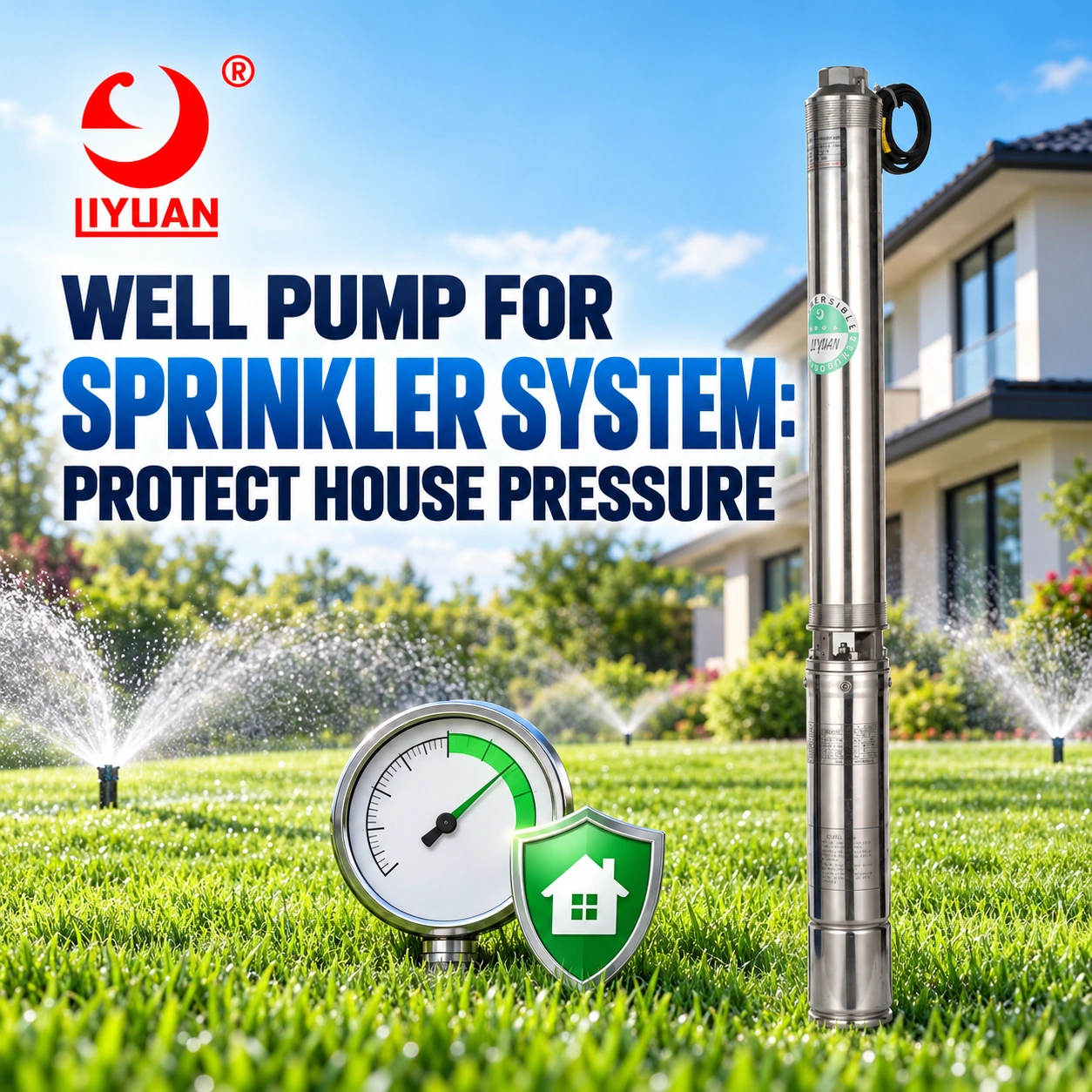
Well Pump For Sprinkler System: Protect House Pressure
A Well Pump For Sprinkler System Use Can Also Supply A House If It Delivers The Combined Simultaneous Flow At The Pressure Required By Both Branches, Without Exceeding The Well’s Sustainable Supply. Adding An Irrigation Booster Can Increase Available Pressure, But It Cannot Make Up For An Inadequate Water Source.
Before Replacing The Well Pump, Separate Three Possible Problems: Insufficient Source Water, Insufficient Pump Head At The Required Flow, And Excessive Loss Between The Pump And The Outlets. Each Requires A Different Response.
All GPM Figures Below Mean US Gallons Per Minute.
The Buyer’s Question: Will A Booster Stop My Shower Losing Pressure?
In A Homeowner’s Irrigation Discussion, The Owner Reported Approximately 4–5 GPM From A Well And Almost No Household Pressure While A Garden Hose Was Running. They Asked About Adding A 300–500-Gallon Tank And A Booster For Irrigation.
Those Are User-Reported Conditions, Not Verified Pump-Test Results. They Illustrate A Specific Purchase Decision: Should The Owner Increase Pressure In The Existing Pipe, Or Store Water First And Deliver It Through A Separate Pump?
Test Your Well Pump For Sprinkler System Demand
A Pressure Gauge Reading Of 60 PSI With Every Outlet Closed Does Not Establish That Sprinklers Will Receive 60 PSI While Operating. Similarly, A Wide-Open Hose Test Does Not Prove The Same Flow Is Available At Sprinkler Operating Pressure.
Rain Bird’s Water-Supply Design Guidance Pairs Available Flow With Working Pressure At The Irrigation Connection. Treat Those As One Measurement, Not Two Unrelated Maximum Values.
Have The Installer Record:
| Operating Condition | Measurements To Compare |
|---|---|
| House Demand Only | Total Flow, Common-Line Pressure, And Pressure At A Critical Fixture |
| Largest Sprinkler Zone Only | Zone Flow, Pressure At The Irrigation Connection, And Pressure Near The Most Demanding Head |
| House And Zone Together | Combined Flow, Both Branch Pressures, And Pumping Water Level |
| Smallest Zone Only | Pump Starts, Running Duration, And Pressure Variation |
Record Readings After Initial Tank Assistance Subsides And During A Meaningful Portion Of The Irrigation Run. A Brief Successful Start Does Not Establish Sustained Performance.
If Pressure Is Adequate Upstream But Low Downstream, Investigate Pipe Sizing, Partly Closed Valves, Filters, Backflow Assemblies, And Leaks Before Buying A Larger Pump. Persistent Source-Pressure Loss Needs Pump-Curve And Well-Performance Checks.
Size A Well Pump For Sprinkler System And House Flow
Add Flows That Can Actually Occur Together. Calculate Each Sprinkler’s Flow At Its Intended Operating Pressure, Then Add A Realistic Simultaneous Household Demand.
The Following Example Is Hypothetical, Not Liyuan Field-Test Data:
- Six Sprinklers Use 1.5 GPM Each At Their Design Pressure.
- The Irrigation Zone Therefore Requires 9 GPM.
- Simultaneous Household Demand Is 4 GPM.
Combined Design Flow = 9 + 4 = 13 GPM
That Is Approximately 49.2 L/min Or 2.95 m³/h. The Shared Riser And Common Supply Pipe Must Carry This Combined Flow. Each Branch Carries Its Own Flow.
If Irrigation Is Reliably Paused During Household Demand, Evaluate The Separate Operating Cases Instead. A Timer Schedule Reduces Expected Overlap; It Does Not Guarantee That Nobody Will Open A Tap. Where Household Priority Is Essential, Specify A Suitable Interlock Or Demand-Based Control.
Use The Irrigation Well Pump Zone-Sizing Method When Several Sprinkler Zones Have Different Flows Or Pressure Requirements.
Add Branch Flows, But Do Not Add Branch Pressures
Suppose The Two Branches Separate At A Common Junction:
| Requirement | Sprinkler Branch | House Branch |
|---|---|---|
| Design Flow | 9 GPM | 4 GPM |
| Minimum Pressure At Critical Outlet | 40 PSI | 35 PSI |
| Branch Losses And Elevation Allowance At Its Flow | 12 PSI | 6 PSI |
| Minimum Pressure Needed At Common Junction | 52 PSI | 41 PSI |
The Junction Must Provide At Least 52 PSI, Not 52 + 41 PSI. The Allowances Include Each Branch’s Relevant Pipework, Valves, Filters, And Protection Devices.
Now Assume The Pumping Water Surface Is 100 Feet Below That Junction At 13 GPM, And Shared Riser-And-Main Losses Are 15 Feet At That Flow.
Required TDH ≈ 100 + (52 × 2.31) + 15 = 235.1 Feet
The Preliminary Selection Target Is Therefore 13 GPM At Approximately 235 Feet TDH, Or About 2.95 m³/h At 71.7 Meters.
Rain Bird’s Hydraulics Reference Explains The Pressure-To-Head Conversion. The Example Assumes Controlled Design Flows And Negligible Velocity-Head Differences; The Actual Pipe Network, Outlet Characteristics, And Controls Must Be Checked Together. Do Not Count Branch Elevation Twice.
Why A 40/60 Pressure Setting May Still Be Insufficient
In The Example Above, The Irrigation Connection Needs 52 PSI At Design Flow. If The Pressure Switch Senses Pressure At That Same Junction And Starts The Pump At 40 PSI, The System Allows Pressure To Fall Below The Irrigation Requirement Before Starting.
Reaching 60 PSI With No Demand Does Not Resolve That Mismatch. Confirm The Pressure Available Throughout The Operating Cycle, Including Startup And Simultaneous House Use.
Do Not Simply Increase The Switch Setting. The Pump Must Reach The New Cut-Out Under Expected Water-Level Conditions, And Pipework, Tank, Controls, And Protection Must Remain Within Their Ratings. Review The Exact Submersible Pump Performance Curve Before Changing The Duty.
Smaller Zones, A Booster, Or A New Well Pump?
| What The Measurements Show | Option To Evaluate | What It Will Not Fix |
|---|---|---|
| House And Irrigation Work Separately But Not Together | Smaller Zones, Revised Scheduling, Or Household-Priority Control | A Sustained Shortage Of Daily Water Volume |
| Adequate Source Flow, But Excessive Loss In One Branch | Correct A Restriction Or Resize That Pipe Section | Inadequate Well Yield |
| Adequate Supply At The Booster Inlet, But Insufficient Delivery Pressure | A Correctly Selected Irrigation Booster | Missing Water At Its Inlet |
| Well Yield Is Adequate, But The Existing Pump Curve Misses The Duty | Reselect The Well Pump And Check Retained Equipment | An Undersized Distribution Network |
| Irrigation Peak Demand Exceeds Sustainable Well Supply | Smaller Zones Or Storage With A Separate Delivery Pump | A Daily Volume Requirement Greater Than Available Supply |
Smaller Nozzles Need A Coverage Review, Not Just A Lower GPM Number. Preserve Suitable Spacing, Radius, And Matched Precipitation, And Recalculate Runtime. Hunter’s MP Rotator Design Guide Shows How Different Precipitation Rates Affect Zoning And Watering Duration.
When A Storage Tank Protects Household Supply
A Separate Irrigation Tank Can Be Filled At A Controlled Rate While A Booster Supplies The Sprinkler Zone. However, Tank Filling Still Consumes Well Capacity. It Must Be Scheduled Or Limited So It Does Not Recreate The Household Pressure Problem.
For Example, Assume A Well Can Sustain 8 GPM, The House Uses 4 GPM, And Tank Refill Is Limited To The Remaining 4 GPM. A 9 GPM Irrigation Zone Running For 40 Minutes Needs:
Minimum Usable Starting Volume = (9 − 4) × 40 = 200 Gallons
If Refill Is Disabled During Irrigation, The Same Zone Needs 9 × 40 = 360 Gallons From Storage. These Simplified Calculations Assume Constant Flows And Exclude Any Additional Reserve.
Use Water Available Above The Tank’s Low-Level Stop, Not Its Nominal Shell Capacity. Check The Complete Daily Schedule And Allow Time To Refill Before The Next Irrigation Cycle. The Submersible Pump For Water Tank Article Covers Delivery Pressure, Usable Volume, And Low-Water Controls.
Can You Install A Booster Directly On The Irrigation Branch?
Possibly, If The Source Can Sustain Its Demand And The Booster’s Inlet Conditions Remain Within The Manufacturer’s Limits. A Booster Changes The Combined System’s Operating Point; Check Its Interaction With The Well Pump, Pressure Controls, And Household Branch.
Grundfos Describes Inadequate Inlet Supply As A Dry-Running Risk. Specify Appropriate Low-Inlet-Pressure Or Low-Water Protection For The Actual Arrangement.
A Larger Pressure Tank Is Not Equivalent To An Irrigation Storage Tank. It Can Provide More Drawdown Between Pump Cycles, But Does Not Increase Continuous Well Production Or Correct An Inadequate Pump Curve.
Protect Drinking Water When Sharing The Well
Do Not Treat An Ordinary Pump Check Valve As Automatic Proof Of Suitable Irrigation Backflow Protection. The Required Arrangement Depends On Local Requirements And The Irrigation Hazard, Especially If Chemicals Are Injected.
The EPA’s Cross-Connection And Backflow Fact Sheet Explains How Pressure Reversal Can Introduce Contamination Through An Unprotected Connection. Have A Qualified Installer Determine The Appropriate Protection And Include Its Pressure Loss In The Calculation.
What To Send Before Buying A Well Pump For Sprinkler System Use
For A Liyuan Submersible Pump Selection, Provide The Existing Pump Model, Supply Voltage And Frequency, Well-Test Results, Pumping Water Levels, Pipe Layout, Nozzle Schedule, Pressure Settings, And Measured Flow-Pressure Pairs.
State Whether Household Use Must Continue During Irrigation. Ask The Supplier To Check The Combined Duty, House-Only Duty, Smallest Zone, Seasonal Water Levels, And Maximum Pressure.
The Goal Is Not Simply To Make The Sprinklers Pop Up. It Is To Sustain The Required Irrigation Coverage While Maintaining Household Service And Keeping Both Pumps And The Well Within Their Operating Limits.
Email:Liyuan@liyuan-pump.com
WhatsApp:+86 181-2828-2767