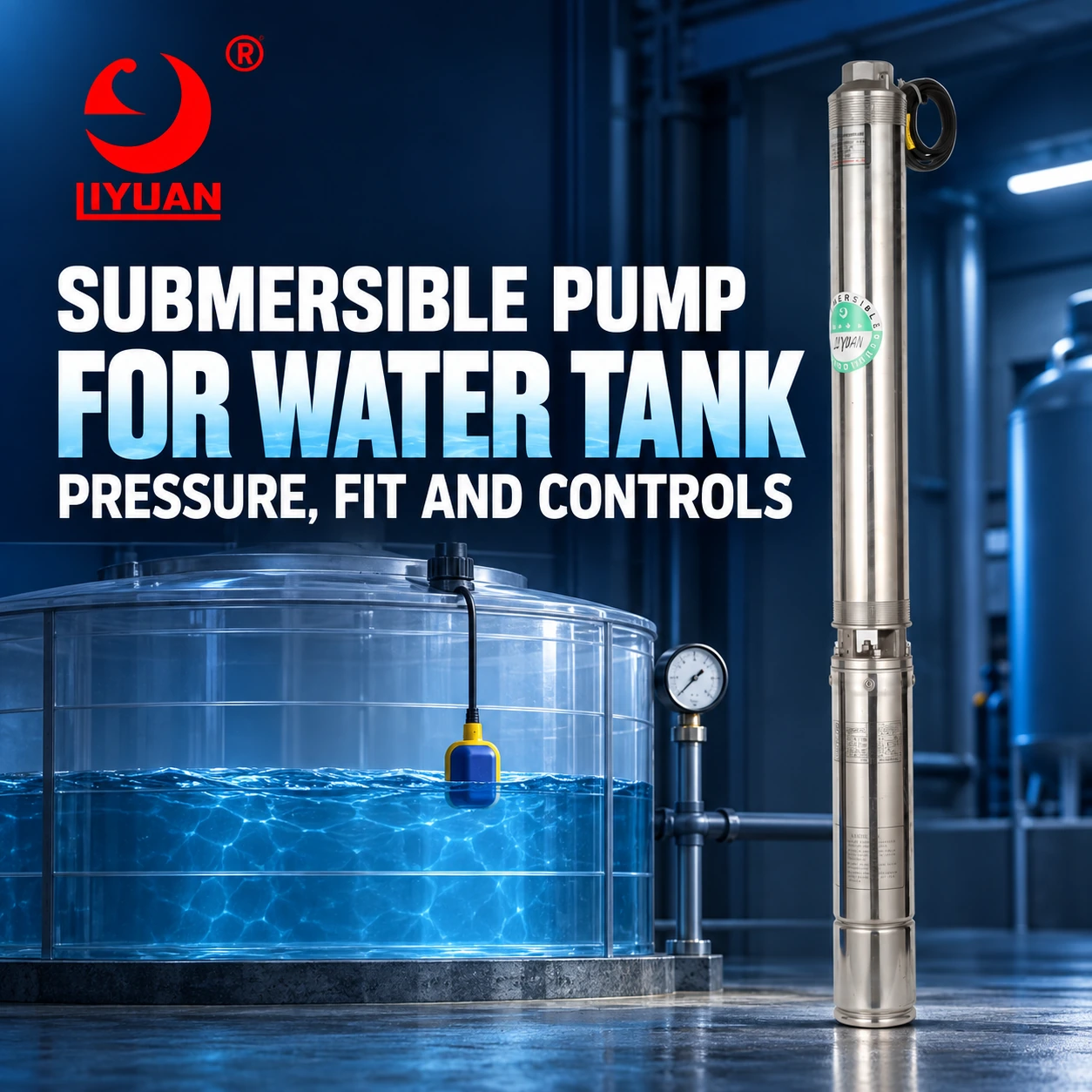
Submersible Pump For Water Tank: Pressure, Fit And Controls
A Submersible Pump For Water Tank Use Must Deliver The Required Flow And Pressure At The Lowest Permitted Water Level, Fit The Tank, And Operate With Suitable Cooling And Controls. For Household Or Irrigation Pressure Supply, Check A Pressure-Pump Curve; A Drainage Pump’s High Maximum Flow Does Not Establish That It Can Run Showers Or Sprinklers.
The Tank’s Size Answers How Much Water It Stores. The Pump Curve Answers How That Water Can Be Delivered. Low-Water Settings Determine How Much Of The Stored Volume Is Actually Available.
What Must The Water Tank Pump Do?
First Identify Whether The Pump Supplies Water From The Tank, Fills The Tank From Another Source, Or Empties It For Maintenance.
| Task | Main Selection Requirement | Control Requirement |
|---|---|---|
| Supply A House Or Irrigation Zone | Flow At The Required Outlet Pressure | Demand Control Plus Low-Water Protection |
| Transfer Water To Another Tank | Flow At The Transfer Head | Receiving-Tank Level Control Plus Source Protection |
| Fill The Tank From A Well | Well Yield And Well-To-Tank Duty | Stop Filling At The Upper Tank Level |
| Drain The Tank For Maintenance | Required Drainage Rate And Residual Water Depth | Level Control Appropriate To The Drainage Pump |
A Pump That Fills A Storage Tank May Be Installed In A Well Elsewhere. Its Job And Operating Head Differ From Those Of A Pump Inside The Tank Supplying A Building.
Specify The Task Before Comparing Horsepower Or Price.
Which Submersible Pump Suits Water Tank Pressure Supply?
For Clean-Water Pressure Supply, A Purpose-Designed Submersible Booster Or Multistage Tank Pump Is A Useful Starting Point. These Products Combine Pressure-Producing Hydraulics With Installation Features Suited To Tanks Or Cisterns.
For Example, DAB Describes Its DTron 2 As A Tank-And-Well Pump For Pressure Boosting, With Automatic On/Off Electronics And Dry-Running Protection. Those Are Features Of That Product, Not Features To Assume On Every Submersible Pump.
A Drainage Pump May Move A Large Volume Through A Short Discharge Hose Yet Provide Insufficient Head For An Elevated Fixture Or Irrigation System. Check Its Actual Curve At Your Required Flow Before Considering It For That Duty.
Also Check Water Suitability. A Clean-Water Booster Is Not Automatically Suitable For Sludge, Abrasive Sediment Or Chemicals Simply Because It Operates Underwater.
Can A Borehole Pump Be Installed Inside A Water Tank?
Some Borehole Pumps Can Serve In Tanks When The Manufacturer Approves The Arrangement. Physical Fit Alone Does Not Establish Suitability.
A Typical Borehole Motor Depends On Water Moving Along Its Surface. In A Wide Tank, Water Can Reach The Pump Intake Without Following That Cooling Path. Grundfos Explains This Difference In Its Cooling Jacket FAQ.
Ask Whether The Proposed Pump Requires A Flow Sleeve, What Cooling Flow It Needs, And Whether Its Installed Orientation Is Approved. A Sleeve Must Guide Water Past The Motor; Merely Surrounding It With A Loose Pipe Is Not A Complete Design.
The Submersible Motor Cooling System Article Explains Why Complete Submersion And Adequate Cooling Are Separate Checks.
Do Not Lay A Vertical-Only Pump On Its Side To Fit A Shallow Tank. Select An Approved Configuration With Suitable Supports And Enough Space For Future Removal.
Size A Submersible Pump For Water Tank Use At Low Water Level
For An Atmospheric Storage Tank, A Preliminary Head Calculation Is:
TDH ≈ Elevation Rise From The Tank Water Surface To The Delivery Point + Required Pressure Head + Pipe And Equipment Losses
For Water Near Normal Temperature:
Pressure Head In m ≈ Pressure In bar × 10.2
Use The Lowest Permitted Operating Water Surface For The Highest Static Lift. Include Losses Along The Actual Pipe Route At The Required Flow, Even Where Part Of That Pipe Is Submerged.
The Pump’s Depth Below The Water Surface Is Not An Additional Static Lift To Add Again. For A More Detailed Calculation, See Total Dynamic Head For Submersible Pump Selection.
Check The High-Water Condition Too. Lower Lift Can Shift A Fixed-Speed Pump Toward Greater Flow. Both Conditions Must Remain Inside The Approved Operating Range.
Worked Example: Pressure, Usable Storage And Runtime
The Following Values Are Illustrative. They Are Not Liyuan Test Results Or Universal Installation Limits.
Assume A Rectangular Tank Supplies A Combined Demand Of 40 L/min. For This Example, The Selected Pump And Installation Have Been Confirmed Suitable For A Low-Water Stop Level Of 0.40 m Above The Tank Floor.
| Design Input | Assumed Value |
|---|---|
| Internal Tank Length × Width | 2.0 m × 2.0 m |
| Upper Operating Water Level Above The Floor | 1.50 m |
| Low-Water Stop Level Above The Floor | 0.40 m |
| Delivery Point Above The Tank Floor | 10.0 m |
| Required Pressure At That Point | 2.5 bar |
| Total Hydraulic Loss Allowance At 40 L/min | 6.0 m |
The Loss Allowance Includes Pipe, Fitting, Intake And Treatment Losses, Plus Any Material Velocity-Head Allowance For This Preliminary Example.
Calculate The Required Pump Duty
At The Low-Water Limit:
Elevation Rise = 10.0 − 0.40 = 9.60 m
Pressure Head = 2.5 × 10.2 = 25.5 m
TDH ≈ 9.60 + 25.5 + 6.0 = 41.1 m
The Selection Target Is Therefore 40 L/min At Approximately 41 m TDH.
At The Upper Water Level, The Corresponding Head Requirement At The Same Flow Is Approximately 40.0 m. The Pump And Controls Must Accommodate The Operating Range.
A Label Showing “Maximum Head: 45 m” Would Not Confirm Suitability. The Submersible Pump Performance Curve Must Show The Required Flow At The Required Head.
Calculate Usable Water Volume
Water Stored At The Upper Operating Level Is:
2.0 × 2.0 × 1.50 = 6.00 m³ = 6,000 L
Water Available Before Low-Water Shutdown Is:
2.0 × 2.0 × (1.50 − 0.40) = 4.40 m³ = 4,400 L
Approximately 1,600 L Remains Below The Stop Level. This Calculation Neglects Equipment Displacement And Assumes Straight Tank Walls. Use A Capacity Chart For Tanks With Curved Or Irregular Shapes.
Calculate Supply Duration
With No Refill And A Constant Delivered Demand Of 40 L/min:
Supply Duration = 4,400 ÷ 40 = 110 Minutes
Dividing The Full 6,000 L By Demand Would Suggest 150 Minutes And Overstate Availability By 40 Minutes.
This Is Why Tank Selection And Pump Selection Must Use The Same Operating Levels. A Lower Stop Setting Can Increase Usable Volume Only If The Pump’s Submergence, Cooling And Intake Conditions Permit It.
Which Controls Does A Tank Pump Need?
Demand Control And Low-Water Protection Perform Different Jobs.
For A Pressurized Supply, A Pressure Switch, Electronic Controller Or Approved Variable-Speed System Requests Water Delivery. A Low-Level Device Or Suitable Dry-Run Function Prevents Operation When The Source Cannot Supply Water.
For Tank-To-Tank Transfer, The Receiving Tank’s Level Usually Governs Filling, While The Source Tank’s Low Level Must Still Stop The Pump. One Float Should Not Be Assumed To Monitor Both Locations.
Grundfos’s SB And SBA Selection Explanation Separates Controller Choice, Low-Level Float Options And Inlet-Strainer Options. This Is A Useful Reminder To Check The Exact Configuration Being Quoted.
Set A Suitable Restart Level Or Delay So A Small Refill Does Not Produce Repeated Brief Starts. Test The Intended Low-Water Shutdown Using The Manufacturer’s Procedure, Without Deliberately Running The Pump Dry. See Submersible Pump Dry-Running Protection For The Protection Principles.
Does A Water Tank Pump Need A Pressure Tank?
An Atmospheric Storage Tank Holds Bulk Water. A Pressure Tank Stores A Limited Volume Under Pressure And Can Help Manage Pump Cycling. They Are Different Components.
A Conventional Pressure-Switch System Normally Needs Suitable Pressure-Tank Drawdown. Some Integrated Tank Pumps Use A Different Arrangement Or Include A Small Vessel. Follow The Specific Pump And Controller Requirements.
Do Not Add Or Omit A Vessel Based Only On The Fact That The Pump Sits In A Storage Tank. The Submersible Pump Pressure Tank Article Explains Drawdown And Its Relationship To Control Settings.
Choose The Intake Position And Check Physical Fit
A Fixed Intake Needs Appropriate Clearance From Sediment. A Floating Intake, Where Supported By The Pump Design, Can Draw Water Away From Bottom Deposits. It Also Needs Space For Its Hose And Float To Move Throughout The Operating Level Range.
A Strainer Removes Only The Particles Its Design Can Capture. It Does Not Make Stored Water Potable. For Drinking-Water Service, Specify Suitable Wetted Materials And The Required Water Treatment Separately.
Before Ordering, Check The Access Opening, Complete Pump Dimensions, Outlet Fittings, Supports, Float Travel And Removal Route. A Pump That Fits Inside The Tank May Still Be Difficult To Pass Through Its Lid Opening Or Retrieve Later.
Keep The Intake Away From Locations Where Refill Water Introduces Air Or Disturbs Sediment. Install And Support The Assembly According To Its Instructions; Do Not Use The Electrical Cable As A Lifting Line.
What Should Be Verified Before Handover?
Have The Installer Demonstrate The Conditions That Matter In Daily Use:
- Required Flow And Pressure At The Delivery Point Under Planned Simultaneous Demand.
- Acceptable Operation At Both Upper And Lower Tank Levels.
- Correct Low-Level Shutdown And Restart After Sufficient Refill.
- Stable Small-Demand Operation And Shutdown When Outlets Close.
- Unobstructed Float Or Floating-Intake Movement.
Record The Stop And Restart Levels Together With The Measured Flow. Those Values Make Future Changes In Available Storage Or Pump Performance Easier To Diagnose.
For A Liyuan Submersible Pump System Assessment, Send A Tank Sketch Showing Dimensions, Access Opening, Water Levels And Delivery Elevation, Along With Required Flow, Pressure, Pipe Details, Water Quality And Power Supply.
Ask For Confirmation Of The Duty Point, Tank-Installation Suitability, Cooling Arrangement, Minimum Operating Level And Control Method. These Details Establish Whether The Proposed Pump Can Deliver The Water You Need From The Storage You Can Actually Use.
Email:Liyuan@liyuan-pump.com
WhatsApp:+86 181-2828-2767