
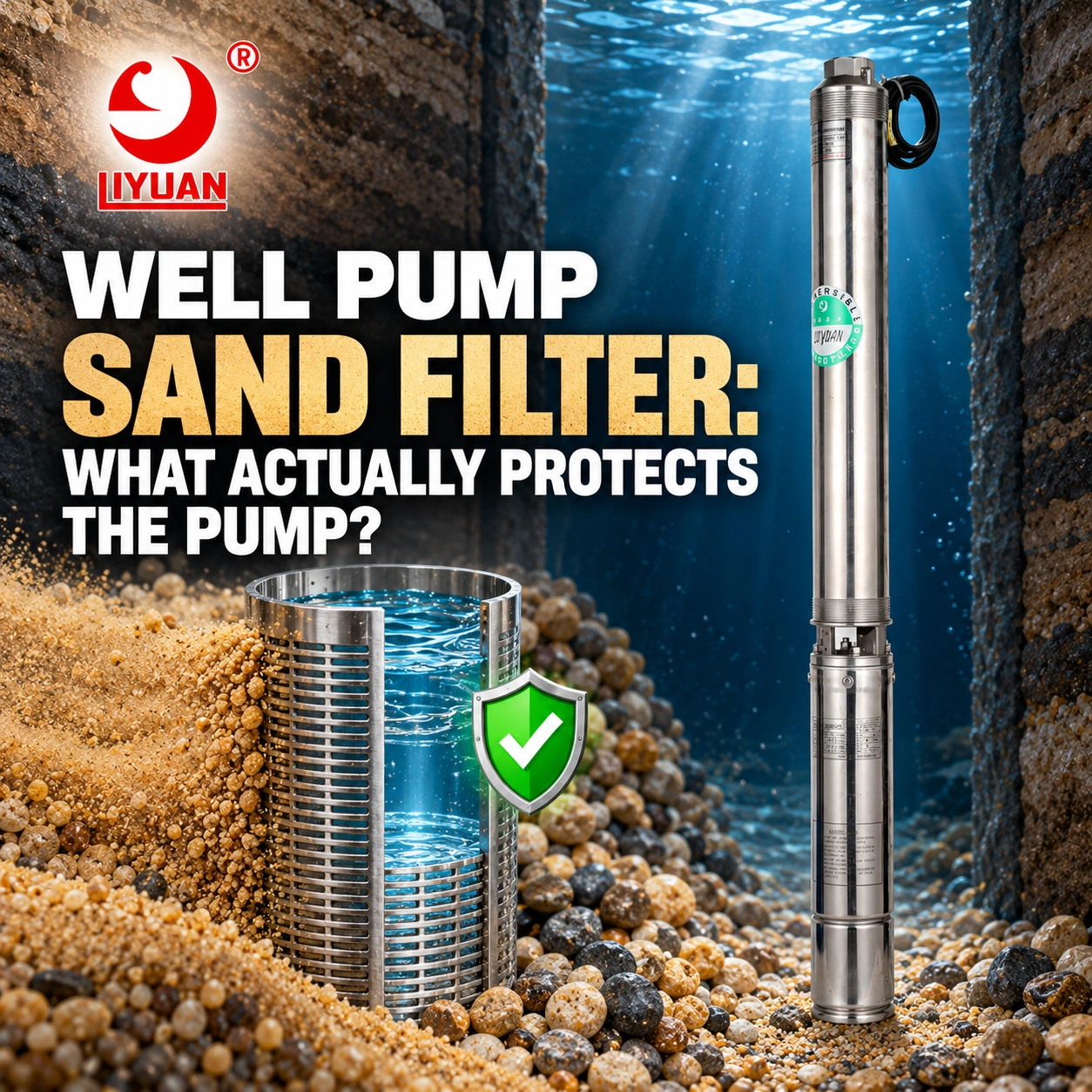
Well Pump Sand Filter: What Actually Protects The Pump?
A Well Pump Sand Filter Installed Above Ground Can Remove Sand Before It Reaches Household Plumbing Or Irrigation Equipment. However, It Cannot Protect A Submersible Pump From Sand That Has Already Passed Through Its Impellers.
Protecting The Pump Requires A Different Decision: Control Sand Entering The Well, Evaluate An Engineered Downhole Separator, Or Select A Pump With Suitable Abrasion Tolerance. These Measures Have Different Functions.
This Guide Covers Removing Sand From Well Water, Not Swimming-Pool Filters That Use Sand As Filter Media.
“I Already Have A Sand Filter. Is My Pump Still Exposed?”
In A Homeowner Discussion About A Sandy Well, The Owner Reported Cleaning A Sand Pre-Filter Roughly Every Two Weeks And Finding Sand Inside An Old Pressure Tank During Replacement.
That Is An Individual Experience, Not A Diagnosis Or A Product Test. However, It Highlights An Important Buying Question: A Pre-Filter Before What?
A Device Before The Water Softener Can Still Be After The Well Pump. Clear Water At The Kitchen Tap Does Not Establish That The Pump Receives Sand-Free Water.
What Does A Well Pump Sand Filter Actually Protect?
Start With The Device’s Position Relative To The Pump Intake.
| Equipment Or Measure | Position | Main Protection | Important Limitation |
|---|---|---|---|
| Properly Designed Well Screen And Gravel Pack, Where Applicable | Where Groundwater Enters The Well | Limits Formation Material Entering The Well | Requires Correct Well Design And Condition |
| Engineered Downhole Sand Separator | Before The Pump Intake | Reduces Suitable Sand Particles Reaching The Pump | Depends On Particle Characteristics, Flow, And Installation Fit |
| Surface Sand Separator | After The Submersible Pump | Protects Equipment Downstream Of The Separator | Does Not Prevent Sand Passing Through The Pump |
| Sediment Cartridge Or Screen Filter | Usually In The Surface Treatment System | Captures Particles Within Its Rated Capability | Loading Can Increase Pressure Loss; Placement Determines Protection |
A Filter Installed After The Pressure Tank Cannot Prevent New Sand From Entering That Tank. Likewise, A Surface Separator Does Not Reverse Existing Pump Wear.
Can A Sand Filter Go Before A Submersible Pump?
Purpose-Designed Downhole Separators Can Treat Water Before It Enters The Pump. For Example, LAKOS SUB-K Pump Protection Separators Use Centrifugal Separation Ahead Of The Intake And Discharge Collected Sand Deeper Into The Well.
That Is Not Equivalent To Wrapping The Intake In Fine Mesh Or Attaching A Household Cartridge Housing.
A Restricted Intake Can Reduce Water Delivery. Equipment Installed Downhole Must Also Remain Mechanically Secure And Retrievable. Do Not Improvise An Intake Filter Without Written Approval For The Exact Pump And Arrangement.
Before Specifying A Downhole Separator, Confirm Actual Casing Clearance, Pump And Motor Dimensions, Water Levels, Installation Depth, Motor Cooling, And The Manufacturer’s Flow Limits. Ask Where Separated Sand Accumulates And How That Affects Available Bottom Clearance.
A Separator Manages Suitable Particles; It Does Not Repair A Damaged Well Screen.
Should A Well Pump Sand Filter Go Before The Pressure Tank?
There Is No Safe Universal Placement Rule For Every Device Sold As A “Well Filter.”
For Example, The LAKOS SandMaster Installation Instructions Specify Installation Between The Pump And Pressure Tank, With Particular Check-Valve And Pressure-Switch Positions.
That Is A Product-Specific Arrangement, Not Permission To Install Any Cartridge Filter In The Same Location.
Have The Installer Review The Exact Manual, Maximum Pressure, Pressure-Sensing Location, Relief Protection, And What Happens If Flow Becomes Restricted. Filters And Isolation Valves Must Not Leave The Pump Without Effective Pressure Control Or Required Overpressure Protection.
For Cartridge Filters, Allow For Pressure Loss At The Manufacturer’s Replacement Threshold, Not Just When The Element Is Clean. Include This Resistance When Checking The Submersible Pump Performance Curve.
Size A Well Pump Sand Filter By Actual Flow, Not Pipe Diameter
A Larger Centrifugal Separator Is Not Automatically Better. It Needs An Appropriate Flow Range To Separate Particles Effectively.
The Published SandMaster Model Specifications Illustrate The Difference:
| Example Model | Published Operating Flow | Connection Size |
|---|---|---|
| SMP-05 | 5–10 US GPM | 1/2 Inch |
| SMP-10 | 10–20 US GPM | 3/4 Inch |
| SMP-20 | 20–32 US GPM | 1 Inch |
Suppose A System Has A 1-Inch Discharge Pipe But Sends Only 6–9 GPM Through The Proposed Separator During Normal Pump Operation.
Selecting The 1-Inch Model Solely To Match The Pipe Would Put That Example Below Its Published Range. The Smaller Model’s Range Covers Those Flows, Subject To The Remaining Installation Requirements.
This Is A Sizing Illustration, Not A Product Recommendation. Obtain Current Data For The Exact Model Offered.
With Variable-Speed Pumps, Check Low-Demand Operation As Well As Peak Flow. A Separator Sized For Irrigation Demand May Perform Differently When The Pump Slows Down To Supply One Tap. Ask The Supplier To Confirm Performance Across The Measured Range.
Is The Problem Coarse Sand, Fine Silt, Or Something Else?
Do Not Choose A Micron Rating From Water Color Alone.
A Centrifugal Separator Is Not A Fine-Mesh Sieve. Its Performance Depends On Particle Characteristics And Operating Conditions, Not Simply A Claimed Hole Size.
LAKOS Describes A Settling Test To Screen Whether Solids Are Suitable For Its Separators. Quickly Settling Grit And Persistent Cloudiness Can Require Different Treatment Approaches.
Treat A Jar Observation As Preliminary Evidence, Not A Laboratory Measurement Of Sand Concentration Or Proof Of Drinking-Water Safety.
Ask For Particle-Size Information And A Clearly Defined Concentration Measurement. Sand Content In g/m³ And mg/L Is Numerically Equivalent. A Percentage Requires Its Basis—Mass Or Volume—Before Comparison.
For Cartridge Filters, Ask Whether The Micron Rating Is Nominal Or Absolute And What Removal Efficiency Was Tested. “Five Microns” Alone Does Not Fully Specify Performance.
Sample Before And After Filtration
If Your Concern Is Pump Exposure, A Sample From The Kitchen Tap Answers The Wrong Question.
Have A Contractor Collect Representative Samples At A Suitable Raw-Water Point Before Surface Treatment And At The Relevant Treated-Water Outlet. Record Pumping Flow, Sampling Time, And Whether The Pump Was Starting Or Running Steadily.
Consider This Hypothetical Example:
- Raw-Water Sand Concentration: 80 mg/L.
- Pump Flow: 3 m³/h.
- Pumping Duration: 4 Hours.
Sand Transported = 80 g/m³ × 3 m³/h × 4 h = 960 Grams.
Even If A Surface Filter Captures Most Of That Sand, It Has Already Travelled Through The Pump. This Calculation Illustrates Exposure; It Does Not Predict Wear Rate Or Remaining Pump Life.
Sediment Collected In A Filter Bowl Is Also Not A Concentration Measurement Unless The Associated Water Volume And Collection Method Are Known.
Would A Sand-Resistant Pump Be A Better Solution?
A Sand-Resistant Submersible Pump Addresses Abrasive Wear Through Its Design And Materials. It Does Not Filter The Well Water Or Guarantee Unlimited Operation With Solids.
Grundfos Explains In Its Submersible-Pump Sand-Content Guidance That Excess Sand Can Shorten Service Life And Increase Blockage Risk. Limits Must Be Checked For The Specific Pump Family.
Compare The Proposed Pump’s Written Sand Limit With Representative Raw-Water Results. Also Confirm Particle Size, Operating Conditions, And Warranty Exclusions For Abrasion.
Do Not Treat A Stainless-Steel Housing, A Sand-Tolerance Claim, And A Downhole Separator As Interchangeable Specifications.
When Should You Investigate The Well Instead?
Seek A Qualified Well Contractor’s Assessment If Sand Suddenly Increases, Returns After Pump Replacement, Or Appears Alongside Falling Flow Or Changing Water Levels.
The National Ground Water Association’s Well Rehabilitation Guidance Describes Assessing Water Levels, Pumping Performance, Sand, And Well Construction Before Choosing Corrective Work.
Bring The Previous And Replacement Pump Details, Installation Depths, Well Log, And Any Earlier Water Tests. A Change In Pumping Rate Is Worth Investigating, But Timing Alone Does Not Prove The New Pump Caused The Sand.
Do Not Assume A Larger Pump Or An Additional Surface Filter Resolves The Underlying Well Condition.
Questions To Resolve Before Ordering
Ask The Supplier And Installer To Answer These Questions Together:
- What Must Be Protected? The Pump, Pressure Tank, Irrigation Emitters, Or Household Treatment Equipment?
- Where Will Treatment Occur? Before The Intake Or Only After The Pump?
- Which Flows Are Covered? Include Low-Demand Operation, Tank Filling, And Irrigation.
- Which Particles Are Covered? Confirm Size, Concentration, And Applicable Performance Conditions.
- What Maintenance Is Required? Include Purging, Cartridge Changes, Access, And Disposal Of Collected Solids.
- What Evidence Confirms Success? Agree On Sampling Points, Acceptable Results, And Pressure-Loss Limits.
Final Answer
Choose A Well Pump Sand Filter According To Its Location, Operating Range, And Intended Protection. Clear Water After Surface Filtration Does Not Prove That A Submersible Pump Is Protected From Sand.
For A Pump-Selection Review, Send Liyuan Pump Your Raw-Water Sand Results, Required Flow And Head, Well Dimensions, Water Levels, And Existing Treatment Layout. Identify The Sand-Control Method Before Finalizing The Replacement Pump.
Email:Liyuan@liyuan-pump.com
WhatsApp:+86 181-2828-2767