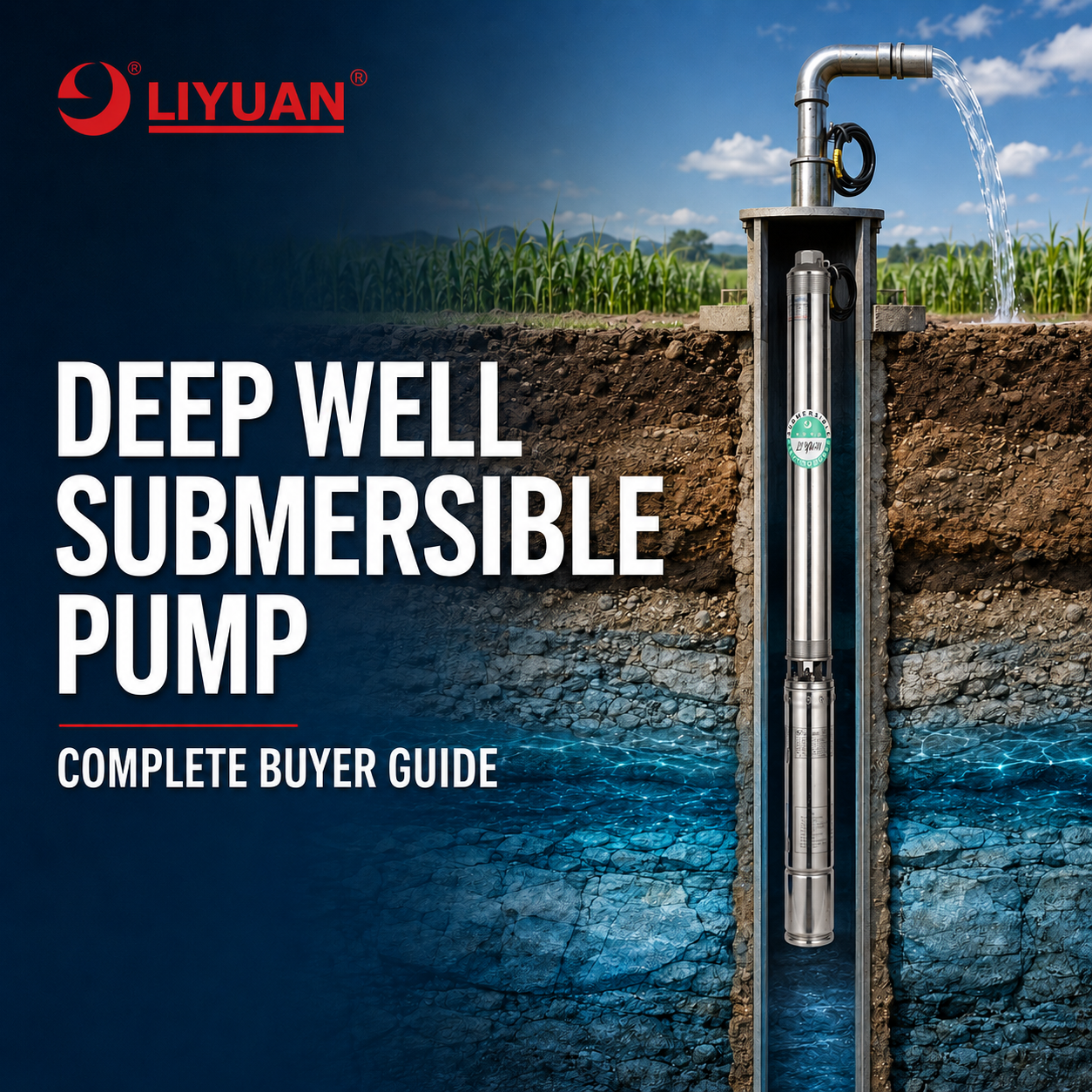
A deep well submersible pump provides an efficient and reliable way to lift groundwater from deep wells, boreholes and underground reservoirs.
However, selecting a pump based only on horsepower often causes low flow, excessive energy use or early failure. Buyers should also calculate total dynamic head, required flow, well diameter, water quality and power supply.
This guide explains how to choose the right pump for residential, agricultural, commercial and industrial water systems.
What Is A Deep Well Submersible Pump?
A deep well submersible pump is a multistage centrifugal pump designed to operate below the water level inside a well.
The pump connects directly to a sealed electric motor. When the motor runs, multiple impellers increase water pressure stage by stage. The pump then pushes water through a vertical discharge pipe to the surface.
Unlike a surface pump, a submersible unit does not need to pull water upward through a suction line. Instead, it pushes water from inside the well. This design reduces priming problems and makes deep-water pumping possible.
The U.S. Geological Survey identifies submersible pumps as the most common pump type for deep private wells.
How Does A Deep Well Submersible Pump Work?
The system begins working when a pressure switch, control panel or level sensor sends power to the motor.
The motor rotates the pump shaft. Each impeller transfers energy to the water and increases its pressure. Guide vanes then direct the water toward the next stage.
As water moves through additional stages, the discharge pressure rises. Finally, the pump sends the water through the outlet, check valve and drop pipe.
A typical system includes:
- Submersible pump
- Water-filled or oil-filled motor
- Drop pipe
- Power cable
- Check valve
- Control box or control panel
- Pressure tank
- Pressure switch
- Dry-run protection
- Wellhead and safety cable
Correct component matching improves reliability and reduces maintenance costs.
Deep Well Pump Vs Surface Pump
A surface pump works well when the water source remains close to ground level. However, suction limits reduce its effectiveness in deeper wells.
A borehole submersible pump operates below the water level. Therefore, it can handle much greater pumping depths.
| Feature | Deep Well Submersible Pump | Surface Pump |
|---|---|---|
| Installation Position | Inside The Well | Above Ground |
| Suitable Water Depth | Medium To Very Deep | Shallow |
| Priming Required | No | Usually Yes |
| Operating Noise | Low | Higher |
| Cooling Method | Surrounding Water | Air Or External Cooling |
| Cavitation Risk | Lower | Higher |
| Maintenance Access | Requires Pump Removal | Easier To Access |
For a deep borehole, a submersible design normally provides better pressure and more stable operation.
Main Deep Well Pump Applications
Residential Water Supply
Residential wells use submersible pumps to supply water for kitchens, bathrooms, washing machines and garden irrigation.
The pump must provide enough flow during peak household demand. It should also maintain stable pressure without starting too frequently.
Agricultural Irrigation
Farmers use deep well pumps for drip irrigation, sprinklers, livestock watering and greenhouse systems.
Agricultural projects often require high flow and long operating hours. Therefore, energy efficiency and motor cooling become especially important.
Municipal Water Systems
Municipal boreholes require durable pumps that can operate continuously. These systems may supply storage tanks, public pipelines and water treatment facilities.
Large municipal projects often use three-phase motors, control panels and variable frequency drives.
Industrial Water Supply
Factories use borehole pumps for process water, cooling systems, cleaning and raw water transfer.
Industrial buyers should consider the water chemistry, operating schedule and required pressure before choosing materials.
Mining And Construction
Deep well pumps can support groundwater extraction, site drainage and dewatering operations.
However, water containing sand or abrasive solids requires a suitable hydraulic design and wear-resistant components.
How To Choose A Deep Well Submersible Pump
1. Confirm The Well Diameter
Measure the internal diameter of the well casing before selecting the pump.
The pump must fit inside the casing while leaving enough space for cooling water to move around the motor. An oversized pump may become stuck or receive insufficient cooling.
Common sizes include:
- 3-inch pumps for narrow boreholes
- 4-inch pumps for residential and agricultural wells
- 6-inch pumps for higher flow requirements
- 8-inch pumps for municipal and industrial systems
- 10-inch and 12-inch pumps for large water projects
Always check the pump’s maximum outside diameter rather than relying only on its product category.
2. Determine The Required Flow Rate
Flow rate describes how much water the pump must deliver over time. Manufacturers commonly express it in cubic meters per hour, liters per minute or gallons per minute.
Estimate demand according to the application:
| Application | Typical Flow Requirement |
|---|---|
| Small Household | 1–3 m³/h |
| Large Residence | 3–6 m³/h |
| Livestock Watering | 2–10 m³/h |
| Small Irrigation System | 5–20 m³/h |
| Commercial Agriculture | 20–100+ m³/h |
| Municipal Water Supply | Project-Specific |
These figures provide only a starting point. The well must also produce enough water to support the selected flow.
Installing a pump with a higher flow than the well yield can cause dry running and excessive drawdown.
3. Calculate Total Dynamic Head
Total dynamic head, or TDH, represents the pressure that the pump must overcome.
A simplified calculation is:
TDH = Vertical Lift + Required Discharge Pressure + Pipe Friction Loss
For example:
- Pumping water level: 70 meters
- Storage tank height: 15 meters
- Required pressure: 20 meters
- Pipe friction loss: 8 meters
The approximate TDH is:
70 + 15 + 20 + 8 = 113 meters
Select a pump that delivers the required flow at 113 meters of head. Do not select it according to maximum head alone.
4. Check The Pump Performance Curve
A pump performance curve shows the relationship between flow and head.
As flow increases, available head normally decreases. Therefore, buyers must locate the required duty point on the manufacturer’s curve.
The best selection places the duty point near the pump’s high-efficiency operating range. Operating too far from this range may cause:
- Higher electricity consumption
- Motor overload
- Excessive vibration
- Bearing wear
- Unstable pressure
- Shorter pump life
Ask the manufacturer for an official pump curve before placing a bulk order.
5. Select The Correct Motor Power
Motor power must support the required hydraulic load. However, selecting the largest available motor does not guarantee better performance.
Common power ratings range from 0.37 kW to several hundred kilowatts.
The correct rating depends on:
- Required flow
- Total dynamic head
- Number of pump stages
- Pump efficiency
- Motor efficiency
- Power supply
- Expected operating hours
A properly matched motor reduces energy costs and avoids unnecessary stress on the electrical system.
6. Choose Single-Phase Or Three-Phase Power
Single-phase pumps commonly support homes, farms and small water systems. Typical voltages include 110V, 220V and 240V.
Three-phase pumps suit commercial, agricultural and industrial applications. Common voltages include 380V, 400V, 415V, 440V and 480V.
Three-phase motors usually offer:
- Smoother operation
- Higher efficiency
- Better starting performance
- Greater power capacity
- Lower current at equivalent output
Before ordering, confirm the local voltage, frequency and phase requirements.
Which Pump Material Is Best?
Water quality determines the most suitable pump material.
Stainless Steel
Stainless steel offers strong corrosion resistance and a clean appearance. It works well in potable water, agricultural and industrial systems.
Common options include AISI 304 and AISI 316 stainless steel. AISI 316 provides better resistance to chloride and mildly corrosive water.
Cast Iron
Cast iron delivers good mechanical strength at a competitive cost. Manufacturers often use it for pump components in clean freshwater applications.
However, untreated cast iron may not suit highly corrosive environments.
Engineering Plastic
High-quality engineered polymers reduce weight and resist some forms of corrosion. They often appear in smaller residential or agricultural pumps.
Buyers should verify temperature, pressure and chemical compatibility before choosing plastic components.
Bronze
Bronze provides strong corrosion resistance and works well in certain seawater or demanding water applications. However, it usually costs more than standard materials.
Water Quality Factors To Check
Water chemistry and suspended solids directly affect pump life.
Before selecting a pump, check:
- Sand content
- Chloride level
- pH value
- Water temperature
- Mineral concentration
- Chemical composition
- Maximum particle size
Excessive sand can wear impellers, diffusers and bearings. Corrosive water can damage metal parts and mechanical seals.
For difficult water conditions, request corrosion-resistant materials, sand-resistant bearings and suitable sealing components.
Energy Efficiency And VFD Control
Energy cost often exceeds the initial purchase price during a pump’s service life. Therefore, efficiency should influence the final selection.
Choose a pump that operates near its best efficiency point. In addition, avoid excessive head or flow capacity.
A variable frequency drive can adjust motor speed when water demand changes. The U.S. Department of Energy explains that variable-speed control can reduce energy consumption in suitable centrifugal pump systems. However, engineers must consider static head before estimating savings. Read the DOE variable-speed pumping guide.
A VFD may also provide:
- Soft starting
- Stable water pressure
- Lower starting current
- Reduced hydraulic shock
- Motor overload protection
- Dry-run protection
- Phase-loss protection
Always confirm that the submersible motor can operate with a VFD.
Common Selection Mistakes
Choosing Only By Horsepower
Horsepower does not define the actual operating point. Two pumps with equal motor power may produce very different flow and head.
Using Well Depth As Total Head
Well depth alone does not represent TDH. Buyers must consider the pumping water level, discharge pressure, elevation and friction loss.
Ignoring Well Yield
An oversized pump can remove water faster than the well can recover. This condition may cause dry running and unstable water supply.
Selecting The Maximum Curve Point
Maximum head normally occurs near zero flow. Maximum flow normally occurs at very low head. Neither point represents a practical duty condition.
Ignoring Cable Voltage Drop
Long power cables create voltage loss. Incorrect cable sizing can cause difficult starting, overheating and motor failure.
Using The Wrong Materials
Standard materials may fail quickly in sandy, saline, acidic or hot water.
Deep Well Pump Installation Tips
Correct installation protects both the pump and the well.
Follow these basic practices:
- Inspect the pump, motor and cable before installation.
- Confirm that the well is clean and properly developed.
- Measure the static and dynamic water levels.
- Install the pump below the lowest expected water level.
- Maintain adequate distance above the well bottom.
- Secure the power cable along the drop pipe.
- Install suitable check valves.
- Verify the motor rotation on three-phase models.
- Test voltage, current, flow and pressure.
- Record all commissioning data.
A qualified technician should complete electrical work. Always disconnect the power supply before inspecting the pump or wiring.
How Long Does A Deep Well Submersible Pump Last?
A properly selected pump can operate for many years. However, actual service life depends on the water quality, operating hours, installation and maintenance.
The following practices can extend pump life:
- Prevent dry running
- Limit frequent start-stop cycles
- Maintain correct voltage
- Monitor operating current
- Control sand content
- Check water output regularly
- Use the correct drop pipe
- Match the pump to its duty point
- Inspect protection devices
- Test motor insulation during maintenance
A sudden change in pressure, flow, noise or current may indicate a developing problem.
Why Choose Liyuan Pump?
Liyuan Pump manufactures deep well submersible pumps and submersible motors for residential, agricultural, municipal and industrial water systems.
Customers can request solutions based on:
- Well diameter
- Required flow
- Total dynamic head
- Motor power
- Voltage and frequency
- Water quality
- Installation depth
- Operating environment
- Material requirements
- OEM and ODM specifications
Instead of selecting a pump by horsepower alone, the Liyuan Pump team can match the hydraulic curve and motor to the actual project conditions.
Visit www.liyuan-pump.com to discuss your deep well pumping requirements.
Frequently Asked Questions
What Type Of Pump Is Best For A Deep Well?
A multistage submersible borehole pump is usually the best choice for a deep well. It operates below the water level and pushes water to the surface efficiently.
How Do I Know What Size Deep Well Pump I Need?
Confirm the well diameter, required flow, pumping water level, discharge pressure, pipe friction loss and power supply. Then select a model whose performance curve covers the calculated duty point.
Can A Deep Well Pump Be Too Powerful?
Yes. An oversized pump may cause excessive drawdown, frequent cycling, high electricity use and unstable system pressure.
How Far Should The Pump Be From The Bottom Of The Well?
The correct distance depends on well construction and sediment conditions. The pump should remain above accumulated sand and below the lowest expected pumping water level.
Can A Submersible Pump Run Continuously?
A correctly sized continuous-duty pump can operate for long periods if it receives adequate cooling and stable power. However, it must not run dry.
Is Stainless Steel Better For A Deep Well Pump?
Stainless steel provides excellent corrosion resistance and durability. However, the best grade depends on the water chemistry, chloride concentration and operating environment.
What Information Does A Manufacturer Need For Pump Selection?
Provide the well diameter, well depth, static water level, dynamic water level, required flow, discharge height, pipe details, voltage, frequency and water quality.
Conclusion
The best deep well submersible pump is not simply the model with the highest horsepower or maximum head. It is the pump that delivers the required flow at the calculated total dynamic head while operating within an efficient range.
Accurate system data helps reduce energy use, prevent failures and extend service life. For a suitable pump and motor recommendation, send your project specifications to Liyuan Pump through
Email:Liyuan@liyuan-pump.com
WhatsApp:+86 181-2828-2767