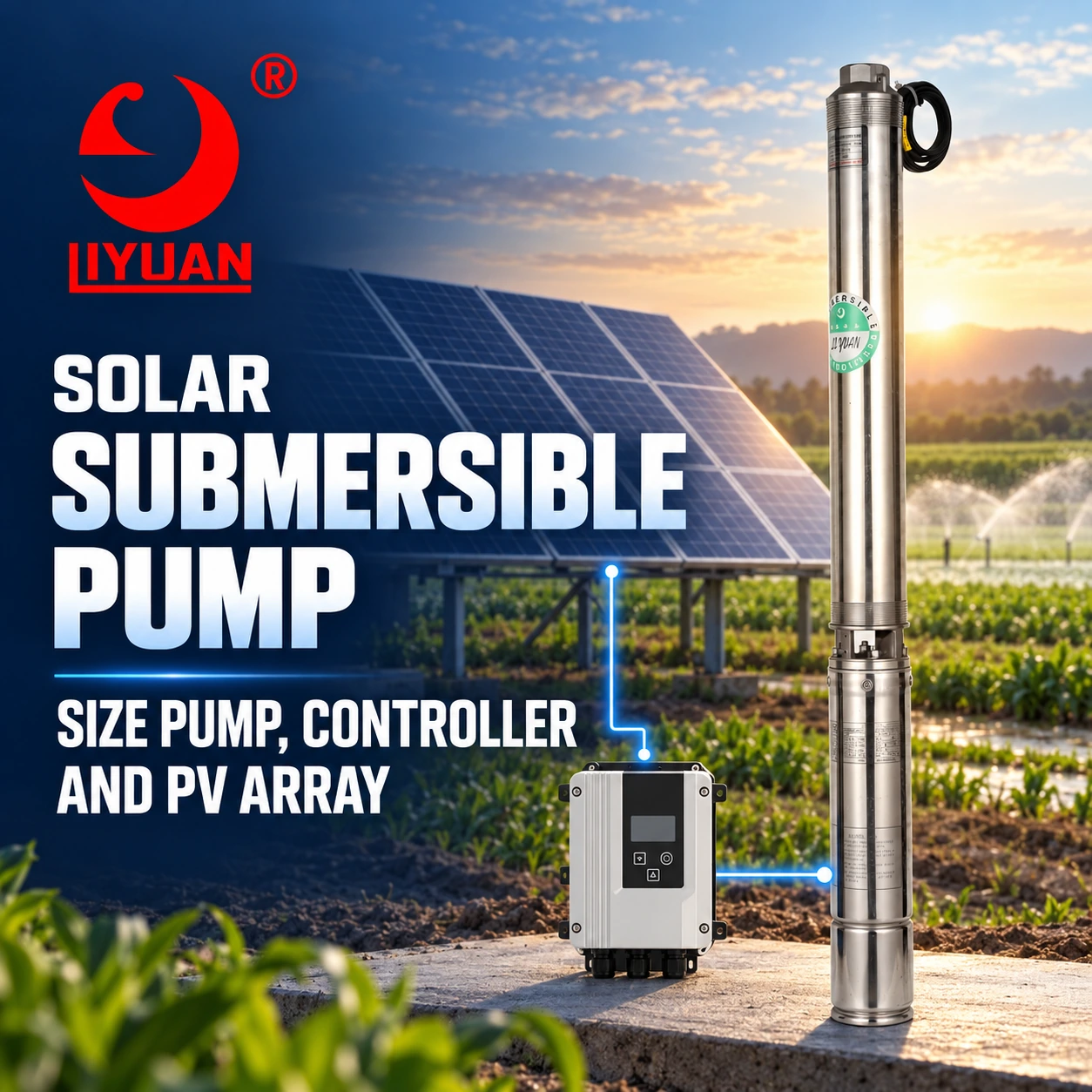
Solar Submersible Pump: How To Size The Complete System
A Solar Submersible Pump Must Satisfy Three Requirements At The Same Time: It Must Deliver The Required Flow At The Actual Total Dynamic Head, Pump The Required Daily Water Volume During The Design Month, And Operate Inside The Electrical Limits Of The Controller And PV Array. Selecting A Pump From Maximum Head, Maximum Flow, Motor Watts, Or Panel Quantity Alone Does Not Prove That The System Will Work.
For A Reliable Selection, Start With Water Demand And Well Data. Next, Establish The Hydraulic Duty Point. Then, Estimate Daily Energy, Match The Solar Array To The Controller, And Verify The Manufacturer’s Hour-By-Hour Or Monthly Water-Output Data.
This Sequence Matters Because A Solar Pump Does Not Usually Operate At One Fixed Power Level All Day. Morning, Cloud Cover, Cell Temperature, And Seasonal Irradiance Change Available Power, Pump Speed, Flow, And Head.
What Must A Solar Submersible Pump Selection Prove?
A Complete Selection Should Answer Five Separate Questions:
- Can The Well Sustain The Required Pumping Flow?
- Can The Pump Deliver That Flow At The Actual TDH?
- Can The System Produce The Required Water Volume On A Design-Day Solar Profile?
- Do The PV String Voltage And Current Stay Inside The Controller Limits?
- Can The Tank, Irrigation Network, Or Pressure System Accept The Changing Solar Pump Output?
Consequently, These Questions Prevent A Common Error: Choosing A 2 kW Pump And Automatically Adding About 2 kW Of Solar Panels. Equal Nameplate Power Does Not Account For Module Temperature, Wiring Loss, Controller Efficiency, Motor Efficiency, Hydraulic Efficiency, Low-Irradiance Operation, Or Daily Water Demand.
How Do You Size A Solar Submersible Pump?
Use This Practical Order:
- Calculate Daily Water Demand.
- Define The Design Month.
- Confirm Sustainable Well Yield.
- Calculate TDH At The Required Flow.
- Select The Pump From Its Q-H Curve.
- Estimate Daily Hydraulic And Electrical Energy.
- Size The PV Array From Local Solar Resource And System Losses.
- Check The Controller’s Voltage, Current, Power, And Motor Compatibility.
- Select Water Storage, Backup Power, Or Both.
- Verify Daily Water Output With Manufacturer Data Before Ordering.
The Grundfos Solar Pump Sizing Process Also Starts With The Application, Required Water Volume, And System Conditions Rather Than A Panel Count.
Step 1: Calculate Daily Water Demand
First, Daily Water Demand Is More Useful Than An Unqualified Maximum Flow Rate Because Solar Pumping Capacity Changes During The Day.
In Addition, Include Every Relevant Demand:
- Crop Irrigation
- Livestock Watering
- Domestic Supply
- Process Water
- Filter Backwash
- Tank Cleaning
- Distribution Loss
- Seasonal Peak Demand
- A Defined Operational Reserve
For Irrigation, Build Demand From Irrigated Area, Crop Water Requirement, Irrigation Efficiency, And Irrigation Schedule. Meanwhile, For Livestock, Use Animal Count And Design-Day Consumption. For Community Water Supply, Use The Applicable Local Planning Standard And Peak-Season Population.
However, Do Not Add An Arbitrary Percentage Before Fixing Uncertain Input Data. Instead, State The Base Demand, Identified Losses, And Design Margin Separately. This Makes The Selection Easier To Audit.
Review The Irrigation Well Pump Method When Different Irrigation Zones Have Different Flows And Pressure Requirements.
Step 2: Choose The Design Month
Next, The Highest Solar Irradiance Month Does Not Automatically Control The Design. The Critical Month May Combine:
- High Crop Water Demand
- Lower Solar Irradiance
- Higher PV Cell Temperature
- Lower Seasonal Groundwater Level
- Longer Pipe Runs Or Additional Irrigation Zones
Therefore, Compare Monthly Water Demand With Monthly Solar Resource. Size The System For The Most Demanding Acceptable Combination, Not Only For An Annual Average.
The FAO Solar Water Pumping Material Explains That Location, Season, Time Of Day, And Weather Determine Solar Energy And The Array Size Needed For A Required Water Volume.
If Several Consecutive Low-Sun Days Matter, Define The Required Storage Autonomy. Otherwise, An Oversized Array May Still Fail To Provide Water After Sunset.
Step 3: Confirm Well Yield Before Pump Flow
The Pump Cannot Sustainably Withdraw More Water Than The Well Can Supply. Therefore, Use A Pumping Test To Record:
- Static Water Level
- Pumping Flow
- Dynamic Water Level
- Drawdown
- Stabilization Time
- Recovery Time
- Sand Production
For Example, Suppose Daily Demand Is 30 Cubic Meters And The Available Solar Pumping Window Is Six Hours. The Preliminary Average Flow Is:
Required Average Flow = 30 ÷ 6 = 5 Cubic Meters Per Hour
If The Well’s Sustainable Yield Is Only 4 Cubic Meters Per Hour, Installing A Larger Pump Will Not Create More Groundwater. Instead, Increase Pumping Time, Reduce Demand, Improve Irrigation Efficiency, Or Add Storage And Operate At A Flow The Well Can Sustain.
The Submersible Pump Flow Rate Explains How Demand, Well Yield, And Pump Curves Limit Available Flow.
Step 4: Calculate Solar Submersible Pump TDH
Use The Dynamic Water Level At The Intended Flow, Not Total Well Depth And Not Pump Setting Depth.
First, For An Open Storage Tank:
TDH = Dynamic Water Level + Elevation To Tank Inlet + Pipe And Fitting Losses
Next, For Direct Pressurized Irrigation:
TDH = Dynamic Water Level + Elevation Difference + Required Outlet Pressure Head + Friction Losses
For Clean Water:
Pressure Head In Meters ≈ Pressure In Bar × 10.2
Moreover, Friction Loss Must Use The Expected Flow, Actual Pipe Internal Diameter, Length, Material, And Fittings. Because Friction Rises Rapidly With Flow, A Small Pipe Can Increase Both Pump Size And PV Cost.
Use The Total Dynamic Head For Submersible Pump Calculation For More Complex Elevation And Pressure Systems.
Tank Filling And Direct Irrigation Are Different Duty Points
Assume The Following Well:
- Dynamic Water Level: 45 Meters Below Ground
- Tank Inlet: 12 Meters Above Ground
- Pipe And Fitting Loss: 6 Meters
For An Open Tank:
TDH = 45 + 12 + 6 = 63 Meters
Now Assume The Same Pump Feeds Sprinklers Directly And They Need 2.5 Bar:
Pressure Head = 2.5 × 10.2 = 25.5 Meters
Direct Irrigation TDH = 45 + 12 + 6 + 25.5 = 88.5 Meters
Therefore, A Pump That Meets The Tank-Filling Duty May Fail To Operate The Sprinklers. Conversely, Designing The Entire System For Direct Irrigation Pressure May Add Unnecessary Pump Stages, Panel Capacity, And Cost When A Tank-Fed Distribution System Is Acceptable.
Step 5: Select The Pump At The Real Duty Point
First, Plot The Required Flow And TDH On The Pump Curve. Then Confirm That The Duty Point Falls Inside The Manufacturer’s Recommended Operating Range.
Check:
- Flow At Required TDH
- Best Efficiency Region
- Minimum And Maximum Permitted Flow
- Motor Input Power
- Maximum Current
- Shut-Off Head
- Axial Thrust Limits
- Minimum Motor Cooling Flow
- Pump Outside Diameter
- Sand And Temperature Limits
However, Do Not Combine Maximum Flow And Maximum Head From A Product Listing. Maximum Head Occurs Near Zero Flow, While Maximum Flow Occurs At Low Head. Neither Value Describes The Required Operating Point.
The Submersible Pump Performance Curve Shows How To Verify Flow, Head, Efficiency, And Power Together.
Step 6: Separate Instantaneous Power From Daily Energy
Instantaneous Power Confirms Whether The Pump Can Operate At A Specific Flow And Head. Meanwhile, Daily Energy Confirms Whether The System Can Move The Required Volume During The Available Solar Day. A Good Design Must Pass Both Tests.
For Clean Water, Estimate Hydraulic Power With:
Hydraulic Power In kW = Flow In Cubic Meters Per Hour × Head In Meters ÷ 367
For 6 Cubic Meters Per Hour At 63 Meters:
Hydraulic Power = 6 × 63 ÷ 367 = 1.03 kW
Next, Include Pump, Motor, And Controller Efficiency. If Their Efficiencies Are 60%, 85%, And 95%:
Required Electrical Power ≈ 1.03 ÷ (0.60 × 0.85 × 0.95)
Required Electrical Power ≈ 2.13 kW
However, This Value Represents An Illustrative Operating Point. It Does Not Yet Define The Final PV Array Because Irradiance And Module Temperature Change Available PV Power.
Solar Submersible Pump Daily Energy Example
Assume The System Must Move 30 Cubic Meters Per Day Through 63 Meters Of TDH.
First, Estimate Daily Hydraulic Energy:
Daily Hydraulic Energy = Daily Volume × Head ÷ 367
Daily Hydraulic Energy = 30 × 63 ÷ 367 = 5.15 kWh Per Day
Next, Using The Same Combined Pump, Motor, And Controller Efficiency:
Daily Electrical Energy = 5.15 ÷ (0.60 × 0.85 × 0.95)
Daily Electrical Energy ≈ 10.63 kWh Per Day
If The Design Month Provides Five Peak-Sun-Hours And A Preliminary PV Derating Factor Of 0.75:
Preliminary PV Array = 10.63 ÷ (5 × 0.75)
Preliminary PV Array ≈ 2.84 kWp
Therefore, This Calculation Is A Screening Estimate, Not A Purchase Specification. The Final Design Must Use Local Monthly Solar Data, Module Temperature Behavior, Controller Characteristics, Pump Performance At Variable Speed, Cable Loss, And The Manufacturer’s Predicted Daily Water Output.
Review Submersible Pump Energy Consumption When Comparing System Efficiency And Operating Energy.
Why A Motor-Watts Multiplier Is Not Enough
A Rule Such As “Use 1.5 Times The Pump Watts In Panels” Can Produce A Rough Starting Point, But It Cannot Verify A Solar Pumping System.
For Example, Two Systems With The Same Motor Rating May Have Different:
- Total Dynamic Head
- Pump Efficiency
- Motor Efficiency
- Controller Loss
- Starting Voltage
- MPPT Range
- Minimum Operating Power
- Cable Length
- Solar Resource
- Required Daily Volume
In Addition, A Larger Array Cannot Correct A Pump Curve That Misses The Duty Point. The Pump, Motor, Controller, And PV Array Must Match As One System.
Step 7: Match The PV Array To The Controller
Panel Wattage Is Only One Electrical Check. Therefore, Verify All Of The Following:
| Electrical Check | Required Verification |
|---|---|
| PV Operating Voltage | String Vmp Must Remain Inside The Controller MPPT Range During Hot Conditions |
| PV Open-Circuit Voltage | Cold-Condition String Voc Must Remain Below The Controller Maximum Input Voltage |
| Start Voltage | The String Must Reach The Controller Start Threshold With Adequate Irradiance |
| Input Current | Parallel-String Current Must Stay Within The Controller Limit |
| Input Power | Array Power Must Stay Within The Permitted Controller And Pump Range |
| Motor Output | Voltage, Current, Phase, Frequency, And Motor Type Must Match |
| Cable Loss | Cable Size Must Limit Voltage Drop And Heating At The Actual Current |
| Protection | Include Isolation, Surge Protection, Dry-Run Protection, And Tank-Level Control As Required |
PV Module Voc Rises In Cold Conditions, While Operating Voltage Usually Falls As Cell Temperature Rises. Therefore, Check Both The Coldest Expected Condition And The Hottest Expected Operating Condition With The Module Datasheet Temperature Coefficients.
Consequently, Never Add Panels In Series Until The Nominal Wattage Looks Correct. Too Many Series Modules Can Exceed The Controller’s Maximum DC Voltage, While Too Few Can Prevent Starting Or Move Operation Below The MPPT Window.
DC, AC/DC Hybrid, Or AC Solar Pump?
| System Type | Best Fit | Main Check |
|---|---|---|
| Dedicated DC Solar Pump | Small Or Medium Off-Grid Wells | Controller And Brushless Motor Compatibility |
| AC/DC Hybrid Pump | Sites Requiring Solar Plus Grid Or Generator Backup | Automatic Source Switching And Input Limits |
| Standard AC Pump With Solar VFD | Larger Agricultural Or Municipal Systems | VFD Output, Motor Cable, Filtering, Cooling, And Minimum Speed |
A Dedicated DC System Can Reduce Components For A Remote Well. However, An AC Pump With A Suitable Solar Drive May Offer A Broader Pump Range And Easier Local Motor Service. An AC/DC Hybrid System Can Maintain Water Supply When Solar Availability Falls, But Backup Operation And Changeover Logic Must Be Defined Before Ordering.
The Best Choice Depends On Required Flow, TDH, Motor Power, Local Service Capability, Backup Energy, And Project Scale.
Centrifugal Or Helical-Rotor Solar Submersible Pump?
A Multistage Centrifugal Pump Usually Suits Moderate-To-High Flow And Provides A Broad Range Of Head Configurations. Moreover, Its Flow Changes With Speed And Available Solar Power.
A Helical-Rotor Or Screw Pump Can Provide Useful Head At Lower Flow And Lower Power. However, Its Rotor And Stator Require Careful Water-Quality And Dry-Run Evaluation, Especially Where Sand Or Heat Is Present.
Compare Both Types At The Required TDH And Daily Volume. Therefore, Do Not Assume That One Technology Is Always More Efficient Across Every Flow, Head, And Water Condition.
Step 8: Choose Water Storage Or Battery Storage
For Many Off-Grid Pumping Systems, Storing Water Is Simpler Than Storing Electricity. The Pump Runs During Solar Hours And Fills An Elevated Or Ground-Level Tank. Then, The Tank Supplies Water During Weak Sunlight Or At Night.
The U.S. Department Of Energy Solar Pumping Example Notes That Stored Water Can Provide Backup In A PV Pumping System Without Requiring Batteries.
Use Battery Storage When The Application Truly Requires:
- Pumping After Sunset
- Constant Pressurized Supply Without A Suitable Tank
- Critical Emergency Availability
- Controlled Night Irrigation
- Stable Operation Through Short Solar Interruptions
However, Batteries Add Charging Loss, Conversion Loss, Temperature Limits, Cycle-Life Constraints, Protection Requirements, And Replacement Cost. Therefore, Compare A Larger Water Tank With A Battery System Before Finalizing The Design.
How Large Should The Water Tank Be?
Use This Preliminary Formula:
Required Usable Tank Volume = Daily Demand × Required Autonomy Days
If Daily Demand Is 30 Cubic Meters And The Project Requires One Day Of Usable Storage:
Required Usable Tank Volume = 30 × 1 = 30 Cubic Meters
Then Add Any Required Fire Reserve, Dead Storage, Sediment Allowance, And Operational Level Band Separately. Also Confirm That The Pump Can Refill The Tank During The Design Solar Day Without Exceeding Well Yield.
For Direct Irrigation, Storage Can Decouple The Variable Solar-Pump Flow From The Fixed Flow And Pressure Required By An Irrigation Zone. In That Layout, A Solar Well Pump Fills The Tank, And A Separate Booster Pump Supplies The Irrigation Network.
Solar Submersible Pump Protection Requirements
A Complete System May Need:
- Dry-Run Or Low-Water-Level Protection
- Tank-Full Shutdown
- Low-Tank-Level Interlock
- Overcurrent Protection
- Overvoltage And Undervoltage Protection
- DC Isolation
- Surge And Lightning Protection
- Motor Overtemperature Protection
- Phase-Loss Protection For Three-Phase Motors
- Reverse-Polarity Protection Where Applicable
- Automatic Restart Delay
- Flow Or Pressure Monitoring
Place Sensors According To The Failure They Must Detect. For Example, A Tank-Full Float Protects Against Overflow, While A Well-Level Sensor Or Validated Underload Function Protects The Pump Against Falling Water Level.
How Should Seasonal Water-Level Changes Be Checked?
Calculate At Least Two Hydraulic Conditions:
| Condition | Likely Effect |
|---|---|
| High Water Level And Full Sun | Higher Flow, Possible Motor Power Or Well-Yield Risk |
| Low Water Level And Design-Month Sun | Higher TDH, Lower Flow, Possible Daily Volume Shortfall |
At The Lowest TDH, Confirm That The Pump Does Not Run Beyond Its Maximum Flow, Power, Or Thrust Limits. Conversely, At The Highest TDH, Confirm That It Still Produces Enough Daily Water.
If Direct Irrigation Uses Several Zones, Check Every Zone Separately. One Zone May Control Flow, While Another Controls Head.
What Should The Manufacturer’s Solar Pump Report Show?
Before Ordering, Request A Selection Report That Identifies:
- Pump And Motor Model
- Required Duty Point
- Q-H Curve With Duty Point Marked
- Efficiency And Input Power At Duty
- Recommended Operating Range
- Predicted Daily Water Volume In The Design Month
- Solar Data Location Or Coordinates
- PV Module Quantity And Series-Parallel Arrangement
- String Vmp And Voc
- Cold-Condition Maximum String Voltage
- Hot-Condition MPPT Check
- Controller Model And Input Limits
- Motor Output Voltage, Current, Phase, And Frequency
- Cable Size And Maximum Length
- Protection And Sensor Logic
- Tank Or Battery Assumptions
- Maximum And Minimum Water-Level Cases
Without These Values, A Supplier Has Quoted Components, Not A Verified Solar Pumping System.
Solar Submersible Pump Commissioning Measurements
Measure Actual Field Performance Instead Of Accepting A “Pump Running” Observation.
Record:
- Date, Time, And Weather
- Solar Irradiance If A Meter Is Available
- PV DC Voltage And Current
- Controller Output Frequency, Voltage, And Current
- Flow Rate
- Dynamic Water Level
- Discharge Pressure
- Tank Level Change
- Pumping Duration
- Daily Water Volume
- Dry-Run Shutdown And Restart
- Tank-Full Shutdown
Finally, Compare Measurements With The Predicted Operating Point Under Similar Solar Conditions. Low Flow May Result From Higher TDH, A Falling Water Level, Incorrect PV String Voltage, Shading, Dirty Modules, Small Cable, Pipe Restriction, Or Pump Wear. The Measurement Set Helps Separate Hydraulic, Electrical, Solar, And Well Problems.
Common Solar Submersible Pump Sizing Mistakes
Selecting From Maximum Head
Maximum Head Occurs Near Zero Flow. It Does Not Show The Water Volume Available At The Required TDH.
Selecting From Maximum Flow
Maximum Flow Usually Occurs At Low Head. It Does Not Prove Performance In A Deep Well.
Sizing Panels From Motor Watts Alone
Motor Watts Do Not Include Daily Water Demand, Local Irradiance, Temperature, All System Losses, Or Controller Voltage Limits.
Using Annual Average Solar Data
An Annual Average Can Hide The Month With High Water Demand And Lower Available Solar Energy.
Ignoring Well Yield
More Solar Power Can Increase Pump Speed, But It Cannot Increase The Aquifer’s Sustainable Yield.
Mixing Tank And Irrigation Pressure
An Open Tank And A Pressurized Irrigation Network Create Different Duty Points. Therefore, Calculate Them Separately.
Checking Only Array Wattage
The PV String Must Also Meet Controller Vmp, Voc, Start Voltage, Current, And Temperature Limits.
Assuming A Battery Is Always Required
Water Storage Often Provides A Simpler Form Of Energy Storage For A Pumping Application.
Solar Submersible Pump Data Checklist
Send The Manufacturer:
- Project Location Or Coordinates
- Monthly Water Demand
- Maximum Daily Water Demand
- Static Water Level
- Dynamic Water Level At A Stated Flow
- Sustainable Well Yield
- Total Well Depth
- Pump Setting Depth
- Well Internal Diameter
- Tank Elevation And Inlet Height
- Required Outlet Pressure
- Pipe Diameter, Length, And Material
- Fittings, Filters, And Valves
- Water Temperature And Chemistry
- Sand Content
- Available Tank Volume
- Required Autonomy
- Grid Or Generator Backup Availability
- Preferred PV Module Datasheet
- Maximum Cable Length
- Required Monitoring And Controls
This Dataset Allows The Supplier To Select The Pump, Motor, Controller, PV Configuration, Cable, Protection, And Storage As One System.
Frequently Asked Questions
How Many Solar Panels Does A Solar Submersible Pump Need?
There Is No Fixed Panel Count For A Given Horsepower. Calculate Required Array Power, Then Choose The Series And Parallel Arrangement That Keeps Hot-Condition Vmp Inside The MPPT Range And Cold-Condition Voc Below The Controller Limit.
Can A Solar Submersible Pump Run Directly From Solar Panels?
Yes, When A Compatible Solar Pump Controller Regulates The PV Power And Drives The Correct Motor. However, Do Not Connect An Ordinary AC Or DC Pump Directly To A Random Panel String.
Does A Solar Well Pump Need Batteries?
Not Always. Many Systems Pump Into A Water Tank During Daylight And Use Stored Water Later. However, Batteries Become Relevant When The Project Requires Night Pumping, Uninterrupted Pressure, Or Electrical Backup.
Will A Solar Submersible Pump Work On Cloudy Days?
It May Run At Lower Speed And Deliver Less Flow When Irradiance Falls. Therefore, The Manufacturer’s Daily Output Prediction And The System’s Water Storage Should Address Expected Low-Sun Conditions.
Can An Existing AC Submersible Pump Run On Solar Power?
Possibly. A Compatible Solar VFD Or Inverter Must Match The Motor Voltage, Current, Phase, Frequency, Power, Cable Length, And Protection Requirements. In Addition, The Pump Curve Must Remain Suitable Across The Intended Speed Range.
Is A DC Solar Pump Better Than An AC Solar Pump?
Neither Is Universally Better. DC Systems Can Suit Smaller Off-Grid Installations, While AC Pumps With Solar Drives May Offer More Hydraulic Choices And Service Options For Larger Projects.
What Is The Best Tank Size For A Solar Pump?
Base Usable Storage On Daily Demand And Required Autonomy. Then, Add Any Dead Storage, Reserve, And Operating Level Allowance Separately. Also Verify That The Well And Solar Pump Can Refill The Tank During The Design Month.
What Happens If The PV Array Is Too Large?
An Oversized Array May Improve Operation During Weaker Sunlight, But Voltage, Current, And Power Must Remain Inside Controller Limits. However, Excess Array Capacity Cannot Fix An Incorrect Pump Duty Point Or Inadequate Well Yield.
Final Answer
Select A Solar Submersible Pump By Proving Three Results: The Pump Meets The Required Flow At Actual TDH, The Complete System Delivers The Required Daily Water Volume In The Design Month, And The PV String Remains Inside The Controller’s Electrical Limits In Both Hot And Cold Conditions.
Do Not Order From Maximum Head, Maximum Flow, Pump Wattage, Or Panel Count Alone. Require A Marked Pump Curve, Daily Water-Output Prediction, PV String Calculation, Controller Limits, And Protection Logic.
For An Accurate Submersible Pump Selection, Send Liyuan Pump Your Daily Water Demand, Project Location, Dynamic Water Level, Well Yield, TDH, Pipe Details, Tank Requirement, PV Module Datasheet, Cable Length, And Backup-Power Preference. Liyuan Pump Can Match The Pump, Motor, Controller, PV Array, And Protection System To One Verified Operating Requirement.
Email:Liyuan@liyuan-pump.com
WhatsApp:+86 181-2828-2767