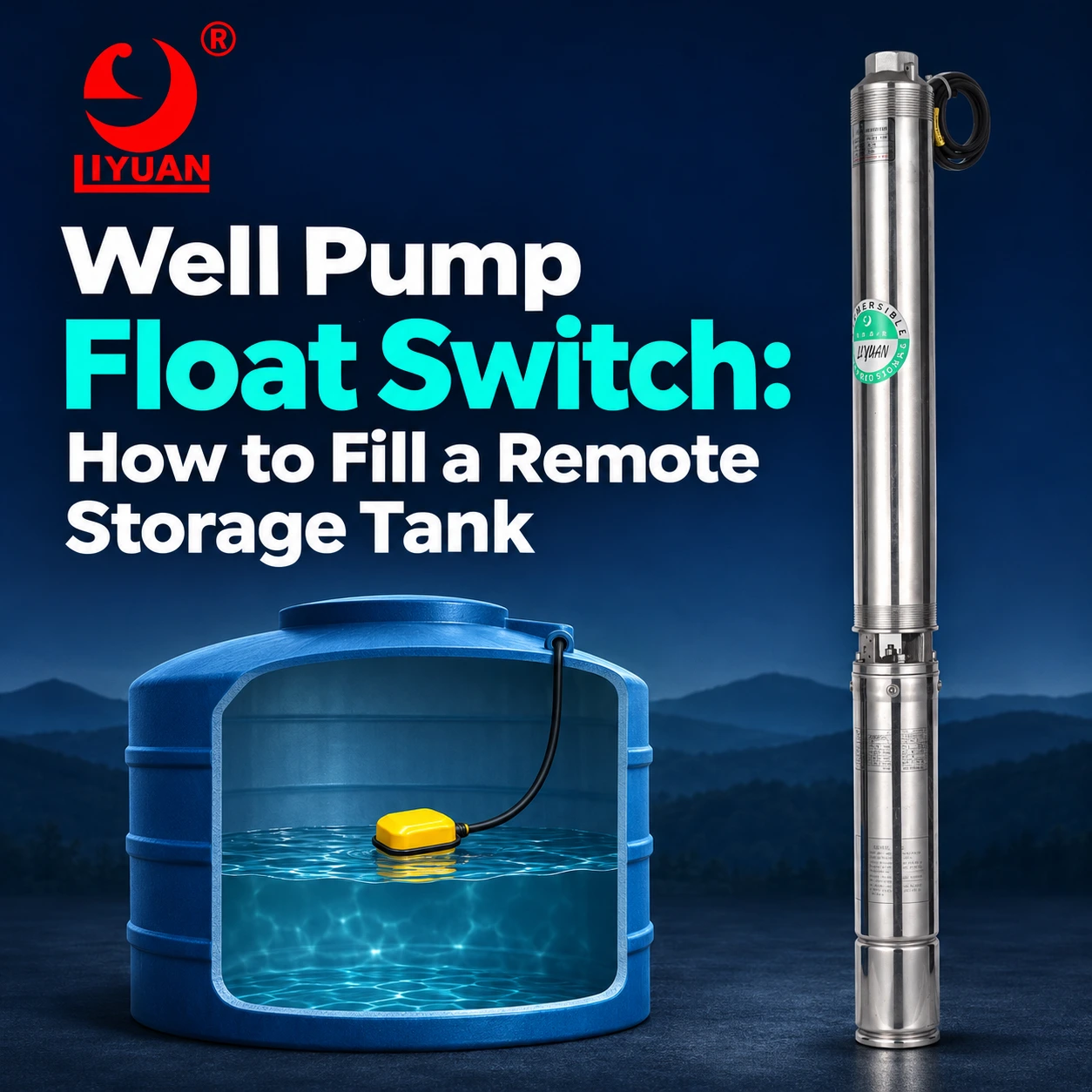
Well Pump Float Switch: How to Fill a Remote Storage Tank
A well pump float switch can stop a borehole pump when a storage tank fills and call for water when the level falls again. For a remote tank, one practical arrangement puts the float in the tank and the motor starter near the well. The float reports the water level; the starter switches power to the motor. The well still needs its own protection if it runs short of water. efotg.sc.egov.usda.gov
Before you order, answer three questions: Does the switch call for filling or draining? What electrical load will its contacts switch? How far must the signal actually travel? A product listing that says “automatic float switch, 10 m cable” does not answer all three.
Which well pump float switch fills a tank instead of draining it?
Look for pump-up or tank-filling operation. A filling system starts at the lower level and stops at the upper level. A sump pump normally needs the opposite sequence: it starts as the water rises and stops after it drains the sump. Two floats can look identical and still produce opposite results. sjerhombus.com
Give the supplier the desired sequence in plain English: Start the well pump when the tank falls to the refill mark. Keep it running until the tank reaches the full mark. Do not start it again until the level falls back to the refill mark. That last sentence matters: it keeps the pump from restarting as soon as someone draws a bucket of water.
Do not order by the words “normally open” or “normally closed” alone. Ask which position opens or closes the contact and how the panel interprets that state. For example, SJE Rhombus’s SignalMaster data sheet distinguishes a high-level switch, a low-level switch and a changeover version. It describes control-panel and alarm duties, not a universal well-motor switch. sjerhombus.com
Can I use a livestock float valve instead?
A mechanical float valve closes the water inlet. An electrical float switch changes a signal. If an existing pressure-controlled supply already stops its pump when demand ends, the valve may be all the tank needs. If a manually switched well pump discharges directly into an open tank, closing a valve can leave the pump running against a closed outlet. In that case, specify how the motor will stop; do not just fit a valve to the hose. efotg.sc.egov.usda.gov
Should the tank float carry the motor current?
In a panel-controlled system, the float sends a command; the starter carries the motor load. Ask the panel supplier for the input type and its electrical rating, then match the float to that input. A float with a large amp rating will not necessarily operate reliably on a low-current electronic input. Some switch manufacturers specify a minimum load as well as a maximum. sjerhombus.com
A direct-acting pump switch does a different job. Consider one only if its manufacturer rates it for the motor’s voltage, phase, running current and starting duty, and the motor manufacturer permits that arrangement. A general-purpose rating such as “10 A” is not a motor-starting rating. sjerhombus.com
This distinction matters even on a small farm. In an AgTalk discussion about a stock tank, an owner described repeated contact damage on a float switch serving a 1.5 hp well pump. The post does not establish the cause. It does show why the first question for a replacement is not “Which brand of float?” but “What do those contacts actually switch?” talk.newagtalk.com
How far can a remote tank float switch be from the well?
Start with the installed route from the panel input to the tank sensor, not the map distance between the well and the tank. Follow the planned conduit, changes in elevation, tank entry and final drop to the switch. Record the motor cable separately. Its length, current and voltage-drop checks answer a different question.
Liyuan’s C1-S2 and C3-SP1 catalog pages list a maximum level-sensor transmission distance of 200 m (about 656 ft). They also list float-switch and electrode-probe inputs. They do not specify that every float, probe, cable or splice combination will work across 200 m. Nor does that figure describe the length of cable in the box or the allowable depth of the pump. liyuan-pump.com
| Illustrative site layout | What the buyer can conclude |
|---|---|
| The panel-to-sensor cable route measures 165 m, including the drop inside the tank. | The route falls below the catalog figure. Ask Liyuan to confirm the selected sensor, cable and input at 165 m before ordering. |
| The tank is 180 m away on the map, but the cable must follow a fence. The installed route totals 215 m. | The proposed direct sensor run exceeds the published figure. Do not approve it as a 180 m installation. |
| The tank has no mains power and a road separates it from the well. | Ask whether a compatible passive float can use an approved wired route. If trenching is impractical, price a separate remote link, including transmitter power and loss-of-signal behavior. |
The Missouri Livestock Watering Systems Handbook, section 8.6.2, illustrates a remote tank float signaling a relay at the pump. It explains the layout; it does not set a cable specification for a Liyuan controller. If you move the panel closer to the tank to shorten the signal route, have the installer reassess the motor power circuit as well. efotg.sc.egov.usda.gov
Which Liyuan control box should you ask about?
Start with the motor nameplate. Then match the level-control input. These examples come from Liyuan’s 2026 control-box catalog, PDF pages 3–4; the public Liyuan catalog, printed pages 18–19, also shows the control options. liyuan-pump.com
| Motor at the well | Catalog starting point | What still needs confirmation |
|---|---|---|
| 220 V single-phase, 0.37–2.2 kW | C1-S2 family; float or electrode input | Exact version, motor current, capacitor arrangement and sensor circuit |
| 380 V three-phase, 0.75–4 kW | C3-SP1; float or electrode input | Motor current, enclosure location and approved cable for the actual run |
| 380 V three-phase, 5.5–7.5 kW | Request the specific 5.5–7.5 kW unit | The 2026 control-box table calls it C3-SP2; an earlier public listing uses C3-SP1. Obtain the order code, nameplate and matching manual before purchase. |
For a 1.5 kW single-phase motor, for example, the power falls within the C1-S2 range. That alone does not tell you whether to order a unit with or without a capacitor. If the motor already has a starting box, send a photograph of its label and use the well pump control box replacement checks before removing it. Likewise, neither a 220 V rating nor a 380 V rating establishes compatibility with a 115 V or 460 V installation. liyuan-pump.com
How far apart should the start and stop levels be?
Choose the volume between the two levels, not a universal number of inches. That volume determines how much water the tank gains per cycle. A tall, narrow cistern and a wide stock tank can store very different amounts between two marks 20 cm apart.
Suppose a vertical, straight-sided tank has a horizontal area of 3 m², and you set the refill mark 0.40 m below the stop mark. The working volume is 3 × 0.40 = 1.2 m³, or 1,200 L. If the pump delivers 6 m³/h at the tank inlet, it takes 12 minutes to refill that band with no simultaneous draw. If livestock draw a steady 2 m³/h during filling, the net refill rate drops to 4 m³/h, and the run takes 18 minutes.
Use the tank manufacturer’s volume chart for a horizontal cylinder or an irregular tank. Compare the expected run time and starts with the motor manufacturer’s limits. Also leave clearance for the float to move without hitting the wall, ladder or inlet pipe. For a narrow tank, ask whether two separate level points and a compatible controller would give a more reliable start/stop band than one swinging float.
That calculation can also explain a pump that never reaches the stop mark. If users draw water as fast as the pump delivers it, the level will not rise even with a working switch. Check delivery at the tank before buying a replacement float.
What should happen if the well runs low or the float signal fails?
A low tank requests water. It does not prove that the well can supply it. If the source runs low while the tank still calls for filling, the source protection should stop the pump and govern when it can restart. Liyuan lists sensor-free dry-run protection on the two controller pages. “Sensor-free” refers to that protection function; it does not mean the controller knows the level in a distant tank without a signal. See well pump dry-running protection if your well recovers slowly. liyuan-pump.com
For an unattended tank, ask the installer to document three responses before handover:
- A broken signal wire or lost radio link: Does the pump stop, continue its last command, or keep filling? How will anyone know that the signal failed?
- A float stuck below the stop level: If overflow would flood a building or waste scarce water, specify an independent high-level alarm or shutdown and a safe overflow route. A second alarm that relies on the same stuck float cannot detect that fault.
- Power returning to a full tank: Verify that the system reads the actual tank level before it resumes pumping. Also verify the agreed restart policy after a dry-well trip.
These are acceptance checks, not instructions to disconnect live wires or run a pump dry. Have a qualified installer verify them using the equipment manufacturer’s test procedure.
What to send for a remote tank control quotation
Send Liyuan Pump two photographs and a sketch: the motor nameplate, the existing control-box label, and the actual cable route. Mark the lower refill level, upper stop level and overflow on the sketch. State whether the tank has power and whether the pump serves anything besides this tank.
Here is a request a supplier can act on:
Our 380 V, three-phase, 3 kW well pump fills one open storage tank. The panel-to-float cable route measures 165 m. The panel stays at the well; the tank has no mains supply. We need low-level start, high-level stop, and a stop with an alarm if the level signal fails. Please identify the controller and sensor, confirm the cable requirements, and itemize any separate alarm, starter or interface. The motor nameplate and tank sketch are attached.
Ask for the control sequence and exact part numbers in the reply. That is what tells you whether the offer covers an automatic tank-filling system or only a switch with a length of cable.
Email:Liyuan@liyuan-pump.com
WhatsApp:+86 181-2828-2767