A Stainless Steel Deep Well Pump Provides Strong Corrosion Resistance, High Pressure, And Reliable Performance For Residential, Agricultural, Municipal, And Industrial Wells.
However, Stainless Steel Grade Alone Does Not Determine Pump Quality. Buyers Must Also Evaluate Flow, Total Dynamic Head, Motor Power, Sand Content, Water Chemistry, And Operating Hours.
What Is A Stainless Steel Deep Well Pump?
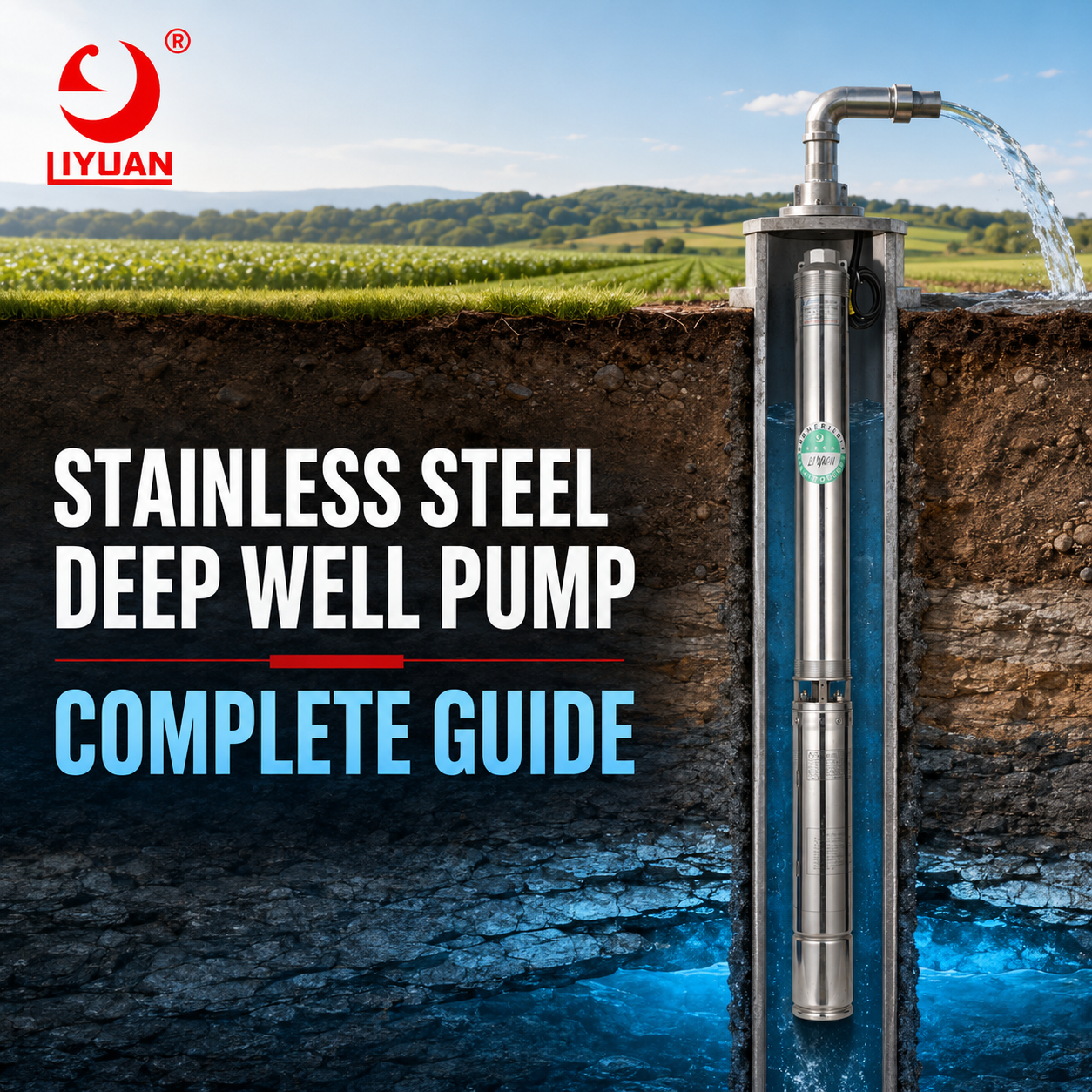
A Stainless Steel Deep Well Pump Is A Multistage Centrifugal Pump Designed To Operate Below The Water Level Inside A Borehole.
The Pump Uses Multiple Impellers And Diffusers To Increase Water Pressure. Meanwhile, A Sealed Submersible Motor Drives The Pump Shaft.
Manufacturers Use Stainless Steel For The Pump Casing, Shaft, Impellers, Coupling, Intake, And Other Critical Components. However, The Exact Material Configuration Varies Between Models.
Buyers Can Explore Liyuan Pump’s Complete Range Of Submersible Pumps For Different Well Sizes And Water Supply Applications.
How Does A Stainless Steel Deep Well Pump Work?
The Motor Converts Electrical Energy Into Mechanical Rotation. Next, The Pump Shaft Transfers This Rotation To The Impellers.
Each Impeller Adds Energy To The Water. The Diffuser Then Converts Water Velocity Into Pressure. As Water Passes Through More Stages, The Discharge Head Increases.
Finally, The Pump Pushes Water Through A Check Valve And Drop Pipe. The Water Then Enters A Pressure Tank, Storage Tank, Irrigation Network, Or Municipal Pipeline.
The Guide On How A Submersible Well Water Pump Works Provides More Information About This Process.
Why Choose Stainless Steel?
Stainless Steel Forms A Thin Protective Oxide Layer On Its Surface. This Layer Helps The Material Resist Rust And Corrosion.
Therefore, Stainless Steel Pumps Often Last Longer Than Basic Cast-Iron Models In Demanding Water Conditions.
Main Advantages Include:
- Strong Corrosion Resistance
- High Mechanical Strength
- Clean And Smooth Surfaces
- Good Temperature Resistance
- Lower Contamination Risk
- Long-Term Dimensional Stability
- Reliable Performance Under Pressure
- Suitability For Potable Water
- Reduced Surface Coating Requirements
However, No Stainless Steel Grade Resists Every Chemical. Buyers Must Match The Material To The Actual Water Analysis.
AISI 304 Vs AISI 316 Stainless Steel Pumps
304 Stainless Steel
AISI 304 Is A Common Stainless Steel Grade For Clean Freshwater Pumps.
It Offers A Good Balance Of Corrosion Resistance, Strength, Availability, And Cost. Therefore, It Works Well For Residential Wells, Farms, And General Water Supply Systems.
Typical Applications Include:
- Clean Groundwater
- Household Water Supply
- Agricultural Irrigation
- Rainwater Systems
- Storage Tank Transfer
- Light Industrial Water Supply
However, High Chloride Levels Can Increase The Risk Of Localized Corrosion.
316 Stainless Steel
AISI 316 Contains Molybdenum, Which Improves Resistance In Chloride-Bearing Environments.
Therefore, It Often Performs Better In Coastal Areas, Mildly Saline Groundwater, Food Processing, And Some Industrial Applications.
Typical Applications Include:
- Mildly Saline Water
- Coastal Groundwater
- Chloride-Containing Water
- Food And Beverage Facilities
- Chemical Process Water
- Demanding Industrial Systems
The Correct Choice Still Depends On Chloride Concentration, Temperature, pH, And Other Chemicals. AISI 316 Does Not Automatically Suit Seawater Or Highly Aggressive Fluids.
| Feature | AISI 304 | AISI 316 |
|---|---|---|
| General Corrosion Resistance | Good | Better |
| Chloride Resistance | Moderate | Higher |
| Freshwater Applications | Excellent | Excellent |
| Mildly Saline Water | Limited | More Suitable |
| Material Cost | Lower | Higher |
| Typical Use | Residential And Agricultural | Coastal And Industrial |
Which Pump Components Should Use Stainless Steel?
Some Pumps Use A Stainless Steel Outer Casing But Contain Plastic Or Cast-Iron Internal Components. Therefore, Buyers Should Review The Complete Material List.
Important Components Include:
- Pump Casing
- Pump Shaft
- Impellers
- Diffusers
- Intake Screen
- Discharge Head
- Motor Casing
- Coupling
- Fasteners
- Check Valve
A Full-Stainless-Steel Hydraulic Structure Usually Offers Better Durability. However, Engineered Polymer Impellers Can Also Work Well In Clean Water.
The Best Material Combination Depends On Pressure, Temperature, Water Chemistry, Sand Content, And Budget.
Stainless Steel Pump Vs Cast-Iron Pump
| Feature | Stainless Steel Pump | Cast-Iron Pump |
|---|---|---|
| Corrosion Resistance | Higher | Moderate |
| Weight | Usually Lower | Usually Higher |
| Surface Coating | Often Unnecessary | Commonly Required |
| Potable Water Suitability | Excellent | Depends On Coating |
| Purchase Cost | Higher | Lower |
| Demanding Water Conditions | Better | More Limited |
| Long-Term Appearance | Better | Can Show Corrosion |
Cast Iron Can Provide Strong Performance In Clean Freshwater. However, Stainless Steel Offers An Advantage When Corrosion Resistance And Water Cleanliness Matter.
Main Applications
Residential Deep Wells
A Stainless Steel Submersible Pump Can Supply Water For Bathrooms, Kitchens, Washing Machines, And Gardens.
The System Usually Includes A Pressure Tank And Pressure Switch. Together, These Components Maintain Stable Pressure And Reduce Frequent Pump Starts.
Agricultural Irrigation
Agricultural Systems Use Deep Well Pumps For Drip Irrigation, Sprinklers, Greenhouses, And Livestock Watering.
Farmers Often Need High Flow And Long Operating Hours. Therefore, Pump Efficiency And Motor Cooling Become Important.
Learn More About Agricultural Applications Of Deep Well Submersible Pumps.
Municipal Water Supply
Municipal Wells Require Reliable Pumps For Groundwater Extraction, Water Treatment, And Storage Tank Filling.
These Projects Often Use Large-Diameter Pumps, Three-Phase Motors, Control Panels, And Variable Frequency Drives.
Industrial Water Systems
Factories Use Stainless Steel Pumps For Process Water, Cooling, Cleaning, And Raw Water Transfer.
Industrial Projects Require Careful Material Selection. Buyers Should Test pH, Chlorides, Temperature, Minerals, And Chemical Content Before Ordering.
The Industrial And Commercial Submersible Pump Guide Explains More Application Requirements.
Solar Water Pumping
A Stainless Steel Borehole Pump Can Operate With A Solar Controller And Photovoltaic Panels.
Solar Systems Suit Remote Farms, Villages, Livestock Projects, And Off-Grid Water Supply. However, The Pump, Controller, And Solar Array Must Match Correctly.
How To Select A Stainless Steel Deep Well Pump
Confirm The Borehole Diameter
Measure The Internal Diameter Of The Well Casing.
Common Pump Sizes Include 3-Inch, 4-Inch, 6-Inch, 8-Inch, And 10-Inch Models. The Pump Must Fit Inside The Casing With Enough Clearance For Installation And Cooling.
Never Select A Pump Based Only On The Nominal Borehole Size. Instead, Check The Pump’s Actual Maximum Outside Diameter.
Determine The Required Flow Rate
Flow Rate Represents The Volume Of Water Delivered Over Time.
Common Units Include:
- Cubic Meters Per Hour
- Liters Per Minute
- Liters Per Second
- Gallons Per Minute
Estimate Peak Water Demand. However, The Selected Flow Must Not Exceed The Well’s Sustainable Yield.
An Oversized Pump Can Lower The Water Level Too Quickly. As A Result, The Pump May Run Dry Or Draw Excessive Sand Into The Well.
Calculate Total Dynamic Head
Total Dynamic Head Represents The Pressure That The Pump Must Overcome.
Use This Simplified Formula:
Total Dynamic Head = Vertical Lift + Required Discharge Pressure + Pipe Friction Loss
For Example:
- Dynamic Water Level: 80 Meters
- Tank Elevation: 15 Meters
- Required Pressure: 25 Meters
- Pipe Friction Loss: 10 Meters
Therefore:
Total Dynamic Head = 80 + 15 + 25 + 10 = 130 Meters
The Pump Must Deliver The Required Flow At Approximately 130 Meters Of Head.
Check The Pump Performance Curve
A Performance Curve Shows The Relationship Between Flow And Head.
First, Locate The Required Flow. Next, Locate The Calculated Total Head. Their Intersection Creates The Required Duty Point.
Choose A Pump That Operates Near Its Best Efficiency Range. This Approach Reduces Energy Use, Vibration, And Component Wear.
The U.S. Department Of Energy Provides Pump System Efficiency Resources For Evaluating Pump Performance And Operating Costs.
Select The Motor Power
Motor Power Must Support The Pump At The Required Duty Point.
However, A Larger Motor Does Not Automatically Improve Water Output. Excessive Power Can Increase Purchase Cost And Electrical Demand Without Improving Efficiency.
Motor Selection Depends On:
- Required Flow
- Total Dynamic Head
- Pump Efficiency
- Number Of Stages
- Voltage
- Frequency
- Starting Method
- Daily Operating Hours
Confirm Voltage And Frequency
Global Projects Use Different Electrical Standards.
Common Options Include:
- 110V Single Phase
- 220V Single Phase
- 230V Single Phase
- 380V Three Phase
- 400V Three Phase
- 415V Three Phase
- 440V Three Phase
- 480V Three Phase
- 50Hz
- 60Hz
Incorrect Voltage Or Frequency Can Reduce Performance, Increase Current, And Damage The Motor.
How Water Quality Affects Material Selection
A Water Analysis Provides Better Guidance Than Visual Inspection.
Test The Following Factors:
- pH Value
- Chloride Concentration
- Sand Content
- Water Temperature
- Total Dissolved Solids
- Mineral Concentration
- Chemical Composition
- Maximum Particle Size
The U.S. Geological Survey Explains That Groundwater Conditions And Well Depth Can Vary Significantly Between Locations.
Therefore, Buyers Should Never Assume That One Stainless Steel Grade Suits Every Well.
Can Stainless Steel Pumps Handle Sand?
A Stainless Steel Pump Can Tolerate Limited Sand When The Hydraulic Design Includes Suitable Bearings And Wear-Resistant Components.
However, Stainless Steel Alone Does Not Make A Pump Sand-Proof.
Excessive Sand Can Cause:
- Impeller Wear
- Diffuser Damage
- Bearing Wear
- Shaft Abrasion
- Motor Overload
- Reduced Flow
- Falling Pressure
- Check Valve Failure
Develop And Clean The Well Before Installation. In Addition, Place The Pump Above The Sediment Zone.
Single-Phase Vs Three-Phase Models
| Feature | Single-Phase Pump | Three-Phase Pump |
|---|---|---|
| Typical Application | Homes And Small Farms | Agriculture And Industry |
| Common Voltage | 110V–240V | 380V–480V |
| Power Capacity | Lower | Higher |
| Starting Method | Capacitor Or Control Box | Contactor, Soft Starter, Or VFD |
| Operating Efficiency | Suitable For Small Loads | Usually Higher |
| Continuous Operation | Limited By Model | Better For Larger Systems |
Single-Phase Pumps Suit Locations Without Three-Phase Electricity. However, Three-Phase Motors Usually Provide Smoother Operation At Higher Power.
Can A VFD Control The Pump?
A Variable Frequency Drive Can Adjust Pump Speed When Water Demand Changes.
Benefits Can Include:
- Soft Starting
- Stable Pressure
- Adjustable Flow
- Lower Starting Current
- Reduced Water Hammer
- Overload Protection
- Phase-Loss Protection
- Potential Energy Savings
However, The Motor Must Support VFD Operation. Installers Must Also Set Minimum Frequency, Acceleration Time, Cable Protection, And Motor Parameters Correctly.
Installation Requirements
Correct Installation Protects The Pump, Motor, Cable, And Well.
Follow These Main Steps:
- Inspect The Pump And Motor.
- Confirm The Well Diameter And Depth.
- Measure Static And Dynamic Water Levels.
- Check Motor Insulation Resistance.
- Select The Correct Drop Pipe.
- Install A Suitable Check Valve.
- Secure The Power Cable.
- Lower The Pump Carefully.
- Confirm Three-Phase Motor Rotation.
- Measure Flow, Pressure, Voltage, And Current.
Review How To Install A Submersible Pump For More Installation Information.
Maintenance And Service Life
Regular Monitoring Helps Detect Problems Before Failure Occurs.
Record The Following Data:
- Operating Current
- Supply Voltage
- Flow Rate
- Discharge Pressure
- Number Of Starts
- Water Level
- Control Panel Alarms
- Insulation Resistance
A Gradual Reduction In Flow Can Indicate Impeller Wear, Sediment Blockage, Pipe Leakage, Or Falling Groundwater Levels.
Follow The Electric Submersible Pump Maintenance Guide To Improve Reliability And Service Life.
Common Buying Mistakes
Choosing Stainless Steel By Appearance
A Polished Surface Does Not Confirm The Stainless Steel Grade. Request A Material Specification Or Inspection Report When Material Identity Matters.
Selecting Only By Horsepower
Horsepower Cannot Replace Flow And Head Calculations. Two Pumps With The Same Motor Power Can Deliver Different Performance.
Ignoring Water Chemistry
High Chloride, Low pH, Chemicals, Or Elevated Temperature Can Cause Corrosion Even In Stainless Steel.
Selecting The Maximum Head
Maximum Head Usually Occurs Near Zero Flow. Therefore, It Does Not Represent A Practical Operating Point.
Ignoring Internal Materials
A Stainless Steel Outer Casing Does Not Guarantee That Every Internal Component Uses Stainless Steel.
Oversizing The Pump
An Oversized Pump Can Cause Frequent Cycling, Excessive Drawdown, High Energy Consumption, And Premature Wear.
Information To Send The Manufacturer
Provide Complete Project Data Before Requesting A Quotation:
- Borehole Diameter
- Total Well Depth
- Static Water Level
- Dynamic Water Level
- Required Flow
- Required Outlet Pressure
- Pipeline Length
- Pipe Diameter
- Voltage And Frequency
- Water Temperature
- pH Value
- Chloride Concentration
- Sand Content
- Daily Operating Hours
- Preferred Stainless Steel Grade
Complete Data Helps The Manufacturer Select A More Accurate Pump And Motor Combination.
Why Choose Liyuan Pump?
Liyuan Pump Has Manufactured Submersible Pumps And Motors Since 1992. The Company Supports Residential, Agricultural, Industrial, And Municipal Water Projects.
Available Capabilities Include:
- 3-Inch To 10-Inch Submersible Pumps
- Stainless Steel Pump Construction
- Single-Phase And Three-Phase Motors
- 50Hz And 60Hz Models
- Custom Voltage Options
- Solar Water Pump Systems
- Pump And Motor Matching
- Control And Automation Solutions
- OEM And Custom Engineering
- Flexible Order Quantities
Buyers Can Review Liyuan Pump’s China Factory Submersible Pump Manufacturer Guide Before Requesting A Customized Solution.
Frequently Asked Questions
Is A Stainless Steel Deep Well Pump Better?
A Stainless Steel Pump Usually Provides Better Corrosion Resistance And Cleaner Water Contact Surfaces. However, The Correct Choice Depends On Water Chemistry, Flow, Head, And Budget.
Is 304 Or 316 Stainless Steel Better For A Well Pump?
AISI 304 Works Well In Clean Freshwater. AISI 316 Usually Offers Better Resistance To Chlorides And Mildly Saline Water.
Can A Stainless Steel Pump Handle Saltwater?
Standard AISI 304 Usually Does Not Suit Saltwater. AISI 316 Provides Better Resistance, But Full Seawater Applications May Require Higher Alloys Or Special Materials.
How Long Can A Stainless Steel Pump Last?
Service Life Depends On Water Quality, Pump Selection, Installation, Voltage Stability, Operating Hours, And Maintenance. Correct Selection Can Support Many Years Of Reliable Operation.
How Deep Can The Pump Operate?
Operating Depth Depends On The Available Head, Number Of Stages, Motor Power, Cable Length, And Pressure Rating.
Can The Pump Run Continuously?
A Continuous-Duty Model Can Operate For Long Periods When It Receives Adequate Cooling, Stable Voltage, And Sufficient Water Flow.
What Causes Stainless Steel Pump Corrosion?
High Chloride Levels, Low pH, Elevated Temperature, Aggressive Chemicals, Galvanic Contact, And Poor Material Selection Can Cause Corrosion.
What Information Is Required For Pump Selection?
Provide Well Diameter, Dynamic Water Level, Required Flow, Total Head, Voltage, Water Quality, And Daily Operating Hours.
Conclusion
A Stainless Steel Deep Well Pump Offers Long-Term Value When Its Material, Hydraulic Performance, And Motor Match The Actual Well Conditions.
Therefore, Buyers Should Evaluate Stainless Steel Grade, Flow, Total Dynamic Head, Water Chemistry, Sand Content, And Power Supply Before Ordering.
For Pump Selection, OEM Production, And Custom Engineering Support, Contact Liyuan Pump Through
Email:Liyuan@liyuan-pump.com
WhatsApp:+86 181-2828-2767