High Head Submersible Pump: Complete Selection Guide
A High Head Submersible Pump Must Deliver The Required Flow At The Calculated Total Dynamic Head Without Overloading The Motor Or Wasting Energy.
However, Maximum Head Alone Does Not Determine Pump Performance. Buyers Must Also Consider Dynamic Water Level, Pipe Friction, Outlet Pressure, Well Diameter, Pump Stages, And Water Quality.
What Is A High Head Submersible Pump?
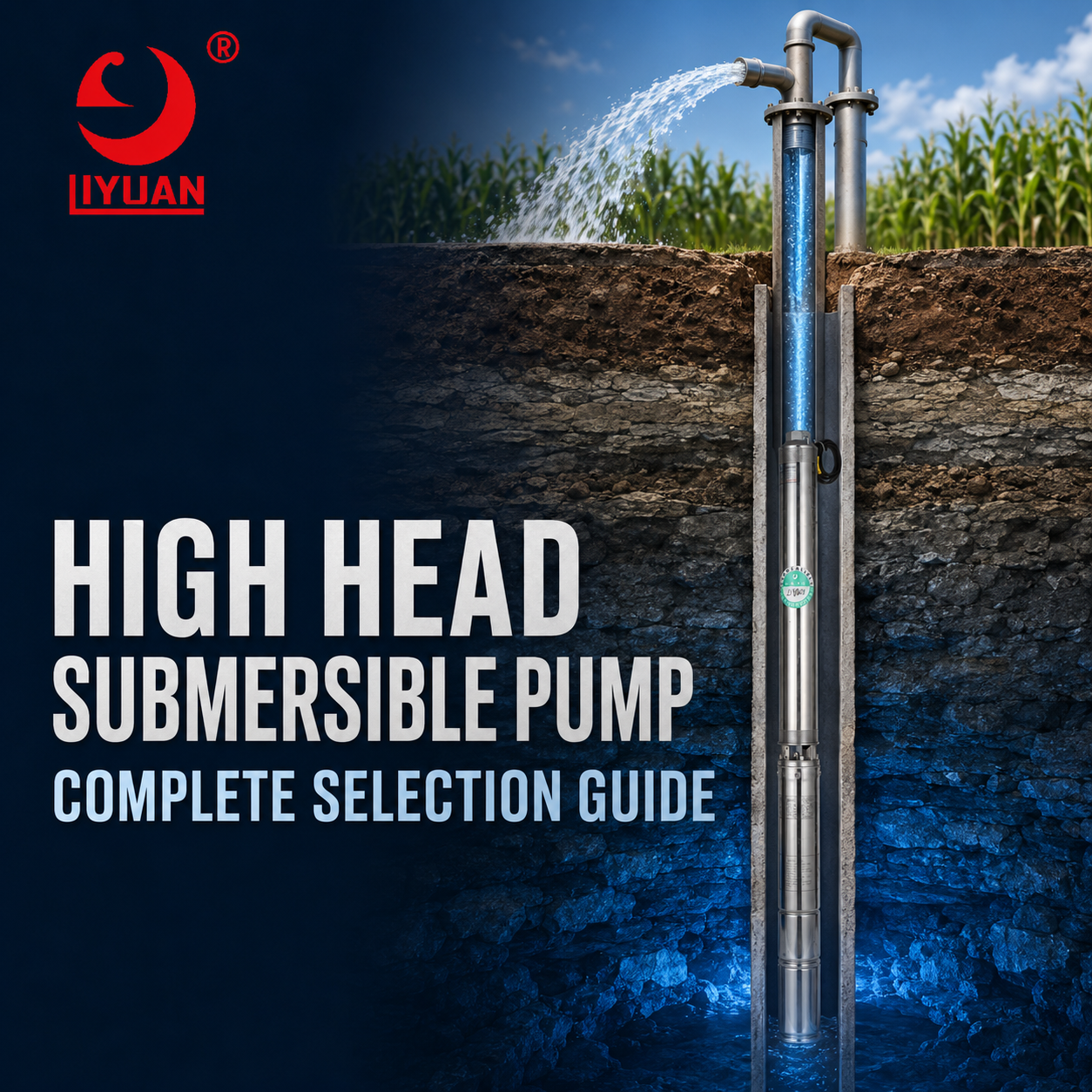
A High Head Submersible Pump Is A Multistage Centrifugal Pump Designed To Move Water Through Large Vertical Distances Or High-Pressure Pipeline Systems.
The Pump Operates Below The Water Level. Therefore, It Pushes Water Upward Instead Of Pulling Water Through A Long Suction pipe.
Each Pump Stage Contains An Impeller And Diffuser. As Water Passes Through Each Stage, Its Pressure Increases.
High-Head Models Commonly Serve Deep Wells, Boreholes, mountain water systems, municipal networks, industrial facilities, and agricultural irrigation projects.
Buyers Can Explore Different Submersible Pump Models For Residential, Agricultural, And Industrial Applications.
How Does A High Head Submersible Pump Work?
The Electric Motor Rotates The Pump Shaft. Next, The Shaft Drives Multiple Impellers At High Speed.
Each Impeller Transfers Mechanical Energy To The Water. Then, The Diffuser Converts Water Velocity Into Pressure.
One Stage Produces A Limited Amount Of Head. However, Several Stages Working In Series Can Generate Much Higher Discharge Pressure.
The Pump Finally Pushes Water Through A Check Valve, Drop Pipe, And Distribution System.
The Article On How A Submersible Well Water Pump Works Explains The Complete Operating Process.
What Does Pump Head Mean?
Pump Head Measures The Energy A Pump Adds To Water. Manufacturers Usually Express It In Meters Or Feet Of Water.
Head Does Not Represent Well Depth Alone. Instead, It Includes Every Pressure Requirement That The Pump Must Overcome.
These Requirements Include:
- Vertical Water Lift
- Required Outlet Pressure
- Elevation Above The Well
- Pipe Friction
- Valve Resistance
- Filter Resistance
- Irrigation Equipment Pressure
- Storage Tank Height
Therefore, A 150-Meter-Deep Well Does Not Always Require Exactly 150 Meters Of Pump Head.
Maximum Head Vs Operating Head
Maximum Head Represents The Highest Pressure A Pump Can Produce At Almost Zero Flow.
Operating Head Represents The Actual Pressure At The Required Flow Rate.
| Parameter | Meaning | Selection Value |
|---|---|---|
| Maximum Head | Highest Possible Head Near Zero Flow | Not Suitable Alone |
| Rated Head | Manufacturer’s Stated Operating Range | Useful Reference |
| Total Dynamic Head | Actual System Pressure Requirement | Main Selection Value |
| Shut-Off Head | Head When Discharge Flow Stops | Safety Reference |
Buyers Should Select A Pump According To The Required Duty Point. They Should Not Choose A Model Only Because Its Maximum Head Exceeds The Well Depth.
How To Calculate Total Dynamic Head
Use This Simplified Formula:
Total Dynamic Head = Vertical Lift + Required Pressure + Friction Loss
For Example:
- Dynamic Water Level: 110 Meters
- Tank Elevation Above Ground: 20 Meters
- Required Outlet Pressure: 30 Meters
- Pipe And Valve Friction: 15 Meters
Therefore:
Total Dynamic Head = 110 + 20 + 30 + 15 = 175 Meters
The Selected Pump Must Deliver The Required Flow At Approximately 175 Meters Of Head.
Convert Pressure To Head
A Practical Water Conversion Is:
1 Bar ≈ 10.2 Meters Of Water Head
For Example, A System Requiring 3 Bar Of Outlet Pressure Needs Approximately 30.6 Meters Of Additional Head.
Include Pipe Friction Loss
Water Loses Pressure As It Travels Through Pipes, Valves, Elbows, Filters, And Fittings.
Friction Loss Increases When:
- Flow Rate Increases
- Pipe Diameter Decreases
- Pipeline Length Increases
- Pipe Surface Becomes Rough
- More Elbows And Valves Are Added
Therefore, Long Or Narrow Pipelines May Require Significantly More Pump Head.
Static Water Level Vs Dynamic Water Level
Static Water Level Measures The Water Depth Before Pumping Begins.
Dynamic Water Level Measures The Water Depth While The Pump Operates At The Required Flow.
Pumping Causes Drawdown. Therefore, The Dynamic Water Level Usually Sits Lower Than The Static Level.
Always Use The Lowest Expected Dynamic Water Level When Calculating Vertical Lift. Seasonal Drought And Nearby Pumping Can Lower Groundwater further.
The U.S. Geological Survey Explains How Pumping And Seasonal Conditions Affect Well Water Levels.
How Many Pump Stages Are Required?
The Required Number Of Stages Depends On The Head Produced By Each Hydraulic Stage.
For Example, If One Stage Produces Approximately 8 Meters Of Head, A Pump Requiring 160 Meters May Need Around 20 Stages.
However, This Calculation Only Provides An Estimate. Actual Performance Depends On:
- Impeller Diameter
- Impeller Design
- Motor Speed
- Required Flow
- Hydraulic Efficiency
- Water Temperature
- Manufacturing Tolerances
Always Use The Manufacturer’s Tested Performance Curve For Final Selection.
How To Read A Pump Performance Curve
A Pump Curve Shows The Relationship Between Flow And Head.
Flow Usually Appears On The Horizontal Axis. Meanwhile, Head Appears On The Vertical Axis.
Follow These Steps:
- Locate The Required Flow Rate.
- Locate The Calculated Total Dynamic Head.
- Find The Point Where Both Values Intersect.
- Confirm That The Pump Curve Passes Through This Point.
- Check Motor Power At The Duty Point.
- Review The Pump’s Efficiency Range.
- Confirm The Allowed Operating Range.
The Best Selection Places The Duty Point Near The Pump’s Best Efficiency Point.
Operating Too Far From This Range Can Increase Vibration, Bearing Load, Energy Use, And Hydraulic Instability.
Flow Rate And High Head Performance
As Pump Head Increases, Available Flow Usually Decreases.
Therefore, Buyers Must Define Both Values:
- Required Flow Rate
- Required Total Dynamic Head
A Pump That Produces 250 Meters Of Maximum Head May Deliver Very Little Water At That Pressure.
Likewise, A Pump With A High Maximum Flow May Not Provide Enough Water At A Deep-Well Duty Point.
The Performance Curve Provides More Useful Information Than The Maximum Flow Or Maximum Head Specification.
Selecting The Correct Motor Power
Motor Power Must Support The Hydraulic Load At The Required Duty Point.
Common Power Ratings Range From Less Than 1 HP To Hundreds Of Horsepower.
Motor Selection Depends On:
- Required Flow
- Total Dynamic Head
- Pump Efficiency
- Number Of Stages
- Motor Efficiency
- Voltage
- Frequency
- Operating Hours
- Starting Method
- Safety Margin
An Undersized Motor Can Overheat And Trip. In Contrast, An Oversized Motor Can Increase Purchase Cost And Reduce System Efficiency.
For More Motor Information, Review The Deep Well Submersible Motors Guide.
Single-Phase Vs Three-Phase High Head Pumps
| Feature | Single-Phase | Three-Phase |
|---|---|---|
| Typical Application | Homes And Small Farms | Agriculture And Industry |
| Common Voltage | 110V–240V | 380V–480V |
| Power Capacity | Lower | Higher |
| Starting Method | Capacitor Or Control Box | Contactor, Soft Starter, Or VFD |
| Efficiency | Suitable For Small Loads | Usually Higher |
| High-Head Applications | Limited By Power | More Suitable |
Single-Phase Models Suit Smaller Water Systems. However, High-Head Applications Often Use Three-Phase Motors Because They Provide Greater Power And Smoother Operation.
Choosing The Correct Pump Diameter
The Pump Must Fit Inside The Borehole Casing.
Common Sizes Include:
- 3-Inch Pumps
- 4-Inch Pumps
- 6-Inch Pumps
- 8-Inch Pumps
- 10-Inch Pumps
Maintain Enough Clearance Between The Pump And Casing. This Clearance Supports Safe Installation And Motor Cooling.
A Pump That Nearly Matches The Borehole Diameter May Become Difficult To Install Or Remove.
Material Selection
Stainless Steel
Stainless Steel Provides Strong Corrosion Resistance And Good Mechanical Strength.
AISI 304 Suits Many Clean-Freshwater Applications. Meanwhile, AISI 316 Offers Better Resistance In Some Chloride-Containing Environments.
Cast Iron
Cast Iron Offers Strength At A Lower Cost. However, It May Require Protective Coatings In Corrosive Water.
Engineering Plastic
Engineering Plastic Impellers Reduce Weight And Resist Some Forms Of Corrosion.
However, Buyers Must Confirm Pressure, Temperature, And Wear Resistance.
Bronze
Bronze Provides Good Corrosion Resistance For Special Applications. Nevertheless, It Usually Costs More Than Standard Materials.
Water Quality Requirements
High-Pressure Components Can Wear Quickly When Water Contains Sand Or Abrasive Particles.
Before Ordering, Test:
- Sand Content
- pH Value
- Chloride Concentration
- Total Dissolved Solids
- Water Temperature
- Chemical Composition
- Maximum Particle Size
Excessive Sand Can Damage Impellers, Diffusers, Bearings, And Mechanical Seals.
Therefore, Buyers Should Develop And Clean The Well Before Installing The Pump.
High Head Submersible Pump Applications
Deep Residential Wells
A High-Head Pump Can Deliver Water From A Deep Borehole To A Pressure Tank Or Elevated Storage Tank.
Correct Pressure Tank Sizing Reduces Frequent Pump Starts And Extends Motor Life.
Agricultural Irrigation
Farmers Use High-Head Pumps For Sprinklers, Drip Irrigation, Greenhouses, And Long-Distance Water Transfer.
Irrigation Systems Require Both Flow And Pressure. Therefore, Buyers Must include sprinkler pressure and pipe friction in the TDH calculation.
Learn More About Agricultural Applications Of Deep Well Submersible Pumps.
Mountain Water Supply
Mountain Projects Often Transfer Water Across Large Elevation Differences.
These Systems Require Careful Pressure Calculations. Moreover, Designers May Need Pressure-Reducing Valves, Intermediate Tanks, Or Multiple Pumping Stations.
Municipal Water Systems
Municipal Boreholes Supply Treatment Plants, reservoirs, and distribution networks.
These projects often require large pumps, high-efficiency motors, VFD control, remote monitoring, and backup protection.
Industrial Water Transfer
Factories Use High-Head Pumps For Process Water, Cooling Systems, Boiler Feed Storage, And Long Pipelines.
Industrial Buyers Should Evaluate Continuous-Duty Requirements, Water Chemistry, And Energy Cost.
Can A VFD Control A High Head Pump?
A Variable Frequency Drive Adjusts Motor Speed According To Water Demand.
Potential Benefits Include:
- Soft Starting
- Lower Starting Current
- Stable Pressure
- Adjustable Flow
- Reduced Water Hammer
- Motor Overload Protection
- Phase-Loss Protection
- Potential Energy Savings
However, Reducing Speed Also Reduces Flow And Head. Therefore, The VFD Must Maintain Enough Speed To Overcome The System’s Static Head.
The U.S. Department Of Energy Provides Pump System Efficiency Resources For Improving Pump Selection And Energy Management.
Essential Protection Devices
A High-Head Pump Often Represents A Significant Investment. Therefore, The Control System Should Include Suitable Protection.
Important Devices Include:
- Dry-Run Protection
- Overload Protection
- Phase-Loss Protection
- Phase-Imbalance Protection
- Overvoltage Protection
- Undervoltage Protection
- Temperature Protection
- Surge Protection
- Water-Level Sensors
- Pressure Sensors
- Non-Return Valves
- Pressure-Relief Valves
The Electric Control Box For Submersible Pump Explains Common Control And Protection Functions.
Installation Guidelines
Correct Installation Helps The Pump Deliver Its Rated Performance.
Follow These Main Steps:
- Confirm The Well Diameter And Depth.
- Measure Static And Dynamic Water Levels.
- Inspect The Pump, Motor, And Cable.
- Check Motor Insulation Resistance.
- Select The Correct Drop Pipe.
- Install Suitable Check Valves.
- Secure The Cable Along The Pipe.
- Lower The Pump Without Impact.
- Confirm Motor Rotation.
- Test Flow, Pressure, Voltage, And Current.
Review How To Install A Submersible Pump For More Installation Guidance.
Common Selection Mistakes
Using Well Depth As Total Head
Well Depth Does Not Include Outlet Pressure, Elevation, Or Pipe Friction. Therefore, It Cannot Replace A Complete TDH Calculation.
Selecting Only By Maximum Head
Maximum Head Usually Occurs Near Zero Flow. Buyers Must Check Available Head At The Required Flow.
Ignoring Dynamic Water Level
The Water Level Falls During Pumping. Using Only The Static Level Can Lead To An Undersized Pump.
Choosing Too Many Stages
Excessive Stages Can Produce Too Much Pressure, Increase Motor Load, And Damage System Components.
Ignoring Pipe Pressure Ratings
High-Head Pumps Can Generate Significant Pressure. Therefore, Pipes, Valves, And Fittings Must Have Suitable Pressure Ratings.
Oversizing Motor Power
A Larger Motor Cannot Correct An Incorrect Hydraulic Selection. Instead, It May Increase Electrical Costs Without Improving Performance.
Maintenance Requirements
Monitor The Pump System Regularly.
Important Measurements Include:
- Flow Rate
- Discharge Pressure
- Operating Current
- Supply Voltage
- Dynamic Water Level
- Starting Frequency
- Insulation Resistance
- Control Panel Alarms
A Gradual Loss Of Head Can Indicate Impeller Wear, Pipe Leakage, Check Valve Failure, Or Falling Water Levels.
The Electric Submersible Pump Maintenance Guide Provides More Maintenance Recommendations.
Information Required For Pump Selection
Send The Following Information To The Manufacturer:
- Borehole Diameter
- Total Well Depth
- Static Water Level
- Dynamic Water Level
- Required Flow Rate
- Required Outlet Pressure
- Tank Elevation
- Pipeline Length
- Pipe Diameter
- Number Of Valves And Elbows
- Voltage And Frequency
- Water Temperature
- Water Quality
- Daily Operating Hours
- Preferred Pump Material
Complete Data Helps The Manufacturer Select A Reliable And Efficient Pump.
Why Choose Liyuan Pump?
Liyuan Pump Has Manufactured Submersible Pumps And Motors Since 1992.
Available Capabilities Include:
- 3-Inch To 10-Inch Submersible Pumps
- High-Head Multistage Designs
- Stainless Steel Pump Options
- Single-Phase And Three-Phase Motors
- Customized Voltage
- 50Hz And 60Hz Models
- Solar Water Pump Systems
- Control And Automation Solutions
- OEM And Custom Engineering
- Pump Curve Selection Support
Buyers Can Review Liyuan Pump’s China Factory Submersible Pump Manufacturer Guide Before Requesting A Project Quotation.
Frequently Asked Questions
What Is Considered A High Head Pump?
A High-Head Pump Produces Enough Pressure To Move Water Through Large Vertical Distances Or High-Resistance Pipeline Systems. The Exact Head Range Depends On The Application.
Is Maximum Head The Same As Pumping Depth?
No. Maximum Head Represents Pressure Near Zero Flow. Pumping Depth Forms Only One Part Of The Total Dynamic Head.
How Do I Calculate The Required Pump Head?
Add The Vertical Lift, Required Outlet Pressure, Pipe Friction, Valve Losses, And Equipment Pressure Requirements.
Does Adding More Pump Stages Increase Head?
Yes. Each Stage Adds Pressure. However, The Motor Must Provide Enough Power For The Complete Hydraulic Load.
Can A High Head Pump Produce High Flow?
Yes, But The Pump Must Have The Correct Hydraulic Design And Motor Power. Buyers Must Verify The Required Flow At The Actual Operating Head.
Can A VFD Reduce High Pressure?
Yes. A VFD Can Reduce Motor Speed And Pump Pressure. However, The Pump Must Still Overcome The System’s Static Head.
What Causes A High Head Pump To Lose Pressure?
Common Causes Include Impeller Wear, Pipe Leakage, Check Valve Failure, Low Voltage, Sand Blockage, Incorrect Rotation, And Falling Water Levels.
What Information Does Liyuan Pump Need?
Provide The Borehole Diameter, Dynamic Water Level, Required Flow, Total Head, Voltage, Water Quality, And Daily Operating Hours.
Conclusion
A High Head Submersible Pump Must Deliver The Required Flow At The Calculated Total Dynamic Head While Operating Inside Its Efficient Range.
Therefore, Buyers Should Calculate Vertical Lift, Outlet Pressure, Friction Loss, And Dynamic Water Level Before Selecting A Model.
For High-Head Pump Selection, OEM Production, And Custom Engineering Support, Contact Liyuan Pump Through
Email:Liyuan@liyuan-pump.com
WhatsApp:+86 181-2828-2767