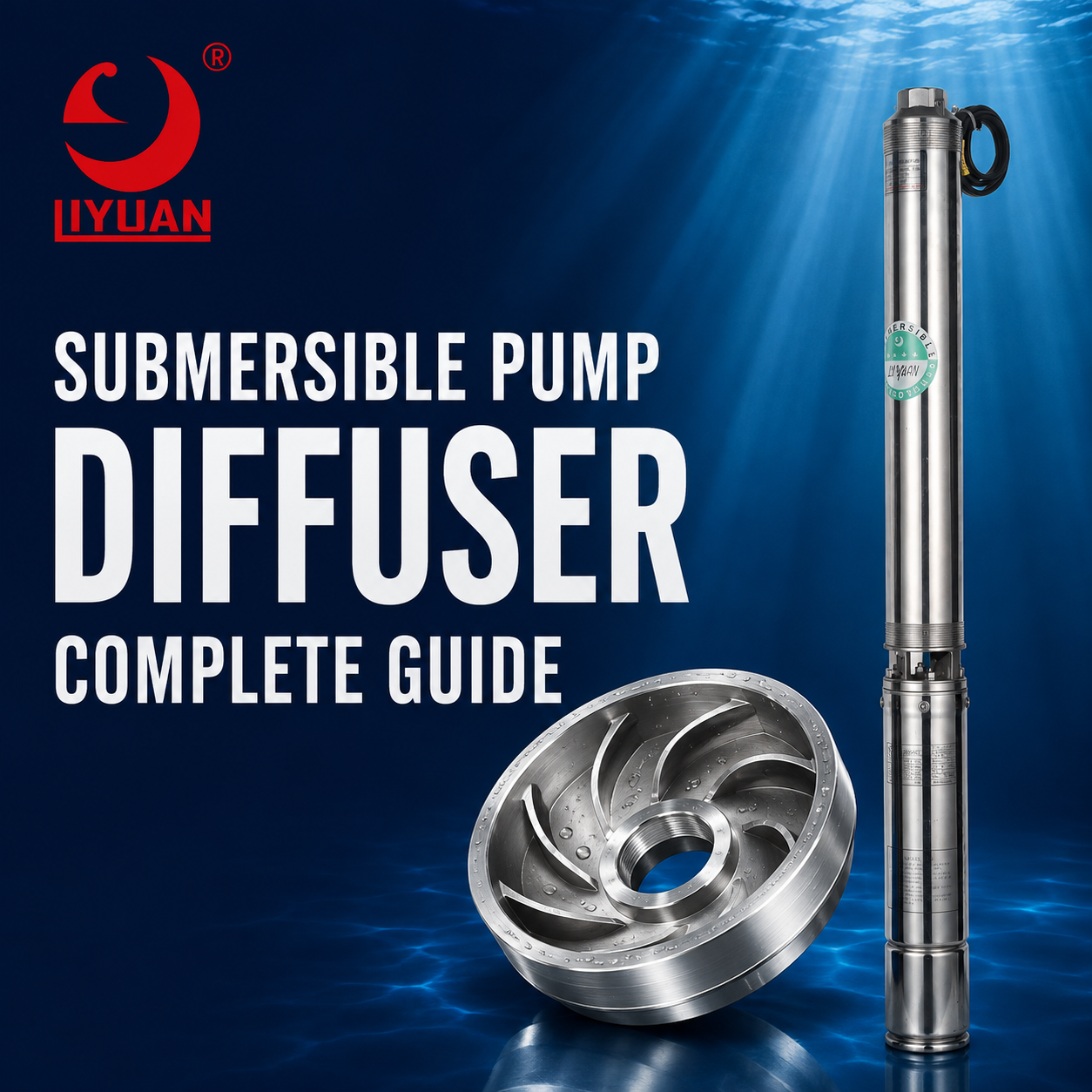
Submersible Pump Diffuser: Complete Guide
A Submersible Pump Diffuser Collects High-Velocity Water Leaving The Impeller And Converts Part Of That Velocity Into Usable Pressure. Its Vane Shape, Flow Passage, Material, Clearance, And Alignment Directly Affect Pump Head, Efficiency, Vibration, And Service Life.
In A Multistage Deep-Well Pump, Every Impeller Works With A Matching Diffuser. The Impeller Adds Energy To The Water, While The Diffuser Directs That Water Into The Next Stage.
A Worn, Blocked, Or Incorrectly Matched Diffuser Can Reduce Flow And Pressure Even When The Motor And Impellers Remain operational.
What Is A Submersible Pump Diffuser?
A Submersible Pump Diffuser Is A Stationary Hydraulic Component Installed Immediately After The Rotating impeller.
Water Leaves The Impeller At High velocity. The Diffuser Uses Expanding Flow Passages And Guide Vanes To Reduce Water Velocity And Increase static pressure.
According To The KSB Diffuser Guide, A Diffuser Reduces Flow Velocity While Increasing Static Pressure With The Lowest Practical hydraulic loss.
The Main Diffuser Components Include:
- Guide Vanes
- Expanding Flow Passages
- Front And Rear Shrouds
- Central Bearing Area
- Stage Sealing Surface
- Impeller Wear Surface
- Stage-To-Stage Outlet
- Outer Pump Casing
The Exact Structure Depends On Pump Diameter, Flow, Head, Impeller Design, Speed, And material.
How Does A Pump Diffuser Work?
The Impeller Rotates And Accelerates Water Outward. The Water Leaves The Impeller With A Combination Of Velocity And pressure.
The Diffuser Receives This Fast-Moving water.
Its Flow Passage Gradually Expands. As The Passage Area Increases, Water Velocity decreases. Part Of The Velocity Energy Changes Into static pressure.
The Basic Process Includes:
- Water Leaves The Impeller At High Velocity.
- Diffuser Vanes Collect The Water.
- Expanding Passages Reduce Water Velocity.
- Static Pressure Increases.
- Return Channels Direct Water Toward The Next Impeller.
This Process Repeats In Every Stage Of A Multistage pump.
Impeller Vs Diffuser
The Impeller And Diffuser Perform Different But Connected functions.
Impeller Function
The Impeller:
- Rotates With The Shaft.
- Receives Mechanical Power From The Motor.
- Accelerates The Water.
- Creates Flow And Velocity.
- Adds Hydraulic Energy.
Diffuser Function
The Diffuser:
- Remains Stationary.
- Collects Water From The Impeller.
- Reduces Flow Velocity.
- Converts Velocity Into Pressure.
- Directs Water Into The Next Stage.
The Pump Cannot Reach Its Designed Efficiency Unless Both Components have matching hydraulic geometry.
What Is A Pump Stage?
One Pump Stage Usually Contains:
- One Impeller
- One Diffuser
- One Stage Casing
- One Bearing Or Guide Area
- One Set Of Hydraulic Clearances
A Multistage Pump Places Several Stages In series.
Each Stage Adds Pressure To The Water. Therefore, Increasing The Number Of Stages Usually Increases Total head.
A High Head Submersible Pump May Use Many Impeller And Diffuser Stages To Produce The Required discharge pressure.
Does A Diffuser Create Pump Head?
A Diffuser Does Not Add Mechanical Energy By itself.
The Motor And Impeller Add Energy To The water. The Diffuser Recovers Part Of The Impeller’s velocity energy as pressure.
An Efficient Diffuser Converts More Velocity Into pressure with lower hydraulic loss.
An Inefficient Diffuser Can Cause:
- Turbulence
- Flow Separation
- Pressure Loss
- Reduced Head
- Higher Energy Consumption
- Vibration
- Noise
- Uneven Stage Loading
Therefore, Diffuser Design Strongly Influences The Final Pump curve.
Main Types Of Pump Diffusers
Diffusers Can Be Classified According To Water-Flow direction and pump construction.
Radial Diffuser
A Radial Diffuser Receives Water Moving Outward From A radial-flow impeller.
It Is Common In:
- High-Head Pumps
- Multistage Deep-Well Pumps
- Pressure-Boosting Systems
- Moderate-Flow Applications
Radial Diffusers Can Produce Efficient Pressure recovery in compact stages.
Mixed-Flow Diffuser
A Mixed-Flow Diffuser Handles Water Moving In Both Radial And Axial directions.
It Is Common In:
- Irrigation Pumps
- Municipal Water Systems
- Medium-Head Applications
- Higher-Flow Borehole Pumps
Mixed-Flow Designs Balance Flow Capacity And pressure generation.
Axial Diffuser
An Axial Diffuser Handles Water Flowing Primarily Parallel To The shaft.
It Is Used In:
- High-Flow Pumps
- Drainage Systems
- Flood-Control Pumps
- Low-Head Irrigation
Axial Diffusers Are Less Common In Slim, High-Head Multistage borehole pumps.
Diffuser Vanes And Return Vanes
Diffuser Vanes Receive Water Directly From The impeller.
Their Shape Controls How Quickly Water Slows And changes direction.
Return Vanes Guide Water Back Toward The Center Of The Next impeller eye.
A Poor Return-Vane Design Can Produce:
- Uneven Impeller Inlet Flow
- Excessive Swirl
- Turbulence
- Cavitation Risk
- Lower Stage Efficiency
- Increased Vibration
KSB Explains That Diffuser Elements Installed After An Impeller Convert Kinetic Swirl Energy Into pressure.
Diffuser Vs Volute Casing
Both Diffusers And Volute Casings Collect Water From an impeller, but their structures differ.
Diffuser
A Diffuser Uses Multiple Stationary Guide vanes.
It Is Well Suited For:
- Multistage Pumps
- Compact Cylindrical Pumps
- Deep-Well Pumps
- Controlled Stage-To-Stage Flow
Volute Casing
A Volute Uses A Spiral-Shaped Passage That Gradually Increases In area.
It Is Common In:
- Single-Stage Centrifugal Pumps
- End-Suction Pumps
- Surface Pumps
- Large Industrial Pumps
A Deep-Well Multistage Pump Usually Uses Diffusers Because They Fit Efficiently Inside A Narrow cylindrical casing.
Diffuser Materials
Diffuser Material Must Match Water Quality, Temperature, Sand Content, Pressure, And expected operating life.
Engineering Thermoplastic
Engineering Thermoplastic Diffusers Are Common In Residential And Light Commercial deep-well pumps.
Advantages Include:
- Corrosion Resistance
- Smooth Internal Surfaces
- Low Weight
- Consistent Molded Geometry
- Competitive Cost
Possible Limitations Include:
- Temperature Restrictions
- Abrasive Wear
- Chemical Compatibility Limits
- Deformation Under Excessive Heat
The Exact Polymer Grade And Manufacturing Quality Are important.
Stainless Steel
Stainless Steel Diffusers Provide Good Strength And Corrosion resistance.
Common Grades Include:
- AISI 304
- AISI 316
- Duplex Stainless Steel
Stainless Steel Is Suitable For Agricultural, Industrial, Municipal, And corrosive-water applications.
The Stainless Steel Deep Well Pump: Complete Guide Explains The Differences Between Common Stainless Steel grades.
Cast Iron
Cast Iron Provides High Strength And Dimensional stability.
It Is Common In Larger Industrial Pumps. However, The Material May Require Protective Coating In Corrosive water.
Bronze
Bronze Provides Good Corrosion Resistance And Wear performance.
It Can Be Used In Industrial, Marine, And Specialized water applications.
Abrasion-Resistant Alloys
High-Chromium Or Specialized Alloys Can Provide Greater Sand And particle resistance.
However, They Increase Weight And cost. They Are Not Required For Every clean-water installation.
Molded Vs Fabricated Diffusers
Diffusers Can Be Molded, Cast, Stamped, Welded, Or machined.
Molded Diffuser
A Molded Engineering-Plastic Diffuser Can Provide:
- Repeatable Vane Geometry
- Smooth Flow Surfaces
- Low Weight
- Economical Production
Mold Quality Must Remain Consistent. Flash, Distortion, Or Poor Surface Finish Can Restrict water flow.
Cast Diffuser
A Cast Metal Diffuser Can Produce Strong And Complex hydraulic shapes.
Casting Quality Must Be Controlled To Prevent:
- Porosity
- Uneven Surfaces
- Dimensional Variation
- Misalignment
- Material Defects
Stamped And Welded Diffuser
Stainless Steel Sheet Can Be Formed And Joined Into diffuser components.
Accurate Forming And Welding Are Essential For Stable stage performance.
How Diffuser Geometry Affects Efficiency
The Diffuser Passage Must Expand Gradually.
If The Passage Expands Too Quickly, Water Can Separate From The surface. This Produces Turbulence And energy loss.
Important Design Factors Include:
- Inlet Angle
- Outlet Angle
- Passage Expansion
- Vane Number
- Vane Thickness
- Surface Roughness
- Stage Clearance
- Return-Channel Shape
- Impeller-To-Diffuser Spacing
A Well-Designed Diffuser Aligns With The Water leaving the impeller.
Incorrect Angles Can Reduce Pressure recovery and increase vibration.
How Diffuser Size Affects Flow
The Diffuser’s Internal Passage Must Carry The Required water volume.
If The Passage Is Too Small:
- Head Loss Increases.
- Flow Is Restricted.
- Water Velocity Becomes Excessive.
- Sand Wear Accelerates.
- Pump Efficiency Falls.
If The Passage Is Too Large:
- Pressure Recovery May Become Inefficient.
- Flow Separation Can Occur.
- The Pump May Operate Unstably.
A High Flow Deep Well Pump Requires Wider Diffuser Passages And A Matching high-capacity impeller.
How Diffuser Clearance Affects Performance
The Gap Between The Impeller And Diffuser Creates A Controlled hydraulic clearance.
Correct Clearance Prevents Mechanical Contact While Limiting internal leakage.
Clearance Too Small
If Clearance Is Too Small:
- The Impeller May Rub The Diffuser.
- Starting Torque Increases.
- Motor Current Rises.
- Components Generate Heat.
- Plastic Parts Can Melt Or Deform.
- Metal Surfaces Can Score.
Clearance Too Large
If Clearance Is Too Large:
- Internal Leakage Increases.
- Pump Head Decreases.
- Efficiency Falls.
- Water Output Drops.
- Stage Performance Becomes Inconsistent.
Sand Wear Gradually Increases These clearances.
How Sand Damages A Diffuser
Sand Moves Through Every Pump stage.
High-Velocity Particles Strike The Diffuser Vanes, Passages, And wear surfaces.
Sand Can Cause:
- Enlarged Flow Passages
- Rounded Vane Edges
- Worn Bearing Areas
- Increased Impeller Clearance
- Scratched Surfaces
- Reduced Pressure Recovery
- Uneven Flow
- Vibration
- Lower Pump Efficiency
Fine Sand May Cause Gradual wear. Coarse Or High-Concentration Sand Can Damage Diffusers quickly.
A Sand Resistant Submersible Pump Uses Suitable Hydraulic Designs And Abrasion-Resistant Materials To Improve service life.
Can A Diffuser Become Blocked?
Yes. Diffuser Passages Can Become Blocked By:
- Sand
- Stones
- Mineral Scale
- Iron Deposits
- Biological Growth
- Broken Well Components
- Foreign Objects
- Damaged Plastic Parts
A Partial Blockage Can Reduce Flow And Create Uneven stage pressure.
A Complete Blockage Can Cause The Pump To Operate At Very Low Flow, Increasing Heat And thrust load.
Mineral Scale And Diffuser Performance
Hard Water Can Deposit Minerals Inside The diffuser passages.
Common Deposits Include:
- Calcium Carbonate
- Iron Compounds
- Manganese Compounds
- Silica
Scale Reduces The Flow Area And Changes The Hydraulic surface.
Possible Results Include:
- Reduced Flow
- Higher Friction
- Lower Efficiency
- Increased Pressure Loss
- Unstable Operation
- Difficulty During Disassembly
Chemical Cleaning Should Use Materials Compatible With The Pump’s Metals, Plastics, And elastomers.
Diffuser Wear And Pump Head Loss
A Worn Diffuser Cannot Recover Pressure efficiently.
As Wear Increases:
- Internal Leakage Rises.
- Pressure Recovery Decreases.
- Stage Head Falls.
- The Pump Runs Longer.
- Energy Consumption Increases.
- Maximum Discharge Pressure Drops.
A Multistage Pump Magnifies This Problem Because Wear Can Affect every stage.
Small Pressure Losses Per Stage Can Create A Significant Total reduction.
Diffuser Damage And Motor Load
Diffuser Damage Can Increase Or Decrease Motor load depending on the failure type.
A Blocked Diffuser May Reduce Flow And Move The Pump To A Different operating point.
A Rubbing Impeller And Diffuser Can Increase friction and motor current.
Severe Wear May Increase Internal Leakage And Reduce useful output.
Therefore, Current Alone Cannot Confirm Diffuser condition. Flow, Head, Vibration, And Electrical Data Should Be evaluated together.
Diffuser Performance At Low Flow
Operating Far Below The Recommended Flow Can Create Internal recirculation.
Water May Move Repeatedly Around The Impeller And diffuser instead of progressing smoothly through the stage.
Low-Flow Operation Can Cause:
- Turbulence
- Vibration
- Temperature Rise
- Unstable Pressure
- Increased Axial Thrust
- Erosion
- Reduced Efficiency
A Pump Should Operate Near Its Recommended duty range.
Diffuser Performance At Excessive Flow
Excessive Flow Can Produce High Water Velocity Through The diffuser passages.
Possible Results Include:
- Increased Hydraulic Loss
- Accelerated Sand Wear
- Low Pressure Recovery
- Cavitation Risk
- Motor Overload
- Vibration
- Reduced Service Life
The Pump Operating Point Depends On Both The Pump Curve And system curve.
How VFD Speed Affects The Diffuser
A Variable-Frequency Drive Changes Impeller speed and flow velocity.
At Reduced Speed:
- Flow Decreases.
- Head Decreases.
- Diffuser Velocity Decreases.
- Pump Efficiency May Change.
At Excessive Speed:
- Flow Velocity Increases.
- Head Rises Rapidly.
- Power Demand Increases.
- Hydraulic Wear Accelerates.
- Diffuser Pressure May Exceed Its Design Limit.
The Manufacturer Should Confirm The Safe Frequency range.
How Hot Water Affects Diffusers
High Temperature Can Affect Material Strength And dimensional stability.
Engineering-Plastic Diffusers May Expand Or Soften Outside Their approved temperature range.
Metal Diffusers Can Also Experience Thermal expansion that changes hydraulic clearance.
Hot Water Can Increase:
- Cavitation Risk
- Seal Wear
- Motor Temperature
- Material Stress
- Scale Formation
For High-Temperature Systems, Read The Hot Water Submersible Pump: Complete Selection Guide.
Corrosion And Diffuser Damage
Corrosive Water Can Attack Metal Diffusers And stage components.
Important Water Conditions Include:
- Low Or High PH
- Chlorides
- Salt
- Dissolved Oxygen
- Industrial Chemicals
- Elevated Temperature
Corrosion Can Roughen Flow Passages And Reduce hydraulic efficiency.
Material Selection Should Be Based On Water Analysis Instead Of appearance alone.
Cavitation Damage Around The Diffuser
Cavitation Usually Begins In Low-Pressure Areas Near The Impeller inlet. However, Vapor Bubbles Can Collapse Around Impeller Exits And diffuser entrances.
Possible Damage Includes:
- Pitted Metal Surfaces
- Eroded Plastic
- Rough Vane Edges
- Vibration
- Noise
- Reduced Efficiency
Causes Can Include Low Water Level, Restricted Intake, Excessive Flow, Hot Water, Or incorrect pump selection.
Diffuser Alignment And Stage Assembly
Each Diffuser Must Align Correctly With The Adjacent impeller and stage.
Incorrect Assembly Can Cause:
- Impeller Rubbing
- Uneven Clearances
- Blocked Return Passages
- Shaft Misalignment
- Excessive Vibration
- Reduced Head
- Motor Overload
- Premature Bearing Wear
During Repair, Keep Every Stage In The Correct sequence and direction.
Common Causes Of Diffuser Failure
Sand And Abrasive Wear
Particles Wear Vanes, Passages, And bearing areas.
Dry Running
Loss Of Water Removes Hydraulic Cooling And lubrication.
Incorrect Assembly
Reversed Or Misaligned Stages Reduce performance and cause contact.
Excessive Temperature
Hot Water Can Deform Plastic Components Or change clearances.
Chemical Attack
Aggressive Liquids Can Damage Metals And polymers.
Cavitation
Collapsing Vapor Bubbles Erode Hydraulic surfaces.
Foreign Objects
Stones Or Well Debris Can Break Vanes And block passages.
Incorrect Operating Point
Very Low Or Excessive Flow Creates Unstable hydraulic conditions.
Excessive Speed
High Speed Increases Pressure, Power, And water velocity.
Signs Of A Worn Or Damaged Diffuser
Possible Warning Signs Include:
- Reduced Pump Head
- Reduced Water Flow
- Longer Operating Time
- Higher Energy Consumption
- Abnormal Vibration
- Scraping Noise
- Unstable Pressure
- Failure To Reach Pressure-Switch Cutout
- Increased Sand In Discharge Water
- Motor Current Changes
- Repeated Overload Trips
These Symptoms Can Also Result From Impeller Wear, Low Water Level, Pipe Leakage, Incorrect Rotation, Or motor problems.
A Complete Hydraulic And Electrical inspection is required.
How To Inspect A Pump Diffuser
A Qualified Technician Should Complete The inspection.
A Typical Process Includes:
- Disconnect And Lock Out The Power Supply.
- Remove The Pump From The Well.
- Clean The Pump Exterior.
- Record The Pump Model And Stage Quantity.
- Disassemble Each Stage In Order.
- Inspect Diffuser Vanes And Flow Passages.
- Check For Sand, Scale, And Corrosion.
- Measure Hydraulic Clearances.
- Inspect The Impeller Contact Areas.
- Check Stage Bearings And Shaft Alignment.
- Replace Damaged Components.
- Reassemble Every Stage In The Correct Direction.
- Rotate The Shaft By Hand.
- Complete A Performance Test.
Photographing Each Stage During Disassembly Can Reduce assembly errors.
Can A Diffuser Be Repaired?
Repair Depends On Material And Damage level.
Small Thermoplastic Diffusers Are Usually replaced instead of repaired.
Large Metal Diffusers May Sometimes Be Restored By Specialized machining or coating. However, Their Original Hydraulic Geometry Must Be maintained.
Replace The Diffuser When It Has:
- Broken Vanes
- Severe Sand Wear
- Excessive Clearance
- Heat Deformation
- Deep Corrosion
- Cracks
- Damaged Bearing Areas
- Blocked Passages That Cannot Be Cleaned
A Repaired Diffuser Must Still Match The Original impeller.
Should Impellers And Diffusers Be Replaced Together?
Not Always. However, They Should Always Be inspected together.
A New Impeller Operating Inside A Severely Worn Diffuser May Still Produce Poor pressure and efficiency.
Likewise, A New Diffuser Cannot Fully Correct A Damaged impeller.
Replacing Matched Hydraulic Components Can Be Better When:
- Wear Is Severe.
- Sand Has Affected Every Stage.
- Clearances Exceed Limits.
- The Pump Has Lost Significant Head.
- Labor Cost Is High.
- The Pump Has Operated For Many Years.
The Repair Decision Should Consider Total Cost And expected remaining life.
How To Extend Diffuser Service Life
Use The Following Practices:
- Select The Correct Pump Duty Point.
- Avoid Dry Running.
- Install The Pump Above Sediment.
- Develop New Wells Before Pump Installation.
- Control Sand Concentration.
- Use Suitable Diffuser Materials.
- Avoid Excessive VFD Speed.
- Prevent Low-Flow Operation.
- Monitor Flow And Pressure.
- Check Three-Phase Rotation.
- Maintain Stable Voltage.
- Inspect Removed Pump Stages.
- Follow Manufacturer Maintenance Requirements.
The Electric Submersible Pump Maintenance Guide Provides Additional Preventive Maintenance information.
How To Select The Correct Diffuser
The Diffuser Must Match The Complete hydraulic stage.
Provide The Manufacturer With:
- Pump Model
- Pump Diameter
- Required Flow
- Required Head
- Number Of Stages
- Impeller Model
- Motor Speed
- Motor Power
- Voltage And Frequency
- Water Temperature
- Sand Content
- Water Chemistry
- Installation Depth
- Operating Hours
- VFD Speed Range
- Required Material
Do Not Select A Replacement Diffuser Only By Outer diameter.
Small Differences In Vane Angle, Passage Size, Bearing Position, Or stage height can change pump performance.
Why Choose Liyuan Pump?
Liyuan Pump Has Manufactured Deep-Well Submersible Pumps And Motors Since 1992.
Our Product Range Includes 3-Inch To 10-Inch Submersible Pumps, Submersible Motors, Solar Pump Systems, Control Equipment, And Customized Water-Pumping solutions.
Liyuan Pump Can Help Customers Evaluate:
- Diffuser Hydraulic Design
- Impeller And Diffuser Matching
- Required Stage Quantity
- Pump Flow And Head
- Stainless Steel And Engineering-Plastic Components
- Sand-Resistant Materials
- Hot-Water Applications
- Pump And Motor Matching
- OEM Production
- Customized Hydraulic Performance
Our Products Serve Residential, Agricultural, Industrial, And Municipal water-supply projects.
Frequently Asked Questions
What Does A Submersible Pump Diffuser Do?
It Slows High-Velocity Water Leaving The Impeller And Converts Part Of That Velocity Into pressure.
Does The Diffuser Rotate?
No. The Diffuser Remains Stationary While The Impeller rotates inside or beside it.
Is A Diffuser The Same As An Impeller?
No. The Impeller Adds Energy To The water. The Diffuser Converts Velocity Into Pressure And Directs Flow Into The Next stage.
Does Each Pump Stage Have A Diffuser?
Most Multistage Deep-Well Pumps Use One Matching Diffuser For Each impeller stage.
Can A Worn Diffuser Reduce Pump Pressure?
Yes. Worn Vanes And Enlarged Clearances Reduce Pressure recovery and stage head.
Can Sand Damage A Stainless Steel Diffuser?
Yes. Stainless Steel Resists Corrosion But Can Still Wear Under Continuous abrasive flow.
Why Is My Diffuser Rubbing The Impeller?
Possible Causes Include Incorrect Assembly, Shaft Misalignment, Bearing Wear, Sand, Heat Deformation, Or improper clearance.
Can I Use A Diffuser From Another Pump Model?
Only If The Manufacturer Confirms Complete Compatibility. Similar External Dimensions Do Not Guarantee Matching hydraulic geometry.
Can A Diffuser Cause Motor Overload?
Yes. A Blocked, Misaligned, Or Rubbing Diffuser Can Increase hydraulic or mechanical load.
Should I Replace Every Diffuser During Pump Repair?
Not Always. Inspect Every Stage And Replace Components That Exceed Wear or clearance limits.
Which Diffuser Material Is Best?
The Best Material Depends On Water Temperature, Sand Content, Water Chemistry, Pump Size, And expected service life.
How Can I Prevent Diffuser Wear?
Control Sand, Operate Near The Recommended Flow, Avoid Dry Running, Use Suitable Materials, And Maintain Correct stage clearances.
Conclusion
A Submersible Pump Diffuser Converts Impeller Velocity Into Pressure And Guides Water Through Every Stage Of A deep-well pump.
Diffuser Geometry, Material, Alignment, Clearance, And Surface Condition Directly Affect Head, Flow, Efficiency, Vibration, And service life.
Correct Hydraulic Matching And Regular Performance Monitoring Can Reduce Sand Wear, Pressure Loss, Motor Overload, And premature pump failure.
Email:Liyuan@liyuan-pump.com
WhatsApp:+86 181-2828-2767