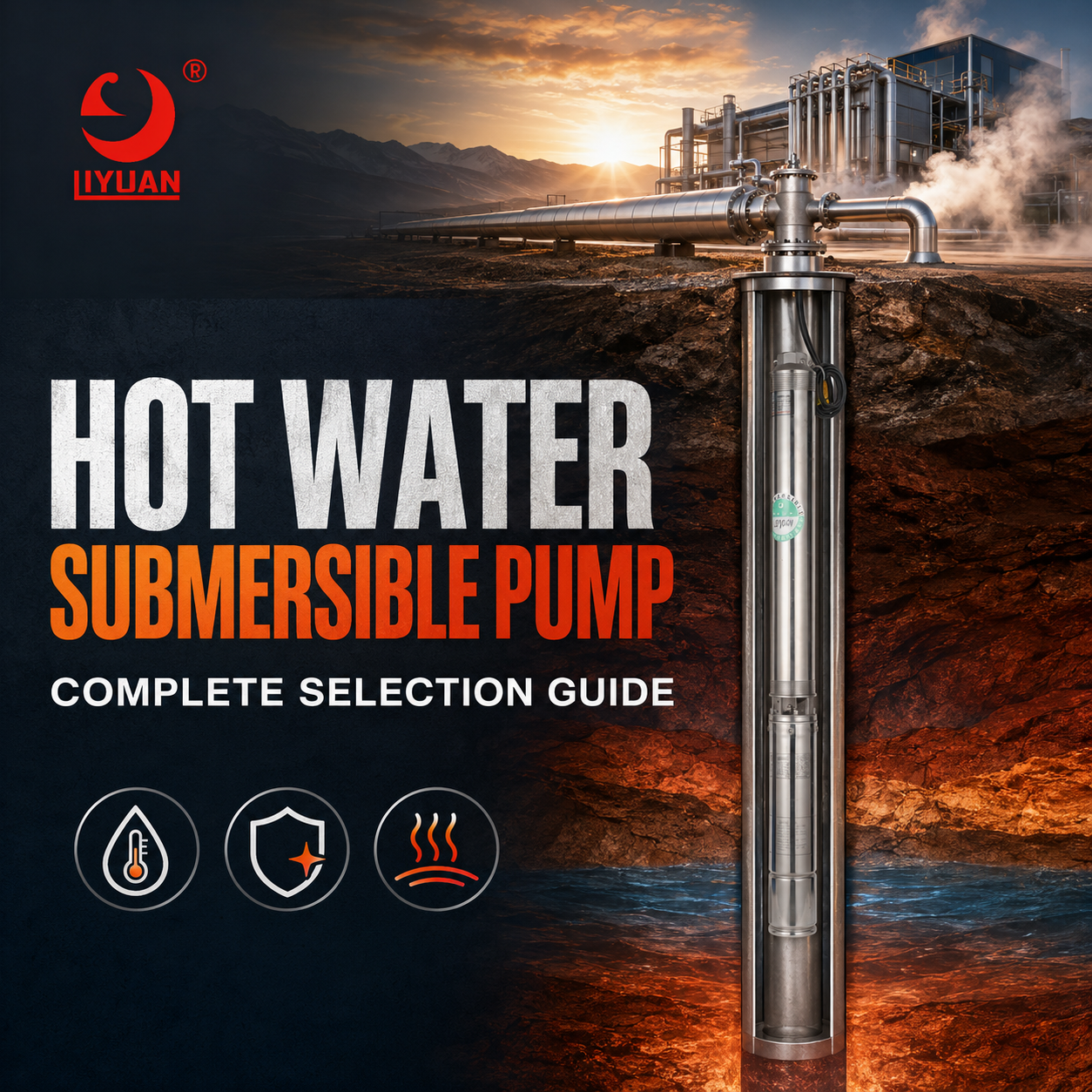
A Hot Water Submersible Pump Must Use Temperature-Rated Motors, Seals, Cables, Bearings, And Hydraulic Components While Maintaining Adequate Motor Cooling.
However, Buyers Should Never Assume That A Standard Well Pump Can Handle Hot Water. Even A Moderate Temperature Increase Can Reduce Motor Life And Damage Seals.
What Is A Hot Water Submersible Pump?
A Hot Water Submersible Pump Is A Pump Designed To Operate Fully Submerged In Water Above Normal Ambient Temperature.
It Usually Uses A Multistage Hydraulic Structure And A Sealed Electric Motor. The Pump Pushes Water Through A Drop Pipe Or Process Pipeline.
Hot-Water Models May Require:
- High-Temperature Motor Windings
- Heat-Resistant Mechanical Seals
- Temperature-Rated Power Cables
- High-Temperature Bearings
- Stainless Steel Hydraulic Components
- Suitable Elastomers
- A Motor Cooling Sleeve
- Temperature Monitoring
- Motor Power Derating
Buyers Can Review Liyuan Pump’s Range Of Submersible Pumps For Different Flow, Head, And Application Requirements.
Hot Water Pump Vs Standard Submersible Pump
A Standard Submersible Pump Is Usually Designed For Clean Water Within A Defined Temperature Range.
A Hot-Water Model Uses Components Selected For Higher Thermal Stress.
| Feature | Standard Submersible Pump | Hot Water Submersible Pump |
|---|---|---|
| Liquid Temperature | Standard Rated Range | Higher Rated Range |
| Motor Windings | Standard Insulation | Higher Temperature Capability |
| Mechanical Seal | Standard Material | Heat-Resistant Material |
| Power Cable | Standard Submersible Cable | High-Temperature Cable |
| Elastomers | Standard Rubber | Temperature-Compatible Rubber |
| Motor Cooling | Standard Water Flow | Increased Cooling Attention |
| Monitoring | Basic Protection | Temperature Monitoring Recommended |
The Exact Temperature Limit Depends On The Pump And Motor Model.
Why Hot Water Changes Pump Performance
Hot Water Changes The Operating Environment Around The Pump.
As Temperature Rises:
- Motor Cooling Becomes More Difficult
- Seal Materials Become Softer
- Cable Insulation Ages Faster
- Bearing Lubrication Changes
- Water Density Changes
- Water Viscosity Changes
- Corrosion Rates May Increase
- Mineral Deposits Can Form Faster
- Motor Winding Temperature Rises
- Cavitation Risk Can Increase In Some Systems
Therefore, Temperature Must Become A Primary Selection Parameter.
Define The Maximum Water Temperature
Do Not Select A Pump From The Average Water Temperature Alone.
Confirm:
- Normal Operating Temperature
- Maximum Continuous Temperature
- Short-Term Peak Temperature
- Startup Temperature
- Seasonal Temperature Changes
- Temperature At Pump Depth
- Daily Operating Hours
- Number Of Starts Per Hour
For Example, A System May Normally Operate At 45°C But Reach 60°C During Process Cleaning.
In This Case, The Pump Must Handle The Higher Peak Or Include Automatic Shutdown Protection.
Why Manufacturer Temperature Ratings Matter
Different Pumps Have Different Temperature Limits.
The Rating Depends On:
- Motor Design
- Insulation Class
- Seal Materials
- Cable Type
- Bearing Design
- Cooling Flow
- Pump Materials
- Installation Position
- Operating Duration
For Example, One Franklin Electric Well Pump Series Lists A Maximum Water Temperature Of 49°C With Proper Flow. This Is A Product-Specific Rating, Not A Universal Limit. Buyers Should Review The Official Product Temperature Specification Before Using Any Pump In Warm Water.
Always Request Written Confirmation For The Selected Model.
How A Hot Water Submersible Pump Works
The Motor Rotates The Pump Shaft. Next, The Shaft Drives Several Impellers.
Each Impeller Transfers Energy To The Water. Meanwhile, The Diffusers Convert Water Velocity Into Pressure.
The Pump Then Pushes Water Through A Check Valve And Pipeline.
However, The Motor Also Produces Heat During Operation. The Surrounding Water Must Remove This Heat.
Learn More About The Standard Operating Principle In How Does A Submersible Pump Work?.
Motor Cooling Is Critical
A Submersible Motor Usually Depends On Water Flow Across Its Surface For Cooling.
Cold Water Can Absorb Motor Heat More effectively than already-hot water.
Therefore, A Hot-Water Installation May Require:
- Higher Cooling Flow
- Reduced Motor Load
- A Cooling Sleeve
- Lower Starting Frequency
- A Larger Motor
- Shorter Operating Periods
- Temperature Sensors
- Thermal Shutdown Protection
Grundfos Explains That A Cooling Jacket Directs Water Across The Motor Surface To Improve Cooling.
When Is A Cooling Sleeve Required?
A Cooling Sleeve, Also Called A Flow Sleeve Or Cooling Jacket, Directs Water Around The Motor.
It May Be Required When:
- The Borehole Diameter Is Large
- The Pump Operates In A Tank
- The Pump Operates In Open Water
- Water Enters Above The Motor
- The Pump Is Installed Horizontally
- Water Velocity Around The Motor Is Low
- The Water Temperature Is High
- The Pump Runs Continuously
The Sleeve Diameter Must Create Adequate Flow Across The Motor Without Restricting The Pump Intake.
Vertical Vs Horizontal Installation
Vertical Installation Usually Supports Natural Water Flow Along The Motor.
Horizontal Installation Changes Cooling And Bearing Conditions.
A Horizontal Hot-Water Installation May Need:
- A Cooling Sleeve
- Correct Shaft Orientation
- Additional Bearing Review
- Full Motor Submersion
- Manufacturer Approval
- Temperature Monitoring
Do Not Install A Standard Vertical Pump Horizontally Without Written Manufacturer Confirmation.
Motor Insulation Class
Motor Insulation Protects The Windings From Electrical And Thermal Stress.
Common Insulation Classes Include:
- Class B
- Class F
- Class H
A Higher Insulation Class Allows A Higher Winding Temperature. However, It Does Not Automatically Increase The Allowed Water Temperature.
The Complete Motor Design Must Support The Application.
Important Factors Include:
- Winding Wire
- Insulation Resin
- Motor Filling Fluid
- Cable Entry
- Mechanical Seals
- Bearings
- Cooling Flow
- Electrical Load
Learn More About Motor Construction In What Is A Submersible Motor?.
Motor Power Derating
A Motor May Need Derating When The Water Temperature Exceeds Its Standard Rating.
Derating Means Reducing The Allowed Motor Load.
For Example, A Motor Rated For A Certain Power In Cool Water May Require A Lower Load In Hot Water.
The Required Derating Depends On:
- Water Temperature
- Motor Size
- Cooling Velocity
- Insulation System
- Installation Method
- Continuous Or Intermittent Duty
- Voltage Quality
Do Not Apply A General Derating Percentage. Request A Manufacturer Calculation For The Selected Motor.
Mechanical Seal Selection
The Mechanical Seal Prevents Water From Entering Critical Motor Areas.
Hot Water Can Change Seal-face lubrication and elastomer performance.
Important Seal Materials Include:
- Carbon
- Ceramic
- Silicon Carbide
- Tungsten Carbide
- EPDM
- FKM
- NBR
- PTFE
The Correct Combination Depends On Temperature, Pressure, Chemicals, And Water Quality.
A Seal That Works In Clean Cold Water May Fail Quickly In Hot Chemical Water.
Elastomer Compatibility
Elastomers Appear In O-Rings, Cable Seals, Mechanical Seals, And Gaskets.
Common Elastomer Materials Include:
- NBR
- EPDM
- FKM
- Silicone
- PTFE-Based Materials
Each Material Has Different Resistance To Heat, Oil, Chemicals, And Steam.
Therefore, Buyers Must Provide Both Temperature And Water Chemistry.
Submersible Cable Selection
Standard Cable Insulation May Harden, Crack, Or Deform At High Temperature.
A Hot-Water Pump Requires A Cable Rated For:
- Maximum Liquid Temperature
- Operating Voltage
- Motor Current
- Installation Depth
- Water Pressure
- Chemical Exposure
- Continuous Submersion
- Mechanical Stress
The Cable Joint Must Also Support The Same Temperature rating.
An Incorrect Splice Can Allow Water Into The Cable And Motor.
Stainless Steel Material Selection
Stainless Steel Provides Strength, Corrosion Resistance, And Clean Water Contact Surfaces.
AISI 304 Stainless Steel
AISI 304 Suits Many Clean-Water Applications.
However, Higher Temperature Can Increase Corrosion Risk In Chloride-Containing Water.
AISI 316 Stainless Steel
AISI 316 Provides Better Resistance To Chlorides Than AISI 304.
It Can Suit Hot Groundwater, Coastal Areas, And Some Industrial Applications.
However, It Does Not Resist Every Hot Chemical Solution.
Duplex And Higher Alloys
More Aggressive Water May Require Duplex Stainless Steel Or Special Alloys.
Material Selection Depends On Temperature, Chloride Level, pH, Oxygen, And Chemical Composition.
Hot Water And Corrosion
Temperature Can Accelerate Chemical Reactions.
Therefore, Hot Water May Corrode Pump Components Faster Than Cold Water With Similar Chemistry.
Test:
- pH Value
- Chloride Concentration
- Sulfate Content
- Dissolved Oxygen
- Total Dissolved Solids
- Hardness
- Chemical Additives
- Maximum Temperature
Do Not Select Materials From Temperature Alone.
Mineral Scaling
Hot Water Can Increase Mineral Deposit Formation.
Scale May Accumulate On:
- Impellers
- Diffusers
- Pump Intakes
- Motor Surfaces
- Cooling Sleeves
- Check Valves
- Pipes
- Sensors
Scale Reduces Hydraulic Efficiency And Motor Cooling.
Common Warning Signs Include:
- Falling Flow
- Rising Pressure
- Higher Motor Current
- Frequent Overheating
- Reduced Cooling Flow
- Valve Blockage
Water Treatment Or Scheduled Cleaning May Be Necessary.
Flow And Head Selection
The Pump Must Deliver The Required Flow At The Calculated Total Dynamic Head.
Use This Formula:
Total Dynamic Head = Vertical Lift + Outlet Pressure + Elevation + Friction Loss
Hot Water Changes Fluid Properties Slightly. However, The Main Selection Process Still Uses Flow And Head.
Provide The Manufacturer With:
- Required Flow
- Total Dynamic Head
- Water Temperature
- Water Chemistry
- Daily Operating Hours
- Installation Position
Check The Pump Performance Curve
Locate The Required Flow And Head On The Manufacturer’s Curve.
Choose A Duty Point Near The Pump’s Efficient Range.
Operating Too Far From This Range Can Cause:
- Higher Motor Temperature
- Increased Vibration
- Bearing Stress
- Internal Recirculation
- Reduced Cooling
- Motor Overload
- Shorter Service Life
Hot-Water Applications Have Less Thermal Margin. Therefore, Correct Duty-Point Selection Becomes Even More Important.
Continuous Vs Intermittent Duty
Continuous Duty Means The Pump Can Operate For Long Periods At Its Rated Conditions.
Intermittent Duty Limits Operating Time Or Requires Cooling periods.
A Pump Approved For Short-Term Hot-Water Use May Not Support Continuous Operation At The Same Temperature.
Confirm:
- Maximum Continuous Temperature
- Maximum Intermittent Temperature
- Maximum Operating Time
- Required Rest Period
- Maximum Starts Per Hour
- Cooling Requirements
Starting Frequency
Every Motor Start Produces Heat.
Frequent Starting Can Raise Winding Temperature Faster Than The Water Can Remove It.
Reduce Cycling With:
- A Correct Pressure Tank
- A Storage Tank
- VFD Control
- Suitable Level Controls
- Leak Repair
- Correct Pump Sizing
The Motor Manufacturer Should Confirm The Maximum Number Of Starts Per Hour.
Can A VFD Control A Hot Water Pump?
A Variable Frequency Drive Can Adjust Flow And Pressure.
Potential Benefits Include:
- Soft Starting
- Lower Starting Current
- Reduced Water Hammer
- Stable Pressure
- Adjustable Flow
- Lower Mechanical Stress
- Motor Protection
However, Low Speed Can Reduce Water Flow Across The Motor.
Therefore, Set A Minimum Frequency That Maintains Enough Cooling.
The Pump And Motor Must Also Support VFD operation.
Temperature Monitoring
Temperature Sensors Can Protect The Motor And Pump.
Useful Sensors Include:
- Motor Winding Sensors
- Bearing Temperature Sensors
- Water Temperature Sensors
- Cable Entry Sensors
- Control Panel Temperature Sensors
The Control System Can Trigger:
- Warning Alarms
- Speed Reduction
- Pump Shutdown
- Backup Pump Operation
- Remote Notification
Temperature Protection Should Complement Overload And Dry-Run Protection.
Electrical Protection
A Hot-Water Pump Should Include:
- Motor Overload Protection
- Dry-Run Protection
- Phase-Loss Protection
- Phase-Imbalance Protection
- Overvoltage Protection
- Undervoltage Protection
- Temperature Protection
- Surge Protection
- Water-Level Protection
The Electric Control Box For Submersible Pump Explains Common Control And Protection Functions.
Hot Water Submersible Pump Applications
Geothermal Wells
Geothermal Water Can Have Elevated Temperature And High Mineral Content.
These Projects Require Temperature-Rated Motors, Corrosion-Resistant Materials, And Scale Control.
Hot Spring Water Transfer
Hot Springs May Contain Minerals, Chlorides, Sulfur Compounds, And Dissolved Gases.
Therefore, Test Both Temperature And Chemistry Before Selecting The Pump.
Industrial Process Water
Factories Use Submersible Pumps For Heated Cleaning Water, Cooling Circuits, Process Tanks, And Water Transfer.
The Pump Must Match The Process Temperature And Duty cycle.
Boiler And Heating Systems
Some Systems Transfer Warm Water To Storage Or Treatment Equipment.
However, Very Hot Boiler Feed Applications May Require A Surface Pump Designed For Higher Temperature.
Food And Beverage Processing
Food Facilities May Use Hot Water For Washing And Sanitation.
Materials, seals, and hygienic requirements must match the application.
Mining And Groundwater Dewatering
Deep Underground Water Can Have Elevated Temperature.
Mining Projects Also Require Strong Materials, long cables, and reliable continuous-duty motors.
When A Submersible Pump Is Not Suitable
A Standard Submersible Pump May Not Suit:
- Boiling Water
- Steam
- High-Temperature Oil
- Aggressive Hot Chemicals
- Highly Viscous Liquids
- Flammable Liquids
- Liquids Above The Approved Rating
In These Cases, Use A Pump Designed Specifically For The Medium.
Do Not Modify A Standard Pump Without Manufacturer Approval.
Installation Checklist
Before Installation:
- Confirm Maximum Water Temperature.
- Test Water Chemistry.
- Calculate Flow And Head.
- Confirm Motor Derating.
- Verify Seal Materials.
- Check Cable Temperature Rating.
- Confirm Installation Position.
- Calculate Motor Cooling Flow.
- Select A Cooling Sleeve If Required.
- Configure Temperature Protection.
During Installation:
- Keep The Motor Fully Submerged.
- Secure The Cable And Splices.
- Install Suitable Check Valves.
- Confirm Three-Phase Motor Rotation.
- Record Water Temperature.
- Measure Flow And Pressure.
- Measure Voltage And Current.
- Confirm Cooling Flow.
- Test Temperature Shutdown.
- Record Commissioning Data.
Review How To Install A Submersible Pump For Additional Guidance.
Maintenance Requirements
Hot-Water Systems Usually Require Closer Monitoring.
Inspect:
- Flow Rate
- Discharge Pressure
- Motor Current
- Supply Voltage
- Water Temperature
- Motor Temperature
- Insulation Resistance
- Seal Condition
- Cable Condition
- Mineral Scale
- Control Panel Alarms
Follow The Electric Submersible Pump Maintenance Guide To Improve Reliability.
Common Selection Mistakes
Using A Standard Pump Without Approval
A Standard Pump May Overheat Or Experience Seal Failure In Hot Water.
Checking Average Temperature Only
Short-Term Temperature Peaks Can Damage Cables, seals, and motor insulation.
Ignoring Motor Cooling
The Motor Needs Adequate Water Flow Across Its Surface.
Choosing Materials By Temperature Alone
Water Chemistry And Temperature Work Together To Influence Corrosion.
Ignoring Cable And Splice Ratings
A High-Temperature Motor Cannot Protect A Standard Cable Joint.
Operating At Low Flow
Low Flow Can Reduce Motor Cooling And Increase Internal Hydraulic stress.
Exceeding The Starting Limit
Frequent Starts Add Heat To The Motor Windings.
Information To Send The Manufacturer
Provide:
- Maximum Water Temperature
- Normal Water Temperature
- Water Chemistry
- Required Flow
- Total Dynamic Head
- Borehole Diameter
- Installation Depth
- Installation Position
- Voltage And Frequency
- Daily Operating Hours
- Starts Per Hour
- VFD Requirements
- Preferred Pump Material
- Cable Length
Complete Information Helps The Manufacturer Select A Suitable Pump, Motor, Seal, And Cable.
Why Choose Liyuan Pump?
Liyuan Pump Has Manufactured Submersible Pumps And Motors Since 1992.
Available Capabilities Include:
- 3-Inch To 10-Inch Submersible Pumps
- Hot-Water Options On Request
- Stainless Steel Pump Construction
- Water-Filled And Oil-Filled Motors
- Temperature-Rated Seals
- Customized Power Cables
- Single-Phase And Three-Phase Models
- 50Hz And 60Hz Options
- Control And Automation Solutions
- OEM And Custom Engineering
Buyers Can Review Liyuan Pump’s China Factory Submersible Pump Manufacturer Guide Before Requesting A Customized Solution.
Frequently Asked Questions
Can A Standard Submersible Pump Handle Hot Water?
Only If The Manufacturer Approves The Water Temperature, cooling conditions, seals, cable, and duty cycle.
What Is The Maximum Temperature For A Submersible Pump?
There Is No Universal Limit. The Maximum Temperature Depends On The Specific Pump, Motor, Cable, Seal, Cooling Flow, And Operating Time.
Does A Hot-Water Pump Need A Cooling Sleeve?
It May Need One When Water Flow Around The Motor Is Insufficient, Especially In Tanks, Large Wells, Or Horizontal Installations.
Is Stainless Steel Suitable For Hot Water?
Yes, In Many Applications. However, The Stainless Steel Grade Must Match The Water Temperature And Chemistry.
Can A VFD Control A Hot-Water Pump?
Yes, If The Pump And Motor Support VFD Operation. However, The Minimum Speed Must Maintain Adequate Motor Cooling.
Why Does A Hot-Water Pump Overheat?
Possible Causes Include High Water Temperature, low cooling flow, overload, low voltage, phase imbalance, frequent starts, and blocked hydraulics.
Can The Pump Operate Continuously?
Only If The Manufacturer Rates The Pump For Continuous Operation At The Specified Temperature.
What Information Does Liyuan Pump Need?
Provide Water Temperature, Chemistry, Flow, Head, Borehole Size, Voltage, Operating Hours, Installation Position, And Cable Length.
Conclusion
A Hot Water Submersible Pump Requires Temperature-Rated Components, Adequate Motor Cooling, Correct Hydraulic Selection, And Reliable Thermal Protection.
Therefore, Buyers Should Confirm Maximum Temperature, Water Chemistry, Duty Cycle, Cable Rating, Seal Materials, And Motor Derating Before Ordering.
For Hot-Water Pump Selection, OEM Production, And Custom Engineering Support, Contact Liyuan Pump Through
Email:Liyuan@liyuan-pump.com
WhatsApp:+86 181-2828-2767