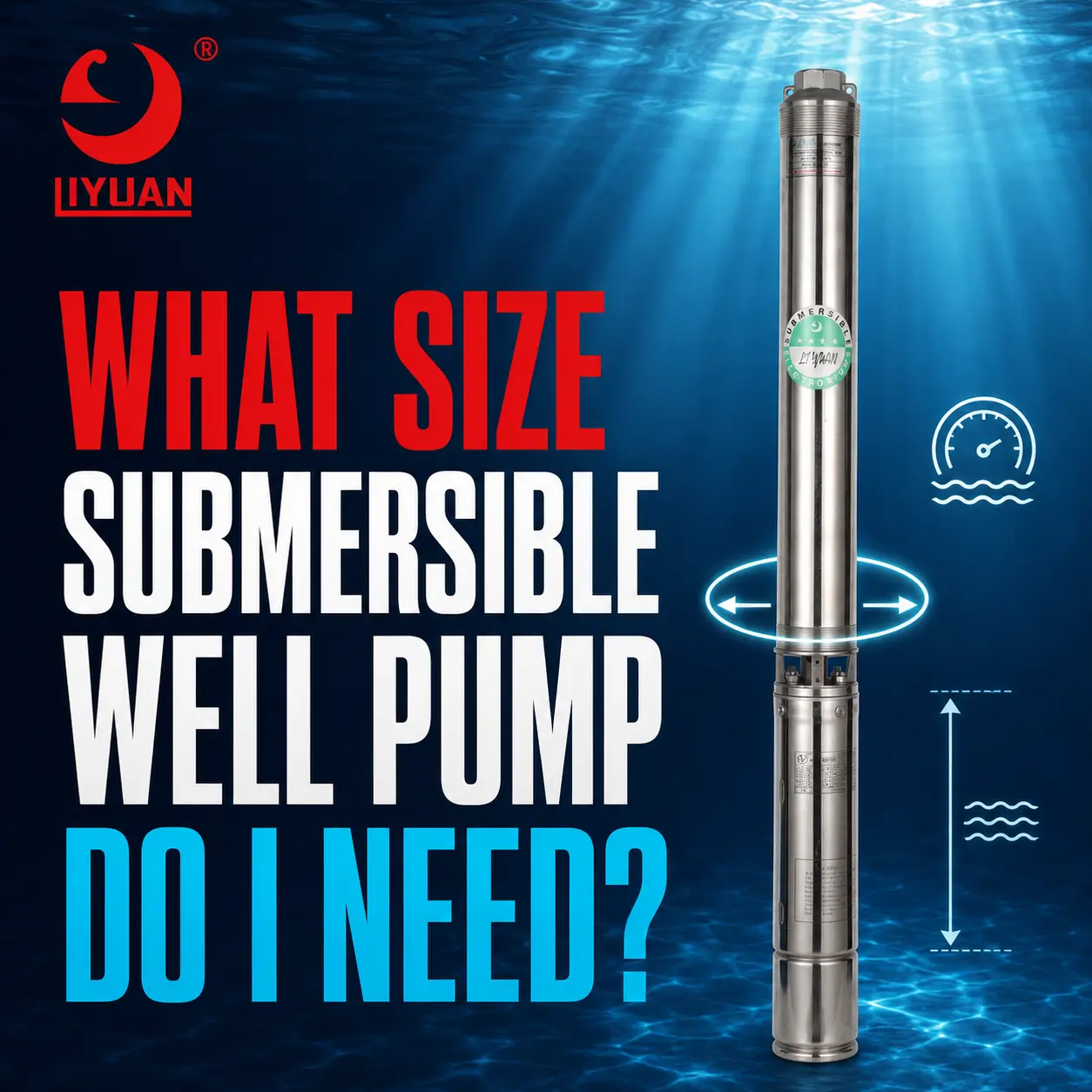
What Size Submersible Well Pump Do I Need?
The Correct Submersible Well Pump Is The Model That Delivers Your Required Flow At The Calculated Total Dynamic Head Without Exceeding The Well’s Sustainable Yield. Do Not Select A Pump From Well Depth Or Motor Horsepower Alone. Use The Duty Point, Pump Curve, Casing Diameter, Water Quality, Voltage, And Operating Schedule.
A Pump That Is Too Small Cannot Produce The Required Water Pressure. A Pump That Is Too Large Can Waste Energy, Overpump The Well, Draw Sand, Short Cycle, And Damage The Motor.
What Does Submersible Pump Size Mean?
Submersible Pump Size Can Refer To Several Different Specifications:
- Nominal Pump Diameter
- Rated Flow
- Maximum Flow
- Rated Head
- Shut-Off Head
- Motor Horsepower
- Motor Power In kW
- Number Of Pump Stages
- Discharge Connection Size
- Single-Phase Or Three-Phase Power
Saying That You Need A “2 HP Pump” Is Not Enough.
Two 2 HP Pumps Can Produce Very Different Flow And Head. One May Be Designed For Low Flow At High Head, While Another May Deliver High Flow At Moderate Head.
The Most Important Pump-Sizing Information Is The Required Duty Point:
Duty Point = Required Flow At Required Total Dynamic Head
What Information Is Required To Size A Well Pump?
Collect The Following Data Before Selecting A Pump:
| Required Information | Why It Matters |
|---|---|
| Required Flow Rate | Determines The Pump Capacity |
| Sustainable Well Yield | Limits Continuous Pump Flow |
| Static Water Level | Shows The Resting Water Level |
| Dynamic Water Level | Determines The Actual Pumping Lift |
| Total Well Depth | Helps Determine Pump Installation Range |
| Pump Setting Depth | Determines Cable And Riser-Pipe Length |
| Required Outlet Pressure | Adds Pressure Head |
| Highest Discharge Elevation | Adds Vertical Lift |
| Pipe Diameter And Length | Determines Friction Loss |
| Well Internal Diameter | Limits Pump Outside Diameter |
| Water Temperature | Affects Materials, Cooling, And Motor Rating |
| Sand Content | Affects Hydraulic Design And Wear Resistance |
| Water Chemistry | Determines Material Compatibility |
| Voltage And Frequency | Determines Motor Compatibility |
| Single-Phase Or Three-Phase | Determines Motor And Control Selection |
| Daily Operating Hours | Affects Duty And Energy Consumption |
| Starts Per Hour | Affects Motor Heating And Pressure-Tank Sizing |
Without This Information, A Manufacturer Can Only Provide A Rough Recommendation.
Step 1: Determine The Required Flow Rate
Required Flow Is The Amount Of Water The Pump Must Deliver During Peak Demand.
Common Flow Units Include:
- Liters Per Minute
- Cubic Meters Per Hour
- Gallons Per Minute
- Liters Per Second
Useful Conversions Include:
/1 Cubic Meter Per Hour = 16.67 Liters Per Minute
1 Liter Per Second = 3.6 Cubic Meters Per Hour
1 US Gallon Per Minute ≈ 0.227 Cubic Meters Per Hour
Required Flow Should Be Based On Real Water Demand, Not The Largest Pump That Fits Inside The Well.
How Do You Estimate Residential Water Demand?
Residential Pump Flow Depends On The Number Of Fixtures That May Operate At The Same Time.
Possible Water Uses Include:
- Showers
- Toilets
- Kitchen Taps
- Washing Machines
- Dishwashers
- Outdoor Irrigation
- Garden Hoses
- Water Treatment Equipment
- Livestock Watering
- Fire-Protection Storage
Do Not Simply Add The Maximum Flow Of Every Fixture Unless They Can Realistically Operate Simultaneously.
For Large Homes, Hotels, Schools, And Apartment Buildings, Use An Applicable Plumbing Fixture-Unit Method Or Local Design Standard.
How Do You Size A Pump For Irrigation?
Calculate The Flow Required By The Largest Irrigation Zone.
Add The Flow Of Every Sprinkler, Dripper, Or Irrigation Outlet Operating In That Zone.
For Example:
- 12 Sprinklers
- Flow Per Sprinkler: 1.5 Cubic Meters Per Hour
Required Zone Flow Is:
12 × 1.5 = 18 Cubic Meters Per Hour
Then Confirm That The Well Can Sustain 18 Cubic Meters Per Hour For The Required Irrigation Duration.
If The Well Yield Is Lower, Possible Solutions Include:
- Reducing Zone Size
- Using Lower-Flow Emitters
- Increasing Irrigation Time
- Installing A Water-Storage Tank
- Using A Booster Pump After The Tank
- Rotating Irrigation Zones
Review The Submersible Pump Flow Rate Before Selecting A Pump For Agricultural Or Irrigation Use.
How Do You Size A Pump For Livestock Watering?
Livestock Systems Should Consider Both Daily Water Volume And Peak Filling Demand.
Use This Preliminary Formula:
Required Pump Flow = Daily Water Demand ÷ Available Pumping Hours
For Example:
- Daily Water Demand: 60 Cubic Meters
- Available Pumping Time: 10 Hours
Required Average Flow = 60 ÷ 10
Required Average Flow = 6 Cubic Meters Per Hour
Add A Reasonable Operational Margin For Tank Filling, Seasonal Demand, Leakage, And Pump Downtime.
A Storage Tank Can Allow A Lower-Flow Well To Meet Short Periods Of High Water Demand.
How Do You Size An Industrial Well Pump?
Industrial Pump Sizing Should Include:
- Process Flow
- Cooling-Water Demand
- Cleaning Demand
- Peak Production Demand
- Storage-Tank Refill Time
- Redundant Pump Capacity
- Water-Treatment Loss
- Filter Backwash Demand
- Fire-Water Requirements
- Future Expansion
Continuous Industrial Applications May Require:
- Duty And Standby Pumps
- VFD Control
- Flow Monitoring
- Water-Level Monitoring
- Motor-Temperature Protection
- Automatic Changeover
- Remote Fault Alarms
The Pump Should Be Selected For The Normal Duty Point And Checked Across Every Expected Operating Condition.
Step 2: Confirm The Sustainable Well Yield
Well Yield Is The Rate At Which The Well Can Supply Water Under Defined Pumping Conditions.
It Should Be Established Through A Pumping Test That Records:
- Pumping Flow
- Static Water Level
- Dynamic Water Level
- Drawdown
- Pumping Duration
- Water-Level Stabilization
- Recovery After Pumping
- Sand Production
The Pump’s Continuous Flow Should Not Exceed The Sustainable Well Yield Unless The System Uses Storage And Suitable Low-Level Protection.
The U.S. Geological Survey Explains That Excessive Pumping Can Lower The Water Table Until A Well No Longer Supplies Water.
What Happens If The Pump Flow Exceeds The Well Yield?
If The Pump Removes Water Faster Than The Aquifer Supplies It, The Dynamic Water Level Falls.
Possible Results Include:
- Dry Running
- Air In The Water
- Unstable Flow
- Motor Overheating
- Increased Sand Production
- Low-Pressure Alarms
- Underload Trips
- Pump Cycling
- Reduced Pump Life
Installing A Larger Pump Does Not Increase The Natural Yield Of The Well.
How Is Well Drawdown Calculated?
Use This Formula:
Drawdown = Dynamic Water Level Depth − Static Water Level Depth
Assume:
- Static Water Level: 25 Meters
- Dynamic Water Level: 45 Meters
Then:
Drawdown = 45 − 25
Drawdown = 20 Meters
Dynamic Water Level Must Be Measured At The Intended Pump Flow. If Flow Changes, Drawdown Can Also Change.
Step 3: Calculate Total Dynamic Head
Total Dynamic Head Is The Total Hydraulic Resistance The Pump Must Overcome At The Required Flow.
Use This Formula:
TDH = Pumping Lift + Elevation Difference + Required Pressure Head + Pipe Friction Losses
Depending On The System Layout, Some Elevation Components May Already Be Included In Pumping Lift. Avoid Counting The Same Vertical Distance Twice.
What Is Pumping Lift?
Pumping Lift Is Normally Measured From The Dynamic Water Level To The Discharge Reference Point.
Do Not Automatically Use Pump Setting Depth As Pumping Lift.
For Example:
- Pump Setting Depth: 100 Meters
- Dynamic Water Level: 55 Meters
- Discharge At Ground Level
The Approximate Vertical Pumping Lift Is 55 Meters, Not 100 Meters.
The Water Above The Pump Provides Submergence. It Does Not Add An Additional 45 Meters Of Vertical Lift.
How Is Pressure Converted Into Head?
For Clean Water:
Pressure Head In Meters ≈ Pressure In Bar × 10.2
Pressure Head In Feet ≈ Pressure In PSI × 2.31
For Example, If The System Requires 3 Bar At The Outlet:
Pressure Head = 3 × 10.2
Pressure Head = 30.6 Meters
1.Pressure Requirements Can Come From:
- Household Fixtures
- Sprinklers
- Drip Irrigation
- Filtration Equipment
- Reverse-Osmosis Systems
- Industrial Machinery
- Pressure Tanks
- Elevated Storage Tanks
How Are Friction Losses Calculated?
Friction Loss Occurs As Water Moves Through:
- Riser Pipe
- Underground Pipe
- Valves
- Check Valves
- Elbows
- Tees
- Filters
- Flow Meters
- Pressure Regulators
- Heat Exchangers
- Irrigation Equipment
Friction Loss Increases With Flow Rate. A Pipe That Has Acceptable Loss At 5 Cubic Meters Per Hour May Create Excessive Loss At 20 Cubic Meters Per Hour.
Use The Actual Pipe Material, Internal Diameter, Length, Flow, And Fittings When Calculating Loss.
Total Dynamic Head Calculation Example
Assume:
- Dynamic Water Level: 45 Meters Below Ground
- Highest Discharge Point: 8 Meters Above Ground
- Required Outlet Pressure: 3 Bar
- Pipe And Fitting Losses: 6 Meters
Calculate Pressure Head:
Pressure Head = 3 × 10.2
Pressure Head = 30.6 Meters
Calculate TDH:
TDH = 45 + 8 + 30.6 + 6
TDH = 89.6 Meters
The Pump Must Therefore Deliver The Required Flow At Approximately 90 Meters Of Total Dynamic Head.
Use The Total Dynamic Head For Submersible Pump To Evaluate More Complex Systems.
Step 4: Define The Pump Duty Point
Assume The Required Flow Is:
3 Cubic Meters Per Hour
And The Calculated TDH Is:
90 Meters
The Design Duty Point Is:
3 Cubic Meters Per Hour At 90 Meters TDH
This Duty Point Should Be Plotted On The Pump Performance Curve.
The Grundfos Submersible Pump Sizing Explanation Also Identifies Required Flow And Head As The Most Important Pump-Sizing Parameters.
Step 5: Read The Pump Performance Curve
A Pump Performance Curve Shows The Relationship Between Flow And Head.
The Horizontal Axis Normally Represents:
- Flow
- Capacity
- Q
- GPM
- Cubic Meters Per Hour
- Liters Per Second
The Vertical Axis Normally Represents:
- Head
- H
- Feet
- Meters
- Pressure
The Pump’s Operating Point Is Where The Pump Curve Intersects The System Curve.
Review The Submersible Pump Performance Curve Before Selecting A Specific Model.
Where Should The Duty Point Be On The Pump Curve?
Select A Pump That Operates:
- Inside The Manufacturer’s Permitted Flow Range
- Away From Shut-Off
- Away From Maximum Runout Flow
- Near A Favorable Efficiency Region
- Within The Motor Power Limit
- Within Permitted Thrust Limits
- With Adequate Motor Cooling
Do Not Select A Pump Only Because Its Curve Barely Passes Through The Required Point.
Allow For Reasonable Variations In:
- Water Level
- Pipe Friction
- Supply Voltage
- Pressure Settings
- System Demand
- Pump Wear
The Margin Should Be Controlled And Justified. Excessive Margin Creates An Oversized Pump.
What Is Shut-Off Head?
Shut-Off Head Is The Maximum Head The Pump Produces At Zero Flow.
It Is Not The Recommended Operating Head.
Operating Near Shut-Off Can Cause:
- Low Internal Cooling Flow
- Water Heating
- Excessive Axial Thrust
- Vibration
- Bearing Stress
- Seal Damage
- Reduced Pump Life
The Pump’s Shut-Off Pressure Must Also Remain Below The Pressure Rating Of The Pipe, Valves, Tank, And Fittings.
Why Is The Best Efficiency Point Important?
The Best Efficiency Point Is The Region Where The Pump Converts Input Power Into Hydraulic Power Most Efficiently.
Operating Near A Suitable Efficiency Region Usually Provides:
- Lower Energy Consumption
- Reduced Vibration
- More Stable Hydraulic Forces
- Lower Bearing Load
- Longer Component Life
- Better Motor Loading
A Deep Well Pump Does Not Need To Operate At One Exact Point Every Second, But Its Normal Duty Should Remain Inside The Manufacturer’s Recommended Range.
Step 6: Determine The Required Motor Power
Motor Power Is Selected After Flow And Head Requirements Are Known.
For Clean Water, Preliminary Hydraulic Power Can Be Estimated With:
Hydraulic Power In kW = Flow In Cubic Meters Per Hour × Head In Meters ÷ 367
Assume:
- Flow: 3 Cubic Meters Per Hour
- Head: 90 Meters
Then:
Hydraulic Power = 3 × 90 ÷ 367
Hydraulic Power ≈ 0.74 kW
This Is Hydraulic Output Power Only.
The Motor Must Also Account For:
- Pump Efficiency
- Motor Efficiency
- Mechanical Losses
- Operating Range
- Service Factor
- Liquid Density
- Manufacturer Requirements
If Pump Efficiency At The Duty Point Is 60%:
Pump Shaft Power = 0.74 ÷ 0.60
Pump Shaft Power ≈ 1.23 kW
The Final Motor Rating Should Be Selected From The Manufacturer’s Curve And Power Data, Not From This Simplified Formula Alone.
How Is Water Horsepower Calculated In US Units?
Use This Formula:
Water Horsepower = Flow In GPM × Head In Feet ÷ 3,960
If:
- Flow: 20 GPM
- Head: 300 Feet
Then:
Water Horsepower = 20 × 300 ÷ 3,960
Water Horsepower ≈ 1.52 HP
If Pump Efficiency Is 65%:
Required Pump Shaft HP = 1.52 ÷ 0.65
Required Pump Shaft HP ≈ 2.34 HP
The Next Suitable Motor Rating Must Be Confirmed From The Manufacturer’s Published Pump Curve And Motor Data.
Does More Horsepower Mean More Water?
Not Necessarily.
Additional Horsepower Can Be Used To Produce:
- More Flow
- More Head
- More Pump Stages
- Higher Pressure
- Operation With Denser Liquid
A High-Head 2 HP Pump May Produce Less Flow Than A 1.5 HP High-Flow Pump.
Compare Flow At The Required Head Instead Of Comparing HP Alone.
How Do Pump Stages Affect Pump Size?
A Deep Well Pump Uses Multiple Impellers And Diffusers Arranged In Stages.
Adding Stages Generally Increases Head.
It Does Not Automatically Increase The Pump’s Nominal Flow.
For Example, Two Pumps May Both Be Rated For 10 Cubic Meters Per Hour, But The Model With More Stages Can Produce That Flow At A Higher Head.
Too Many Stages Can Produce Excessive Pressure And Increase Motor Load.
Step 7: Check The Well And Pump Diameter
The Pump Must Fit Through The Smallest Internal Diameter Of The Well.
Check:
- Nominal Casing Diameter
- Actual Internal Diameter
- Well Liner
- Casing Joints
- Welded Seams
- Encrustation
- Corrosion
- Well Deviation
- Cable Guard
- Cable Thickness
- Pipe Couplings
- Centralizers
A Pump Advertised As A 4-Inch Pump Does Not Necessarily Have An Exact 4-Inch Outside Diameter.
Request The Maximum Pump Diameter With The Cable Guard Installed.
What Pump Diameter Fits A 4-Inch Well?
It Depends On The Actual Casing Internal Diameter And Pump Outside Diameter.
A Nominal 4-Inch Pump May Fit Some 4-Inch Wells But Not Others Because Of:
- Different Casing Standards
- Internal Weld Beads
- Mineral Encrustation
- Well Deviation
- Liner Restrictions
- Cable-Guard Dimensions
Never Force The Pump Into A Tight Well. The Pump Must Be Removable For Future Maintenance.
Step 8: Select Single-Phase Or Three-Phase Power
Single-Phase Submersible Pump
Single-Phase Motors Are Common In Residential, Farm, And Small Commercial Systems.
They May Use:
- Two-Wire Motor Design
- Three-Wire Motor With External Control Box
- Start Capacitor
- Run Capacitor
- Starting Relay
Three-Phase Submersible Pump
Three-Phase Motors Are Common In Larger Agricultural, Industrial, And Municipal Systems.
They Usually Offer:
- Balanced Power
- Efficient Motor Operation
- Simpler Motor Construction
- Compatibility With Larger Power Ratings
- Easier VFD Integration
Review The Single-Phase Submersible Pump Vs Three-Phase Pump Before Selecting The Motor.
Always Confirm:
- Voltage
- Frequency
- Phase
- Available Transformer Capacity
- Generator Compatibility
- Starting Method
- Protection Requirements
Step 9: Check Water Quality And Pump Materials
Pump Materials Should Be Selected For The Actual Water.
Test For:
- Sand
- Silt
- Chlorides
- Salinity
- pH
- Iron
- Manganese
- Hardness
- Dissolved Gas
- Temperature
- Chemical Contamination
Stainless Steel Pump
A Stainless Steel Deep Well Pump Can Provide Improved Corrosion Resistance And Mechanical Strength.
However, Stainless Steel Grade Must Match The Water Chemistry. Standard Stainless Steel Is Not Universally Resistant To Every High-Chloride Or Chemical Environment.
Sand-Resistant Pump
A Sand Resistant Submersible Pump Can Reduce Wear In Wells Producing Limited Abrasive Particles.
It Does Not Replace Proper Well Development, Screen Repair, Or Sand-Control Measures.
Step 10: Check The Pressure Tank And Control Method
A Fixed-Speed Pump Controlled By A Pressure Switch Requires A Properly Sized Pressure Tank.
The Tank Helps:
- Limit Starts Per Hour
- Maintain System Pressure
- Reduce Motor Heating
- Provide Water Between Pump Cycles
- Reduce Contactor Wear
An Undersized Tank Can Cause Short Cycling.
Review The Submersible Pump Pressure Tank When Designing A Residential Or Commercial Pressure System.
A Variable-Speed Pump Can Maintain More Constant Pressure, But It Requires:
- Correct VFD Selection
- Pressure Sensor
- Minimum-Speed Limits
- Motor Cooling Evaluation
- Dry-Run Protection
- Harmonic Management
- Proper Drive Programming
Submersible Well Pump Sizing Example
Assume A Farm Requires:
- Required Flow: 12 Cubic Meters Per Hour
- Sustainable Well Yield: 15 Cubic Meters Per Hour
- Dynamic Water Level: 52 Meters
- Elevation To Discharge: 8 Meters
- Required Outlet Pressure: 2.5 Bar
- Friction Loss: 7 Meters
- Well Internal Diameter: 150 Millimeters
- Power Supply: 380 V, 50 Hz, Three-Phase
Calculate Pressure Head:
Pressure Head = 2.5 × 10.2
Pressure Head = 25.5 Meters
Calculate TDH:
TDH = 52 + 8 + 25.5 + 7
TDH = 92.5 Meters
The Required Duty Point Is:
12 Cubic Meters Per Hour At Approximately 93 Meters TDH
The Selection Process Is:
- Find A Pump Curve That Passes Through 12 Cubic Meters Per Hour At 93 Meters.
- Confirm The Point Is Inside The Recommended Operating Range.
- Check Pump Efficiency At That Point.
- Confirm The Pump Power Requirement Does Not Overload The Motor.
- Confirm The Pump Outside Diameter Fits The Well.
- Confirm 380 V, 50 Hz, Three-Phase Compatibility.
- Check Cable Size And Starting Method.
- Confirm The Well Can Sustain The Required Flow.
- Check Water Quality And Material Compatibility.
- Verify Shut-Off Pressure Against The Pipe And Tank Ratings.
What Happens If The Pump Is Too Small?
An Undersized Pump May Cause:
- Low Water Pressure
- Insufficient Flow
- Long Tank-Recovery Time
- Poor Irrigation Performance
- Inability To Reach Pressure-Switch Cut-Out
- Continuous Pump Operation
- Motor Heating
- Customer Complaints
A Small Pump Can Sometimes Provide Adequate Flow At Low Head But Fail When Required Pressure And Friction Loss Are Included.
What Happens If The Pump Is Too Large?
An Oversized Pump May Cause:
- Excessive Flow
- Excessive Drawdown
- Dry Running
- Sand Production
- High Motor Current
- Water Hammer
- Rapid Pressure Rise
- Short Cycling
- Energy Waste
- Increased Pipe Friction
- Excessive Shut-Off Pressure
- Bearing And Thrust Damage
Oversizing Should Not Be Used To Compensate For Missing Well Or System Data.
Can A VFD Correct An Oversized Pump?
A VFD Can Reduce Pump Speed And Flow, But It Does Not Correct Every Selection Error.
The System Must Still Meet:
- Minimum Motor Frequency
- Minimum Cooling Flow
- Permitted Pump Operating Range
- Cable-Length Requirements
- Bearing And Thrust Limits
- Harmonic Limits
- Required Maximum Demand
A Grossly Oversized Pump May Be Less Efficient And More Expensive Even With Variable-Speed Control.
Common Submersible Pump Sizing Mistakes
Selecting By Total Well Depth
Pump Selection Should Use Dynamic Water Level And TDH, Not Total Well Depth Alone.
Selecting By HP Only
Horsepower Does Not Define Pump Flow And Head.
Ignoring Well Yield
A Pump Cannot Sustainably Produce More Water Than The Aquifer Supplies.
Ignoring Required Outlet Pressure
Vertical Lift Alone Does Not Include Pressure Needed At The Final Outlet.
Ignoring Pipe Friction
Friction Can Become A Major Part Of TDH In Long Or Small-Diameter Pipes.
Selecting From Shut-Off Head
Shut-Off Head Occurs At Zero Flow And Is Not A Normal Duty Point.
Choosing The Largest Available Pump
A Larger Pump Can Cause Dry Running, Sand Production, High Current, And Energy Waste.
Ignoring Maximum Pump Diameter
Nominal Well And Pump Sizes May Not Represent Actual Internal And Outside Diameters.
Ignoring Water Quality
The Wrong Material Can Cause Corrosion, Abrasion, Or Premature Failure.
Ignoring 50 Hz And 60 Hz Differences
Frequency Changes Motor Speed, Pump Flow, Head, And Power.
Quick Pump Selection Checklist
Before Ordering, Confirm:
- Required Flow
- Total Dynamic Head
- Well Yield
- Static Water Level
- Dynamic Water Level
- Total Well Depth
- Pump Setting Depth
- Well Internal Diameter
- Pump Maximum Outside Diameter
- Water Temperature
- Sand Content
- Water Chemistry
- Voltage
- Frequency
- Phase
- Cable Length
- Pipe Diameter
- Pressure-Tank Size
- Starting Method
- Daily Operating Hours
- Starts Per Hour
- Pump Curve
- Motor Power
- Shut-Off Pressure
Frequently Asked Questions
What Size Submersible Pump Do I Need For A 100-Foot Well?
Well Depth Alone Cannot Determine Pump Size. Calculate Flow And TDH Using The Dynamic Water Level, Required Outlet Pressure, Elevation, And Friction Loss.
What Size Pump Do I Need For A 200-Foot Well?
A 200-Foot Well May Require A Small Or Large Pump Depending On The Pumping Water Level And Required Flow. The Pump Does Not Necessarily Lift Water From The Bottom Of The Well.
What Size Pump Do I Need For A 300-Foot Well?
Use The Dynamic Water Level Rather Than The Total 300-Foot Depth. Then Add Pressure Head, Elevation Difference, And Friction Loss To Calculate TDH.
Is A 1 HP Well Pump Better Than A 0.5 HP Pump?
Not Automatically. The Better Pump Is The Model That Meets The Required Flow And Head Near A Suitable Efficiency Region Without Exceeding Well Yield.
How Many GPM Should A Well Pump Produce?
The Correct GPM Depends On Peak Water Demand And Sustainable Well Yield. Residential, Irrigation, Livestock, And Industrial Systems Have Different requirements.
Can I Replace A 1 HP Pump With A 1.5 HP Pump?
Only After Comparing Pump Curves, Flow, Head, Well Yield, Pipe Pressure, Cable Size, Control Equipment, And Motor Current. A Higher-HP Replacement Is Not Automatically compatible.
Can I Replace A Well Pump With The Same Horsepower?
The Same Horsepower Does Not Guarantee The Same Performance. Match The Original Duty Point, Pump Curve, Diameter, Voltage, Frequency, And Phase.
Does A Deeper Well Need More Horsepower?
Not Necessarily. Motor Power Depends On Flow And TDH. A Deep Well With A High Static Water Level May Require Less Head Than A Shallower Well With Greater Drawdown And Pressure Demand.
Is A Higher-Flow Pump Always Better?
No. Excessive Flow Can Overpump The Well, Increase Friction Loss, Draw Sand, Waste Energy, And Reduce Pump Life.
What Is The Difference Between Rated Head And Maximum Head?
Rated Head Is Associated With A Specified Operating Flow. Maximum Or Shut-Off Head Occurs At Zero Flow And Is Not The Recommended Continuous Operating Point.
Can One Pump Supply A House And Irrigation System?
Yes, If It Meets The Combined Peak Duty Point And The Well Can Sustain The Flow. Separate Storage, Zones, Or Booster Systems May Be More Efficient For Large Irrigation Demand.
How Do I Choose Between A High-Head And High-Flow Pump?
Choose A High-Head Pump When The System Has Large Lift Or Pressure Requirements. Choose A High-Flow Pump When Water demand is high and TDH is moderate. The final selection must satisfy both flow and head.
Final Answer
What Size Submersible Well Pump Do I Need? Select A Pump That Delivers The Required Flow At The Calculated Total Dynamic Head, Operates Inside Its Recommended Curve Range, Fits The Well, Matches The Power Supply, And Does Not Exceed Sustainable Well Yield.
Do Not Order A Pump Using Only Well Depth Or Motor Horsepower.
For An Accurate Submersible Pump Selection, Send Liyuan Pump Your Required Flow, Dynamic Water Level, Total Well Depth, Outlet Pressure, Pipe Details, Well Diameter, Water Quality, Voltage, Frequency, And Phase. This Information Allows Liyuan Pump To Select The Pump Curve, Number Of Stages, Motor Power, Cable, And Control System For Your Actual Duty Point.
Email:Liyuan@liyuan-pump.com
WhatsApp:+86 181-2828-2767