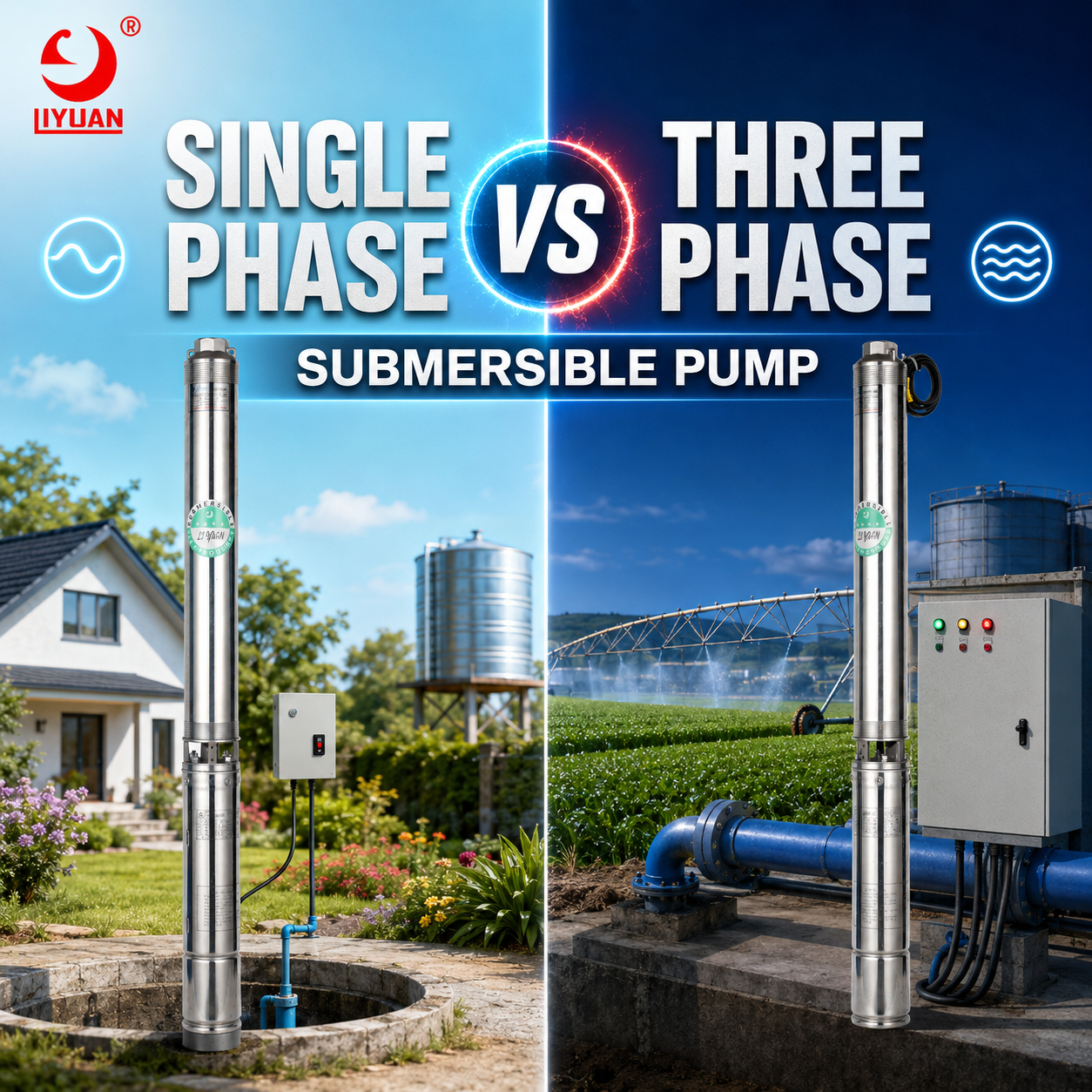
Single Phase Submersible Pump Vs Three Phase Pump
A Single Phase Submersible Pump Suits Homes And Small Farms, While A Three Phase Pump Usually Performs Better In Larger Agricultural, Commercial, And Industrial Systems.
However, Power Availability Alone Should Not Determine The Choice. Buyers Must Also Compare Motor Output, Starting Current, Efficiency, Control Method, Cable Length, Flow, Head, And Operating Hours.
What Is A Single Phase Submersible Pump?
A Single Phase Submersible Pump Uses A Single-Phase AC Power Supply To Operate Below The Water Level.
Common Voltages Include:
- 110V
- 115V
- 220V
- 230V
- 240V
The Motor Usually Requires A Starting Capacitor, Running Capacitor, Or Dedicated Control Box.
Single-Phase Pumps Commonly Supply Water For:
- Residential Wells
- Small Farms
- Gardens
- Livestock Watering
- Small Irrigation Systems
- Remote Properties
- Storage Tanks
- Light Commercial Buildings
Buyers Can Review Liyuan Pump’s Complete Range Of Submersible Pumps For Different Voltage, Flow, And Head Requirements.
What Is A Three Phase Submersible Pump?
A Three Phase Submersible Pump Uses Three Alternating Electrical Phases.
Common Voltages Include:
- 208V
- 230V
- 380V
- 400V
- 415V
- 440V
- 460V
- 480V
- 575V
Three-Phase Power Produces A Rotating Magnetic Field Inside The Motor. Therefore, The Motor Can Start And Run Without The Same Capacitor arrangement used by many single-phase motors.
Three-Phase Pumps Commonly Serve:
- Large Farms
- Commercial Irrigation
- Municipal Water Supply
- Industrial Processes
- Mining Projects
- Construction Dewatering
- Large Residential Developments
- High-Flow Boreholes
- Deep High-Head Wells
Main Differences
| Feature | Single Phase Pump | Three Phase Pump |
|---|---|---|
| Typical Application | Residential And Small Farms | Commercial And Industrial |
| Common Voltage | 110V–240V | 208V–575V |
| Available Motor Power | Lower To Medium | Medium To Very High |
| Starting Method | Capacitor Or Control Box | Starter, Soft Starter, Or VFD |
| Starting Current | Often Higher Relative To Output | Usually Better Controlled |
| Motor Efficiency | Suitable For Small Loads | Usually Higher At Larger Loads |
| Torque | More Pulsating | Smoother |
| Control Complexity | Lower | Higher |
| Installation Cost | Usually Lower | Usually Higher |
| Long-Duty Operation | Model-Specific | Often More Suitable |
The Best Choice Depends On The Actual Pumping System.
How A Single Phase Motor Works
A Single-Phase Power Supply Does Not Naturally Create A Self-Starting Rotating Magnetic Field.
Therefore, The Motor Uses An Auxiliary Starting System.
This System May Include:
- Start Winding
- Run Winding
- Start Capacitor
- Run Capacitor
- Starting Relay
- Electronic Controller
- Centrifugal Switch
- External Control Box
The Starting Circuit Creates A Phase Shift. This Phase Shift Produces Enough Starting Torque To Rotate The Motor.
Learn More About Motor Structure In What Is A Submersible Motor?.
How A Three Phase Motor Works
Three-Phase Power Uses Three Alternating Currents Separated Electrically From Each Other.
These Currents Create A Naturally Rotating Magnetic Field.
As A Result, A Three-Phase Motor Usually Provides:
- Smooth Starting Torque
- Stable Rotation
- Lower Vibration
- Better Power Distribution
- Higher Power Capacity
- Good Continuous-Duty Performance
- Easier VFD Integration
However, Incorrect Phase Sequence Can Reverse The Motor Rotation.
Installers Must Check Rotation Before Full Operation.
Two-Wire Vs Three-Wire Single Phase Pumps
Single-Phase Well Pumps May Use A Two-Wire Or Three-Wire Motor Design.
Two-Wire Submersible Pump
A Two-Wire Pump Usually Contains The Starting Components Inside The Motor.
Its Main Advantages Include:
- Simpler Surface Wiring
- No External Starting Box
- Compact Installation
- Fewer Surface Components
However, Internal Starting Components Require Pump Removal if they fail.
Three-Wire Submersible Pump
A Three-Wire Pump Uses An External Control Box.
The Control Box May Contain:
- Start Capacitor
- Run Capacitor
- Relay
- Overload Protection
- Terminal Connections
This Design Makes Some Starting Components Easier To Test And Replace.
However, It Requires More Wiring And Correct Control-Box Matching.
Power And Horsepower Range
Single-Phase Pumps Commonly Serve Lower And Medium Power Requirements.
Three-Phase Pumps Can Support Much Larger Motors.
The Correct Power Depends On:
- Required Flow
- Total Dynamic Head
- Pump Efficiency
- Motor Efficiency
- Number Of Pump Stages
- Daily Operating Hours
- Voltage
- Frequency
- Starting Method
Do Not Choose Motor Power By Well Depth Alone.
A Lower-Power Pump With The Correct Hydraulic Curve Can Outperform A Larger, Incorrectly Selected Pump.
Starting Current
Electric Motors Draw More Current During Startup Than During Normal Operation.
Single-Phase Motors Can Create High Starting Demand Relative To Their Running Current.
High Starting Current May Cause:
- Voltage Drop
- Light Flicker
- Generator Overload
- Contactor Wear
- Cable Heating
- Difficult Motor Starting
- Breaker Trips
Three-Phase Motors Also Draw Starting Current. However, Soft Starters And VFDs Can Control The Startup process in larger systems.
Starting Torque
Starting Torque Determines Whether The Motor Can Accelerate The Pump From Rest.
Insufficient Starting Torque Can Result From:
- Low Voltage
- Undersized Cable
- Incorrect Capacitor
- Damaged Control Box
- Mechanical Binding
- Sand Blockage
- Excessive Pump Load
- Generator Undersizing
Three-Phase Motors Usually Deliver Smoother Torque. Therefore, They Often Suit Larger Pumps And Demanding Starts.
Motor Efficiency
Three-Phase Motors Generally Offer Better Efficiency In Medium And Large Power ranges.
However, Efficiency Still Depends On:
- Motor Design
- Load Percentage
- Power Quality
- Voltage Balance
- Winding Materials
- Cooling Flow
- Bearing Condition
- Pump Duty Point
A High-Efficiency Motor Cannot Correct An Oversized Pump, blocked pipe, or poor hydraulic design.
Flow And Head Performance
The Number Of Electrical Phases Does Not Directly Define Pump Flow Or Head.
Hydraulic Performance Depends On:
- Impeller Diameter
- Number Of Stages
- Motor Speed
- Pump Design
- Motor Power
- System Resistance
- Operating Frequency
A Single-Phase Pump And Three-Phase Pump Can Share Similar Hydraulic curves when their pump sections and speeds match.
However, Three-Phase power supports higher motor output more easily.
Calculate Total Dynamic Head
Use This Formula:
Total Dynamic Head = Vertical Lift + Outlet Pressure + Elevation + Friction Loss
For Example:
- Dynamic Water Level: 70 Meters
- Tank Elevation: 15 Meters
- Required Pressure: 25 Meters
- Pipe Friction: 10 Meters
Therefore:
Total Dynamic Head = 70 + 15 + 25 + 10 = 120 Meters
Choose A Pump That Delivers The Required Flow At Approximately 120 Meters.
Check The Performance Curve
The Pump Curve Shows The Relationship Between Flow And Head.
Follow These Steps:
- Determine The Required Flow.
- Calculate Total Dynamic Head.
- Locate Both Values On The Curve.
- Confirm The Duty Point.
- Check Pump Efficiency.
- Confirm Motor Power.
- Review The Allowed Operating Range.
Electrical Phase Selection Comes After The Hydraulic Requirement Is Clear.
Voltage Drop And Cable Length
Deep Wells Require Long Electrical Cables.
Cable Resistance Creates Voltage Drop Between The Power Source And Motor.
Excessive Voltage Drop Can Cause:
- Low Starting Torque
- Higher Motor Current
- Motor Overheating
- Longer Starting Time
- Reduced Efficiency
- Control Box Failure
- Shorter Motor Life
Select Cable Size According To:
- Motor Current
- Supply Voltage
- Cable Length
- Installation Method
- Conductor Material
- Starting Current
- Local Electrical Requirements
Lower-Voltage Single-Phase Systems Usually Require Greater Attention To Cable Size.
Generator Sizing
Remote Wells Often Use Diesel Or Gasoline Generators.
The Generator Must Handle Both Running Power And Starting Demand.
An Undersized Generator Can Cause:
- Severe Voltage Drop
- Low Starting Torque
- Repeated Starting Attempts
- Motor Overheating
- Capacitor Damage
- Control Failure
Provide The Generator Supplier With:
- Motor Voltage
- Rated Current
- Starting Current
- Power Factor
- Starting Method
- Cable Length
- Other Connected Loads
A Soft Starter Or VFD May Reduce Generator Starting demand in suitable three-phase systems.
Single Phase Pump Control Box
The Control Box Must Match The Motor’s:
- Horsepower
- Voltage
- Frequency
- Current
- Wire Configuration
- Capacitor Values
- Starting Method
Using The Wrong Control Box Can Damage The Motor.
Common Control Components Include:
- Start Capacitor
- Run Capacitor
- Relay
- Overload Protector
- Contactor
- Circuit Breaker
- Terminals
Learn More In The Electric Control Box For Submersible Pump.
Three Phase Pump Starter
A Three-Phase Pump Usually Requires A Starter Or Control Panel.
The System May Include:
- Circuit Breaker
- Contactor
- Overload Relay
- Phase Monitor
- Voltage Monitor
- Surge Protection
- Dry-Run Protection
- Level Controller
- Pressure Controller
- Soft Starter
- VFD
The Starter Must Match The Motor Current And Starting Method.
Phase Sequence And Reverse Rotation
Changing Two Phase Connections Reverses A Three-Phase Motor’s rotation.
Incorrect Rotation Can Cause:
- Low Flow
- Low Pressure
- Higher Current
- Increased Vibration
- Hydraulic Instability
- Reduced Efficiency
Installers Should Check Rotation During Commissioning.
Do Not Allow The Pump To Run For Long Periods In The Wrong Direction.
Phase Loss
Phase Loss Occurs When One Electrical Phase Disconnects Or Fails.
A Three-Phase Motor May Continue Running While Drawing excessive current in the remaining phases.
This Condition Can Quickly Damage The Motor.
Use Phase-Loss And Phase-Imbalance Protection.
Grundfos Recommends Suitable Overload And Phase-Failure Monitoring For Three-Phase Submersible Motor Protection.
Voltage Imbalance
Small Voltage Differences Between Phases Can Create Larger Current imbalances.
Current Imbalance Increases Motor Heating.
Possible Causes Include:
- Uneven Transformer Loads
- Loose Connections
- Damaged Contactors
- Poor Utility Supply
- Cable Problems
- Incorrect Terminal Connections
Measure Voltage And Current On All Three Phases During Commissioning.
Can A VFD Control A Single Phase Pump?
Most Standard VFDs Provide Three-Phase Output.
Therefore, They Usually Control Three-Phase Motors Instead Of Capacitor-Start Single-Phase Motors.
Some Specialized Controllers Can Operate Specific Single-Phase Pumps. However, Compatibility Must Be Confirmed.
Never Connect A Standard Single-Phase Capacitor Motor To A VFD Without Manufacturer Approval.
Benefits Of VFD Control For Three Phase Pumps
A VFD Can Provide:
- Soft Starting
- Adjustable Flow
- Stable Pressure
- Lower Starting Current
- Reduced Water Hammer
- Motor Overload Protection
- Phase Monitoring
- Potential Energy Savings
- Remote Control
- Process Automation
However, The Pump Must Maintain Enough Speed For Motor cooling and system pressure.
Single Phase Pump Applications
Residential Water Wells
A Single-Phase Pump Works Well Where Homes Have Only 110V, 220V, Or 240V Power.
The System Usually Includes A Pressure Tank And Pressure Switch.
Small Agricultural Systems
Small Farms Can Use Single-Phase Pumps For Livestock, Gardens, Drip Irrigation, And Storage Tanks.
Learn More About Agricultural Applications Of Deep Well Submersible Pumps.
Remote Properties
A Single-Phase Pump Can Operate From A Suitable Generator Or Off-Grid Inverter.
However, The Power Source Must Handle Starting Current.
Small Commercial Buildings
Hotels, Shops, And Workshops May Use Single-Phase Pumps Where Water Demand Remains Moderate.
Three Phase Pump Applications
Large Agricultural Irrigation
Three-Phase Pumps Can Support High Flow, high head, and long operating hours.
Municipal Water Supply
Municipal Wells Often Require Large Motors, automatic controls, remote monitoring, and backup systems.
Industrial Water Transfer
Factories Use Three-Phase Pumps For Process Water, cooling, cleaning, and storage.
Mining And Construction
Three-Phase Pumps Suit Deep Dewatering, large flow, and continuous operation.
Commercial Buildings
Large Hotels, Hospitals, And Residential Complexes May Use Three-Phase Pumping Systems.
Cost Comparison
Single Phase System Costs
A Single-Phase Installation May Have:
- Lower Initial Equipment Cost
- Simpler Controls
- Lower Electrical Infrastructure Cost
- Easier Residential Installation
However, Larger Single-Phase Motors May Require Heavy Cables And Higher Starting capacity.
Three Phase System Costs
A Three-Phase Installation May Require:
- Three-Phase Utility Service
- Motor Starter
- Phase Protection
- Professional Commissioning
- More Complex Control Panels
However, Large Three-Phase Systems Often Provide Better Efficiency And Control.
Maintenance Comparison
Single-Phase Systems Require Inspection Of:
- Capacitors
- Relays
- Control Boxes
- Cable Connections
- Overload Devices
- Pressure Switches
Three-Phase Systems Require Inspection Of:
- Contactors
- Overload Relays
- Phase Monitors
- Voltage Balance
- Current Balance
- VFD Or Soft Starter
- Cable Connections
Both Systems Require Hydraulic And Motor Maintenance.
Follow The Electric Submersible Pump Maintenance Guide To Improve Reliability.
Electrical Protection Requirements
A Complete System Should Include:
- Short-Circuit Protection
- Motor Overload Protection
- Dry-Run Protection
- Overvoltage Protection
- Undervoltage Protection
- Surge Protection
- Water-Level Protection
- Temperature Protection
Three-Phase Systems Should Also Include:
- Phase-Loss Protection
- Phase-Reversal Protection
- Phase-Imbalance Protection
Installation Checklist
Before Installation:
- Confirm The Available Power Supply.
- Verify Voltage And Frequency.
- Calculate Flow And Head.
- Select The Pump Curve.
- Confirm Motor Power.
- Calculate Cable Size.
- Match The Control Box Or Starter.
- Configure Motor Protection.
- Test Motor Insulation.
- Inspect The Pump And Cable.
During Commissioning:
- Check Supply Voltage.
- Measure Starting Current.
- Measure Running Current.
- Confirm Three-Phase Rotation.
- Test Flow And Pressure.
- Check Phase Balance.
- Test Protection Functions.
- Record Commissioning Data.
Review How To Install A Submersible Pump For Additional Guidance.
Which Pump Should You Choose?
Choose A Single-Phase Pump When:
- Only Single-Phase Power Is Available
- Motor Power Is Moderate
- Water Demand Is Limited
- The System Serves A Home Or Small Farm
- Simple Control Is Preferred
Choose A Three-Phase Pump When:
- Three-Phase Power Is Available
- High Motor Power Is Required
- The Pump Runs For Long Hours
- Water Demand Is High
- VFD Control Is Required
- The System Serves Agriculture, Industry, Or Municipal Water
Always Complete The Hydraulic Calculation Before Selecting The Electrical Configuration.
Information To Send The Manufacturer
Provide:
- Available Voltage
- Single-Phase Or Three-Phase Power
- Frequency
- Borehole Diameter
- Total Well Depth
- Static Water Level
- Dynamic Water Level
- Required Flow
- Total Dynamic Head
- Cable Length
- Daily Operating Hours
- Starting Method
- Control Requirements
- Water Quality
Complete Information Helps The Manufacturer Match The Pump, Motor, Cable, And Control System.
Why Choose Liyuan Pump?
Liyuan Pump Has Manufactured Submersible Pumps And Motors Since 1992.
Available Capabilities Include:
- Single-Phase Submersible Pumps
- Three-Phase Submersible Pumps
- 3-Inch To 10-Inch Pump Sizes
- 50Hz And 60Hz Models
- Customized Voltage
- Water-Filled And Oil-Filled Motors
- Control Boxes
- VFD And Automation Solutions
- Pump Curve Matching
- OEM And Custom Engineering
Buyers Can Review Liyuan Pump’s Submersible Motor Manufacturer Guide Before Requesting A Customized Quotation.
Frequently Asked Questions
Is A Three Phase Pump Better Than A Single Phase Pump?
A Three-Phase Pump Usually Performs Better At Higher Power. However, A Single-Phase Pump Can Provide Reliable Service In Homes And Small Farms.
Can I Run A Three Phase Pump On Single Phase Power?
Not Directly. A Suitable Phase Converter Or VFD May Create Three-Phase Output, But The Complete System Requires Professional Design.
Does A Single Phase Pump Use More Electricity?
It May Have Lower Efficiency At Larger power levels. However, Actual Energy Use Depends On The Pump Curve, Motor Efficiency, Flow, Head, And Operating Hours.
Does A Single Phase Pump Need A Control Box?
Some Two-Wire Motors Contain Starting Components Internally. Three-Wire Motors Usually Require An External Control Box.
Can A Three Phase Pump Run Backward?
Yes. Incorrect Phase Sequence Can Reverse Motor Rotation And Reduce Pump Performance.
Which Pump Is Better For A Generator?
The Best Choice Depends On Motor Power, starting current, generator capacity, and available output phases.
Can A VFD Operate A Single Phase Pump?
Only When The VFD And Motor Manufacturer Confirm Compatibility. Standard VFDs Usually Control Three-Phase Motors.
What Information Does Liyuan Pump Need?
Provide Voltage, Phase, Frequency, Flow, Head, Well Size, Cable Length, And Operating Hours.
Conclusion
A Single Phase Submersible Pump Offers A Practical Solution For Homes, Small Farms, And Locations Without Three-Phase Electricity.
In Contrast, A Three-Phase Pump Usually Provides Better Performance For High-Power, Continuous-Duty, And Variable-Speed Applications.
For Pump, Motor, Cable, And Control-System Selection, Contact Liyuan Pump Through
Email:Liyuan@liyuan-pump.com
WhatsApp:+86 181-2828-2767