Rewindable Submersible Motors: Complete Guide
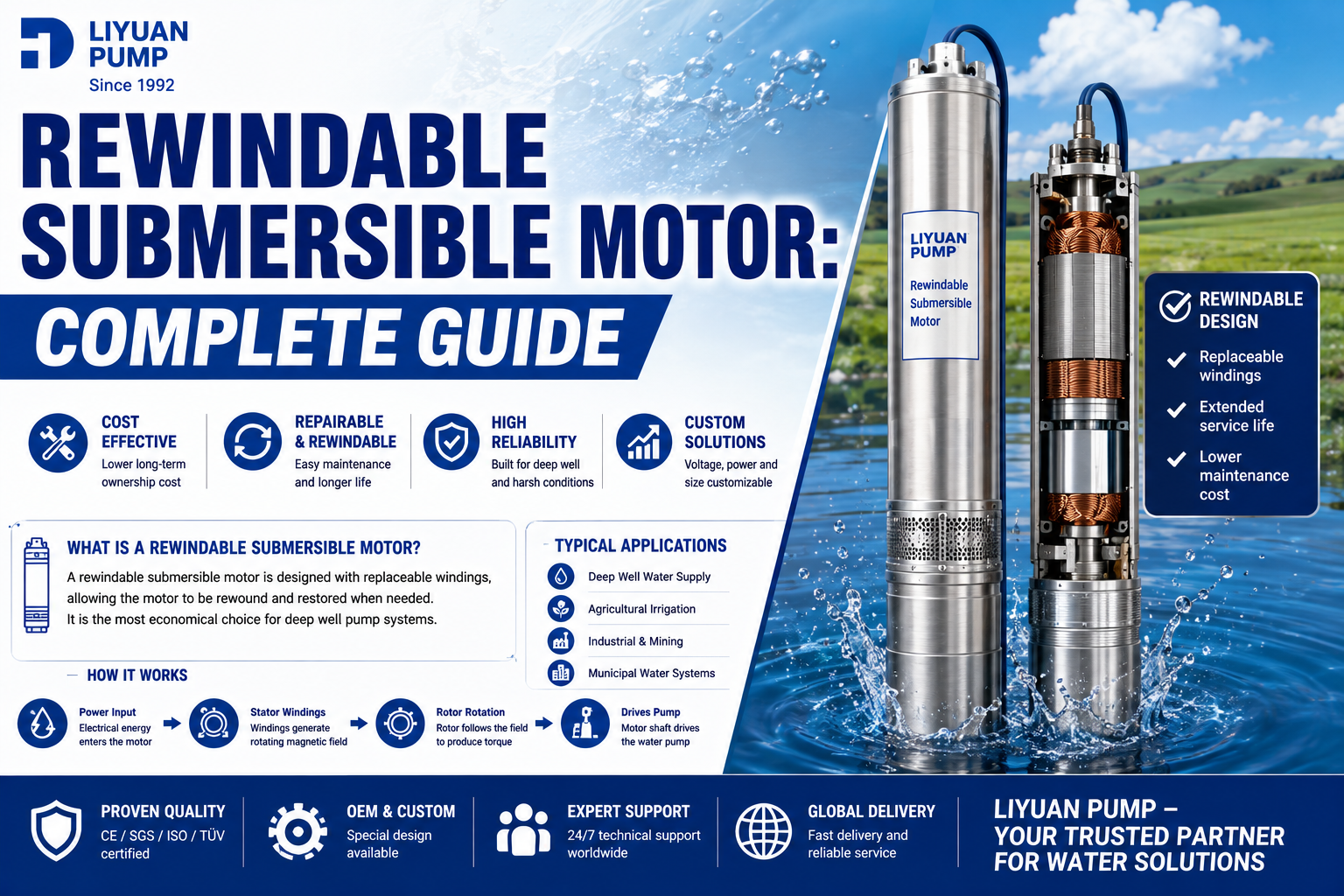
A Rewindable Submersible Motors Allows Qualified Technicians To Replace Damaged Windings, Bearings, Seals, And Internal Components Instead Of Replacing The Complete Motor.
Therefore, It Can Reduce Long-Term Ownership Costs In Agricultural, Municipal, Mining, And Industrial Water Systems. However, Buyers Must still match motor power, voltage, thrust, cooling, water quality, and pump load.
What Is A Rewindable Submersible Motors?
A Rewindable Submersible Motors Is A Serviceable Underwater Motor Designed To Drive A Borehole Or Deep Well Pump.
Unlike A Fully Encapsulated Motor, Its Stator Windings Can Be Removed And Replaced By A Qualified Motor Service Center.
The Motor Usually Contains A Water-Based Cooling And Lubricating Fluid. This Fluid Removes Heat, lubricates bearings, and helps balance internal pressure.
Common Sizes Include:
- 4-Inch Motors
- 6-Inch Motors
- 8-Inch Motors
- 10-Inch Motors
- 12-Inch Motors
Learn More About The Basic Structure In What Is A Submersible Motor?.
How Does A Rewindable Submersible Motors Work?
The Motor Stator Creates A Rotating Magnetic Field When Electrical Power Reaches The Windings.
This Magnetic Field Turns The Rotor And Motor Shaft. The Shaft Then transfers torque to the connected pump.
Inside The Motor, A Manufacturer-Approved Fluid:
- Cools The Windings
- Lubricates Radial Bearings
- Lubricates The Thrust Bearing
- Transfers Heat To The Motor Shell
- Supports Pressure Compensation
External Well Water Flows Across The Motor Shell And Carries Heat Away.
Therefore, Both Internal Fluid And External Water Flow Support Motor Cooling.
Main Motors Components
A Rewindable Motor Usually Contains:
- Stator Windings
- Rotor
- Stainless Steel Motor Shell
- Motor Shaft
- Radial Bearings
- Thrust Bearing
- Mechanical Seal
- Sand Slinger
- Pressure Diaphragm
- Internal Motor Fluid
- Power Cable
- Cable Connector
- Upper And Lower End Bells
Every Component Must Match The Motor Power, Pump Load, Installation Depth, And Water condition.
Rewindable Vs Encapsulated Motors
| Feature | Rewindable Motor | Encapsulated Motor |
|---|---|---|
| Winding Construction | Replaceable | Sealed In Resin |
| Repairability | High | Limited |
| Common Motor Size | Medium To Large | Small To Medium |
| Internal Fluid | Usually Water-Based | Model-Specific |
| Service Requirements | Skilled Workshop | Often Complete Replacement |
| Initial Cost | May Be Higher | Often Lower |
| Long-Term Cost | Lower In Serviceable Projects | Depends On Replacement Cost |
| Custom Voltage | Often Available | More Limited |
| Field Applications | Municipal And Industrial | Residential And Commercial |
Neither Design Is Better In Every Application. The Correct Choice Depends On Motor Size, local repair capability, operating hours, and project value.
How Rewindable Windings Are Constructed
A Rewindable Stator Uses Insulated Winding Wire Installed Into Stator Slots.
Technicians Connect The Windings According To The Required:
- Voltage
- Frequency
- Phase
- Number Of Poles
- Motor Power
- Starting Method
- Connection Type
The Winding System Must Resist Continuous Submersion And Internal Motor Fluid.
Therefore, Standard Dry-Motor Winding Materials May Not Suit A Submersible motor.
Copper Winding Advantages
High-Quality Rewindable Motors Commonly Use Copper Windings.
Copper Can Provide:
- Low Electrical Resistance
- Strong Heat Transfer
- High Current Capacity
- Compact Winding Design
- Stable Starting Torque
- Good Continuous-Duty Performance
However, Copper Alone Does Not Guarantee High Efficiency.
Motor Performance Also Depends On Core Steel, slot design, rotor construction, bearing friction, and cooling.
Water-Filled Motor Design
Many Rewindable Motors Use Water Or An Approved Water-Based Solution.
The Internal Fluid Supports:
- Winding Cooling
- Bearing Lubrication
- Heat Transfer
- Pressure Equalization
- Continuous Operation
The Fluid May Include An Approved Antifreeze Or Corrosion inhibitor.
Never Fill The Motor With Untreated Or Contaminated Water Unless The Manufacturer Specifically Allows It.
Review Water Filled Submersible Motor Vs Oil Filled Motor For A Detailed Comparison.
Internal Fluid Requirements
The Correct Motor Fluid Depends On:
- Minimum Storage Temperature
- Maximum Operating Temperature
- Drinking-Water Requirements
- Seal Materials
- Bearing Materials
- Corrosion Protection
- Manufacturer Specifications
Incorrect Fluid Can Cause:
- Winding Damage
- Bearing Wear
- Internal Corrosion
- Seal Failure
- Freezing Damage
- Poor Heat Transfer
Use Only The Fluid Type And Concentration Approved By The Manufacturer.
External Motor Cooling
A Rewindable Motor Requires Water Flow Across Its Outer Shell.
Insufficient Cooling Can Cause:
- Winding Overheating
- Insulation Breakdown
- Bearing Damage
- Reduced Motor Efficiency
- Shorter Service Life
- Thermal Protection Trips
Cooling Problems Commonly Occur In:
- Large-Diameter Wells
- Storage Tanks
- Reservoirs
- Open-Water Installations
- Horizontal Installations
- Low-Flow Systems
- Hot Water
A Cooling Sleeve Can Direct Water Across The Motor Surface.
Motor Cooling Sleeve
A Cooling Sleeve, Also Called A Flow Sleeve, Creates Controlled Water Velocity Around The Motor.
It May Be Necessary When:
- Water Enters Above The Motor
- The Well Diameter Is Large
- The Pump Operates In A Tank
- The Motor Runs Horizontally
- The System Has Low Flow
- The Water Temperature Is High
The Sleeve Must Not Restrict The Pump Intake.
Ask The Manufacturer To Calculate The Required Sleeve Diameter And Cooling velocity.
Thrust Bearing Capacity
A Deep Well Pump Creates Axial Force During Operation.
The Motor Thrust Bearing Supports This Load.
Thrust Depends On:
- Pump Design
- Number Of Stages
- Flow Rate
- Total Head
- Operating Point
- Starting Conditions
- Motor Speed
- Installation Orientation
A Motor With Insufficient Thrust Capacity Can fail even when its horsepower appears correct.
Always Match The Motor’s Thrust Rating To The Pump.
Radial Bearing Design
Radial Bearings Keep The Rotor And Shaft Centered.
Worn Radial Bearings Can Cause:
- Shaft Movement
- Rotor Contact
- Increased Vibration
- Seal Damage
- Higher Current
- Reduced Efficiency
- Winding Failure
Internal Motor Fluid usually lubricates the radial bearings.
Proper Fluid Level And Cleanliness Remain Essential.
Pressure Compensation
Water Pressure Increases As Installation Depth Increases.
At The Same Time, Internal Motor Fluid Expands When The Motor Warms.
A Pressure-Compensation Diaphragm Helps Balance Internal And External Pressure.
This System Can:
- Reduce Seal Stress
- Allow Fluid Expansion
- Limit Water Entry
- Protect Internal Components
- Support Deep Installation
Inspect The Diaphragm During Motor Repair Or Preventive maintenance.
Mechanical Seal And Sand Protection
The Mechanical Seal Protects The Motor From External Water And Abrasive particles.
A Sand-Protection System May Include:
- Sand Slinger
- Mechanical Seal
- Labyrinth Structure
- Silicon Carbide Seal Faces
- Protected Upper Bearing
- Replaceable Wear Components
Excessive Sand Can Still Damage Any Motor.
Therefore, Inspect The Well Screen, control the pumping rate, and position the pump above the sediment zone.
Common Motors Sizes
4-Inch Rewindable Motors
A 4-Inch Motor Fits Narrow Residential And Agricultural Wells.
Common Applications Include:
- Household Water Supply
- Small Irrigation Systems
- Livestock Watering
- Storage Tank Filling
- Light Commercial Water Supply
Review The 4-Inch Submersible Motor Guide For More Information.
6-Inch Rewindable Motors
A 6-Inch Motor Supports Greater Power, flow, and thrust.
Applications Include:
- Commercial Irrigation
- Industrial Water Transfer
- Municipal Wells
- Mining
- Large Farms
Explore The 6-Inch Submersible Motor Guide.
8-Inch Rewindable Motors
An 8-Inch Motor Commonly Powers Large Borehole Pumps.
It Suits:
- Municipal Water Supply
- High-Flow Irrigation
- Industrial Process Water
- Mine Dewatering
- Community Water Systems
10-Inch Rewindable Motors
A 10-Inch Motor Supports High Power And Large Thrust Loads.
Franklin Electric Describes Water-Lubricated Bearings And Pressure Compensation In Its 10-Inch Rewindable Motor.
Liyuan Pump Also Provides 10-Inch Submersible Motor Solutions For Large Water Projects.
12-Inch Rewindable Motors
A 12-Inch Motor Serves Major Municipal, industrial, mining, and irrigation projects.
These Motors Require Accurate Pump Matching, electrical protection, cooling calculations, and professional commissioning.
Review Liyuan Pump’s 12-Inch Submersible Motors For More Details.
Single-Phase Vs Three-Phase Motors
Small Rewindable Motors May Use Single-Phase Or Three-Phase Power.
Large Motors Usually Use Three-Phase Power.
Three-Phase Motors Can Provide:
- Higher Power Capacity
- Smoother Torque
- Better Continuous Operation
- Lower Current Per Phase
- VFD Compatibility
- Star-Delta Starting Options
Common Voltages Include:
- 220V
- 230V
- 380V
- 400V
- 415V
- 440V
- 460V
- 480V
- 575V
Confirm Voltage, phase, and frequency before production.
Direct-On-Line Starting
Direct-On-Line Starting Connects The Motor Directly To Full Supply Voltage.
Advantages Include:
- Simple Control
- Strong Starting Torque
- Lower Equipment Cost
- Easy Maintenance
However, It Produces High Starting Current.
The Power System, cable, contactor, and generator must handle this demand.
Star-Delta Starting
Star-Delta Starting Reduces Starting Current By Changing The Motor Connection During Startup.
It Commonly Supports Larger Motors.
However, The Motor Must Have Suitable Winding Leads And Connection Design.
Incorrect Timing Or Wiring Can Cause:
- Current Surges
- Low Starting Torque
- Contactor Damage
- Motor Stress
- Failed Acceleration
Soft Starter Control
A Soft Starter Gradually Raises Motor Voltage During Startup.
Potential Benefits Include:
- Lower Starting Current
- Reduced Mechanical Shock
- Reduced Water Hammer
- Smoother Acceleration
- Lower Cable Stress
However, A Soft Starter Does Not Control Pump Speed During Normal operation.
VFD Compatibility
A Variable Frequency Drive Can Control A Compatible Three-Phase Rewindable Motor.
Potential Benefits Include:
- Adjustable Flow
- Stable Pressure
- Soft Starting
- Lower Starting Current
- Reduced Water Hammer
- Process Automation
- Potential Energy Savings
However, The VFD Can Increase Electrical Stress On Motor insulation and cables.
Confirm:
- Minimum Frequency
- Maximum Frequency
- Carrier Frequency
- Cable Length
- Voltage
- Motor Current
- Cooling Flow
- Output Filter Requirements
Motor And Pump Matching
The Motor Must Match The Pump’s:
- Rated Power
- Speed
- Shaft Connection
- Mounting Flange
- Thrust Load
- Rotation
- Diameter
- Operating Duty Point
NEMA-Compatible Dimensions Can Simplify Pump And Motor matching.
However, Dimensional Compatibility Does Not Guarantee Electrical Or thrust compatibility.
When Should A Motor Be Rewound?
Rewinding May Be Suitable When:
- Insulation Resistance Is Low
- Windings Are Burned
- The Motor Trips Repeatedly
- Winding Resistance Is Unbalanced
- The Motor Has An Internal Short Circuit
- The Motor Value Justifies Repair
- Mechanical Components Remain Serviceable
- Replacement Lead Time Is Long
A Complete Inspection Must Confirm Whether Rewinding Is Economical.
When Should The Motor Be Replaced?
Replacement May Be Better When:
- The Shell Is Severely Corroded
- The Shaft Is Damaged
- The Stator Core Is Burned
- Multiple Components Have Failed
- Repair Cost Approaches Replacement Cost
- The Motor Efficiency Is Obsolete
- Spare Parts Are Unavailable
- The Motor Cannot Meet The Required Duty
Small Motors May Cost Less To Replace Than To Rewind.
Rewinding Process
A Professional Rewinding Process Usually Includes:
- Record Motor Nameplate Data.
- Measure Winding Resistance.
- Test Insulation Resistance.
- Drain And Inspect Motor Fluid.
- Disassemble The Motor.
- Remove The Damaged Windings.
- Inspect The Stator Core.
- Clean The Stator Slots.
- Install New Insulation.
- Wind New Coils.
- Connect The Windings.
- Test Electrical Balance.
- Replace Bearings And Seals.
- Reassemble The Motor.
- Fill With Approved Fluid.
- Complete Pressure And Electrical Tests.
Improper Rewinding Can Reduce Efficiency And Motor Life.
Tests After Rewinding
The Service Center Should Complete Suitable Tests.
These May Include:
- Insulation Resistance Test
- Winding Resistance Test
- High-Voltage Test
- Surge Comparison Test
- No-Load Current Test
- Phase Balance Test
- Rotation Test
- Leak Test
- Pressure Test
- Vibration Test
Record The Results For Future Maintenance Comparison.
Does Rewinding Reduce Motor Efficiency?
Poor Rewinding Can Reduce Efficiency If The Technician Changes:
- Wire Size
- Number Of Turns
- Coil Pitch
- Connection Design
- Insulation Thickness
- Stator Core Condition
A Professional Rewind Should Follow The Original Electrical design and use suitable materials.
Core Damage From Excessive Burnout Temperature Can Also Increase electrical losses.
Main Applications
Agricultural Irrigation
Rewindable Motors Suit Farms That Operate Pumps For Long Hours.
Local Repairability Can Reduce Downtime During Irrigation Seasons.
Municipal Water Supply
Municipal Wells Require Reliable Motors, high thrust capacity, and planned maintenance.
Rewindable Construction Supports Long-Term Asset Management.
Industrial Water Systems
Factories Use These Motors For Process Water, cooling systems, and raw water transfer.
Mining
Mining Projects Require Strong Motors For Dewatering And Groundwater control.
Community Water Projects
Remote Communities May Prefer Serviceable Motors When Replacement logistics are difficult.
Common Failure Causes
A Rewindable Motor Can Fail Because Of:
- Insufficient Cooling
- Low Voltage
- High Voltage
- Phase Loss
- Phase Imbalance
- Motor Overload
- Excessive Thrust
- Frequent Starting
- Sand Damage
- Seal Failure
- Cable Damage
- Incorrect Internal Fluid
- Dry Running
- Lightning Or Power Surges
Rewindable Construction Improves Repairability. It Does Not Prevent Incorrect operation.
Motor Protection
A Complete Control System Should Include:
- Short-Circuit Protection
- Overload Protection
- Dry-Run Protection
- Overvoltage Protection
- Undervoltage Protection
- Surge Protection
- Temperature Protection
- Water-Level Protection
Three-Phase Motors Should Also Use:
- Phase-Loss Protection
- Phase-Reversal Protection
- Phase-Imbalance Protection
The Electric Control Box For Submersible Pump Explains Common Control Functions.
Preventive Maintenance
Monitor:
- Supply Voltage
- Operating Current
- Phase Balance
- Flow Rate
- Discharge Pressure
- Motor Temperature
- Insulation Resistance
- Starting Frequency
- Vibration
- Control Panel Alarms
A Change In Current, flow, or pressure may indicate pump wear or motor problems.
Follow The Electric Submersible Pump Maintenance Guide To Improve Reliability.
Information To Send The Manufacturer
Provide:
- Required Motor Power
- Motor Diameter
- Pump Flow
- Total Dynamic Head
- Pump Thrust Requirement
- Voltage
- Frequency
- Phase
- Installation Depth
- Water Temperature
- Water Chemistry
- Sand Content
- Daily Operating Hours
- Starts Per Hour
- Starting Method
- VFD Requirements
- Installation Orientation
Complete Data Helps The Manufacturer Match The Motor To The Pump And Well.
Why Choose Liyuan Pump?
Liyuan Pump Has Manufactured Submersible Motors And Pumps Since 1992.
Available Capabilities Include:
- Rewindable Submersible Motors
- 4-Inch To 12-Inch Motor Sizes
- Water-Filled Motor Designs
- High-Thrust Bearings
- Stainless Steel Construction
- Single-Phase And Three-Phase Models
- 50Hz And 60Hz Options
- Customized Voltage
- Hot-Water Options
- VFD-Compatible Solutions
- OEM And Custom Engineering
Buyers Can Review Liyuan Pump’s Submersible Motor Manufacturer Guide Before Requesting A Customized Quotation.
Frequently Asked Questions
What Is A Rewindable Submersible Motor?
It Is A Serviceable Underwater Motor With Replaceable Stator Windings And Internal Components.
Can Every Submersible Motor Be Rewound?
No. Encapsulated And Fully Sealed Motors May Be Difficult Or Uneconomical To Rewind.
Is Rewinding Cheaper Than Motor Replacement?
It Often Costs Less For Large Motors. However, The Decision Depends On Motor Condition, size, parts, labor, and efficiency.
Does A Rewindable Motor Use Water Inside?
Many Designs Use Water Or A Manufacturer-Approved Water-Based Fluid For Cooling And Lubrication.
Can A Rewound Motor Maintain Its Original Efficiency?
Yes, When A Skilled Service Center Follows The Original Winding Design And Protects The Stator Core.
Are Rewindable Motors Suitable For VFD Control?
Compatible Three-Phase Models Can Use A VFD When The Manufacturer Approves The Settings And Installation.
Which Motor Size Is Best?
The Correct Size Depends On Borehole Diameter, pump power, shaft connection, thrust load, flow, and head.
What Information Does Liyuan Pump Need?
Provide Motor Power, diameter, voltage, phase, pump data, installation depth, water quality, and operating hours.
Conclusion
A Rewindable Submersible Motors Provides A Serviceable And Cost-Effective Solution For Long-Duty Deep Well Pumping Systems.
However, Reliable Operation Requires Correct Power, thrust capacity, cooling flow, internal fluid, voltage, and motor protection.
For Rewindable Motor Selection, OEM Production, And Custom Engineering Support, Contact Liyuan Pump Through
Email:Liyuan@liyuan-pump.com
WhatsApp:+86 181-2828-2767