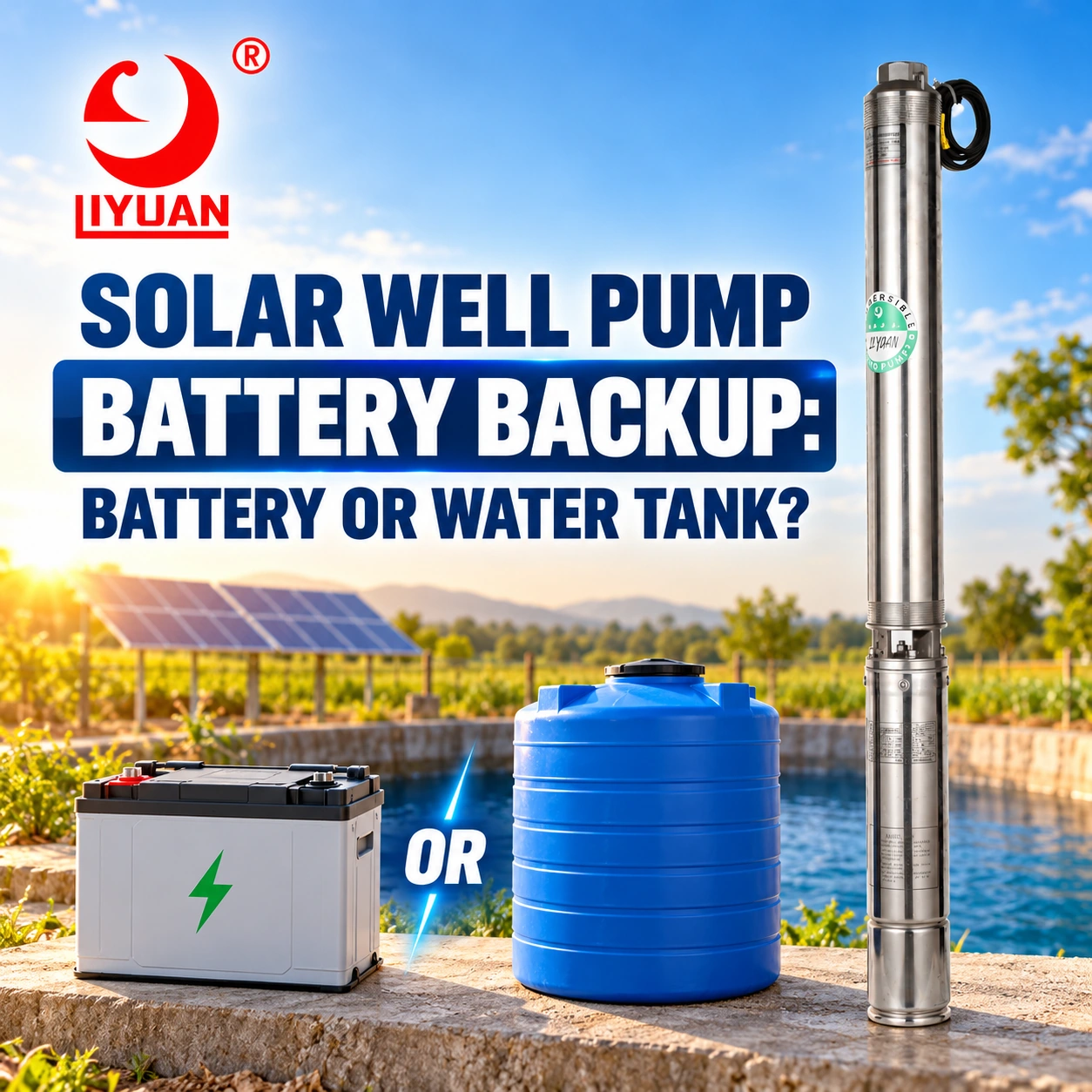
Solar Well Pump Battery Backup: Battery Or Water Tank?
Solar Well Pump Battery Backup Is Useful When The Pump Must Operate After Sunset Or During Insufficient Sunlight. However, If Your Main Requirement Is Having Water Available At Night, Daytime Pumping Into A Storage Tank May Meet The Need. The Decision Depends On Three Things: Required Water Volume, Required Delivery Pressure, And How Long The System Must Operate Without Adequate Solar Production.
A Full Tank Does Not Automatically Provide Household Or Irrigation Pressure. A Charged Battery Does Not Guarantee That The Well Can Supply Enough Water. Check Both Conditions Before Buying Either System.
The Real Problem: Water Is Needed After Solar Pumping Stops
In A Whirlpool Forum Discussion About Solar Bore Pumping, One Participant Reported Helping On An Off-Grid Australian Farm Where Three Overcast Days Produced Little Solar-Pump Flow. The Installation Used A Large Storage Tank And A Separate Diesel Pump To Transfer Water Uphill To Livestock Tanks.
This Is A User-Reported Experience, Not A Controlled Performance Test. It Illustrates Two Separate Requirements: Storing Enough Water And Delivering That Water To Its Destination.
When Does Solar Well Pump Battery Backup Make Sense?
Start With The Actual Nighttime Task.
| Your Situation | Arrangement To Evaluate | Decisive Check |
|---|---|---|
| Livestock Need Water Overnight Below A Suitable Tank Site | Daytime Solar Pumping With Gravity Storage | Usable Volume And Flow At The Lowest Tank Level |
| A House Needs Pressurized Water From A Ground-Level Tank | Water Storage With A Booster And Backup Electricity | Booster Starting Demand, Running Energy, And Outlet Pressure |
| The Well Pump Must Feed A Pressurized Network At Night | Battery-Powered Pumping Or Another Compatible Backup Source | Pump Duty Point, Electrical Compatibility, And Required Runtime |
| Irrigation Can Be Scheduled During Solar Hours | Direct Solar Pumping, Possibly With Buffer Storage | Zone Pressure And Daily Water Output During The Design Month |
| Several Low-Sun Days Would Interrupt An Essential Supply | Storage Plus A Defined Backup Source | Time Until Reserve Is Exhausted And Time Needed To Restore It |
The U.S. Department Of Energy’s Zuni Solar-Pumping Study Describes Using Stored Water To Supply Demand Outside Solar Hours. Its Historical Project Costs Should Not Be Used As Current Quotations.
Compare Complete Installed Arrangements. A Tank Quote Should Include Foundations, Pipework, Level Controls, And Any Booster. A Battery Quote Should Include Charging Equipment, Conversion Equipment, Protection, Installation, And Expected Replacement Costs.
Can A Water Tank Supply Enough Pressure Without Batteries?
For An Open Tank, Gravity Pressure Depends On The Vertical Distance Between The Water Surface And The Outlet.
Static Pressure In Bar ≈ Vertical Height In Meters ÷ 10.2
For Example, A Water Surface 10 Meters Above A Shower Provides Approximately:
10 ÷ 10.2 = 0.98 Bar Before Flow Losses
Grundfos Explains The Relationship Between Elevation And Water Pressure. During Use, Pipe, Valve, And Filter Losses Reduce The Pressure Available At The Outlet.
If Your Equipment Requires 2.5 Bar, The Theoretical Static Height Is About 25.5 Meters, Before Allowing For Those Losses. Check The Lowest Usable Water Level, Because Pressure Falls As The Tank Empties.
Where Elevation Is Insufficient, A Booster May Be Necessary. That Booster Still Needs Electricity At Night. Its Energy Requirement Can Be Lower Than Pumping From A Deep Well, But The Comparison Must Use Actual Flow, Head, And Efficiency.
Can A Pressure Tank Replace A Storage Tank?
A Pressure Tank Provides A Limited Volume Between Pump Cycles. Its Available Drawdown Is Smaller Than Its Nominal Shell Volume And Depends On Pressure Settings And Precharge.
Do Not Treat A 100-Liter Pressure Tank As 100 Liters Of Usable Overnight Water. Use The Manufacturer’s Drawdown Data; The Submersible Pump Pressure Tank Guide Explains This Sizing Distinction.
How Much Water Storage Replaces Nighttime Pumping?
Calculate The Water Needed During The Period You Intend To Cover.
Required Usable Reserve = Demand During That Period − Credited Pumped Volume During That Period
Only Credit Low-Sun Pumping When You Have A Defensible Output Estimate. A Pump That Runs In Bright Overcast Conditions May Deliver Very Little At Your Actual Lift.
Consider This Illustrative Farm System:
- Daily Demand: 4 Cubic Meters, Or 4,000 Liters.
- Required Reserve: Two Days With No Well-Pump Production.
- Tank Starts The Event With Its Full Usable Reserve.
Required Usable Reserve = 4 × 2 = 8 Cubic Meters
An 8-Cubic-Meter Nominal Tank May Be Too Small. Water Below The Outlet Or Low-Level Shutdown, Unfilled Space Above The Stop Level, And Any Separately Protected Reserve Reduce Available Volume.
Define Usable Storage Between The Actual Operating Levels. Include Distribution Losses In Demand And Select A Tank Suitable For The Water’s Intended Use.
If Only Overnight Supply Is Required, Calculate Overnight Consumption Specifically. Two Days Of Storage Is An Example Here, Not A Universal Solar-Pump Requirement.
What Happens After Two Cloudy Days?
Storage Must Recover Before The Next Shortfall. Merely Matching Normal Daily Demand Will Not Refill A Depleted Reserve.
Keep The Same 4-Cubic-Meter Daily Demand And 8-Cubic-Meter Initial Usable Storage. Now Assume Some Cloudy-Day Production:
| Period | Well-Pump Production | Water Demand | Usable Storage At Period End |
|---|---|---|---|
| Start | — | — | 8 m³ |
| Cloudy Day 1 | 2 m³ | 4 m³ | 6 m³ |
| Cloudy Day 2 | 2 m³ | 4 m³ | 4 m³ |
| Recovery Day | 8 m³ | 4 m³ | 8 m³ |
These Are Hypothetical Volumes, Not A Forecast For A Particular Pump Or Location. The Daily Balance Also Assumes The Timing Of Consumption Does Not Empty The Tank Within A Day.
The Recovery Day Needs 8 Cubic Meters Of Production: 4 For Current Use And 4 To Restore Storage. If Production Is Only 6 Cubic Meters Per Day, Restoring That Reserve Takes Two Days At Unchanged Demand.
Ask For A Solar Submersible Pump Selection Based On Local Seasonal Solar Conditions And Actual Total Dynamic Head. The Well Must Sustain The Required Flow And Pumping Duration. A Larger Tank Or Battery Cannot Increase Its Sustainable Yield.
How Do You Size Solar Well Pump Battery Backup?
Separate Stored Energy From The Ability To Start And Run The Motor.
For A Preliminary Energy Calculation:
Nominal Battery Energy = Required Load Energy ÷ (Usable Capacity Fraction × Discharge-Path Efficiency)
Use Electrical Input Power At The Required Operating Point. Motor Shaft kW Or Horsepower Alone Does Not Give Battery Energy Consumption.
Suppose A Compatible Pump System Requires:
- Electrical Input At The Inverter AC Output: 1.2 kW.
- Total Pump Runtime During The Backup Period: 2 Hours.
- Permitted Usable Battery Capacity: 80%.
- Assumed Battery-To-AC Delivery Efficiency: 90%.
Load Energy = 1.2 × 2 = 2.4 kWh
Preliminary Nominal Battery Energy = 2.4 ÷ (0.80 × 0.90) ≈ 3.33 kWh
These Assumptions Are Illustrative. Add Standby Consumption And Other Loads, Then Apply The Selected Battery’s Temperature, Aging, And Discharge-Rate Allowances. The Victron Energy System-Sizing Example Likewise Accounts For System Losses And Permitted Depth Of Discharge.
Why Is Battery Capacity Alone Insufficient?
Enough kWh Does Not Prove That The Inverter Can Start The Pump. Check Motor Starting Demand, Inverter Surge Duration, Battery Discharge Limits, And The Battery Management System’s Current Limits. Victron’s Battery Compatibility Guidance Separately Requires Battery Peak Capability To Support Load Surges.
The PV System Must Also Cover Daytime Consumption And Restore Battery Charge, Including Charging Losses. A Battery That Survives One Night But Cannot Recharge Reliably Is An Incomplete Design.
Can You Add A Battery To Any Solar Well Pump Controller?
No. A Controller Designed For Direct PV Input Is Not Automatically A Battery Charger Or An Approved Battery-Powered Motor Drive.
The Grundfos SQFlex Data Booklet Shows A Defined Battery-Backup Arrangement Using A Charge Controller And Compatible Pump Controls. This Demonstrates That Battery Operation Depends On The Specified System Architecture.
Before Ordering, Obtain The Manufacturer’s Approved Connection Diagram And Confirm:
- Battery Operating Voltage Across Its Full Charge Range.
- Controller Acceptance Of Battery Or Inverter Power.
- Motor Voltage, Phase, Frequency, And Drive Compatibility.
- Charging Method And Battery Protection.
- Low-Battery Shutdown, Well Dry-Run Protection, And Tank-Level Control.
Do Not Connect A Battery To PV Terminals Simply Because The Nominal Voltages Appear Similar.
What Should A Supplier Prove Before You Buy?
Ask For Two Comparable Proposals Where Both Arrangements Are Feasible: Water Storage With Its Distribution System, And Battery Backup With Its Complete Electrical System.
Both Proposals Should State The Same Required Result:
- Daily Water Demand And The Portion Required After Sunset.
- Flow And Pressure At The Most Demanding Outlet.
- Usable Reserve At The Start Of A Low-Sun Event.
- Assumed Production During That Event And The Resulting Autonomy.
- Time Needed To Restore The Reserve While Continuing Normal Supply.
- Included Equipment, Installation Scope, And Backup Arrangements If The Event Lasts Longer.
For A Liyuan Solar Water Pump Selection, Send Your Location, Daily And Nighttime Demand, Pumping Water Level, Tested Well Yield, Tank Position, Required Outlet Pressure, And Existing Pump Or Controller Details.
Choose The Arrangement That Can Deliver The Required Water At The Required Pressure Throughout The Defined Backup Period. That May Be Gravity Storage, A Tank With A Battery-Powered Booster, Or Battery Backup For The Well Pump Itself.
Email:Liyuan@liyuan-pump.com
WhatsApp:+86 181-2828-2767