Submersible Motor Thrust Bearing: Complete Guide
A Submersible Motor Thrust Bearing Supports The Axial Force Produced By A Multistage Pump And Protects The Motor Shaft, Rotor, And Hydraulic Components.
However, Motor Horsepower Alone Does Not Determine The Required Bearing Capacity. Buyers Must Also Consider Pump Stages, Flow, Head, Impeller Design, Starting Method, Speed, And Operating Range.
What Is A Submersible Motor Thrust Bearing?
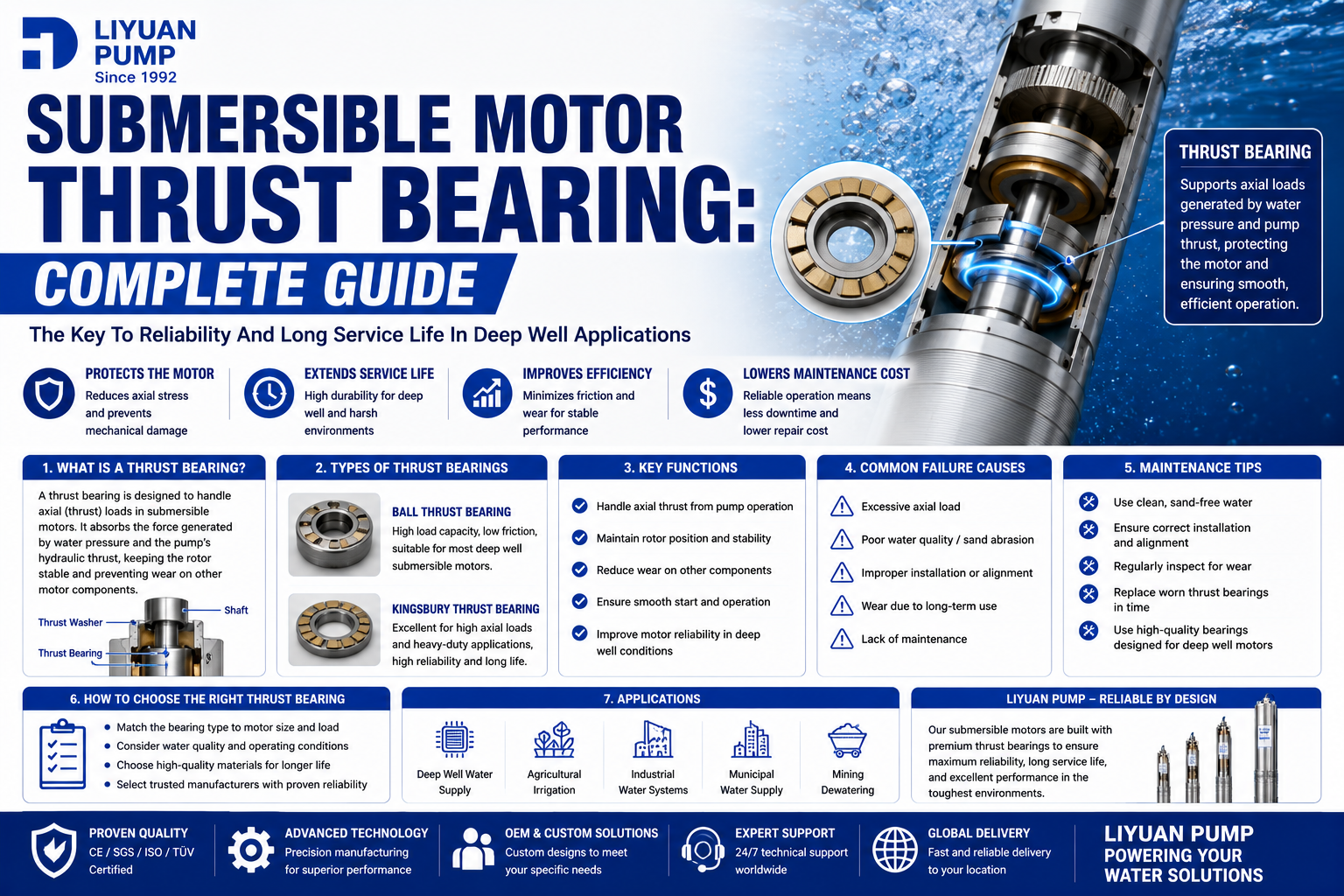
A Submersible Motor Thrust Bearing Is An Internal Motor Component Designed To Support Axial Load Along The Motor Shaft.
A Deep Well Pump Uses Multiple Impellers To Push Water upward. During Operation, Hydraulic Pressure Creates Axial Force On The Pump Shaft.
The Pump Transfers This Force Through The Coupling To The Motor Shaft. The Thrust Bearing Then Controls Shaft movement and supports the load.
Without A Suitable Bearing, The Shaft Can Move Vertically And Damage The Motor Or Pump.
Learn More About The Complete Motor Structure In What Is A Submersible Motor?.
What Is Axial Thrust?
Axial Thrust Is A Force Acting Parallel To The Motor And Pump Shaft.
This Force Can Move:
- Downward Toward The Motor Bottom
- Upward Toward The Pump
- Between Both Directions During Startup
- Rapidly During Flow Changes
Axial Thrust Differs From Radial Load.
Radial Bearings Control Side-To-Side Shaft Movement. Meanwhile, The Thrust Bearing Controls Vertical Or Axial Movement.
Downthrust Vs Upthrust
What Is Downthrust?
Downthrust Pushes The Pump And Motor Shaft Downward.
Most Multistage Borehole Pumps Produce Downthrust During Normal operation.
The Motor Thrust Bearing Usually supports this continuous downward force.
What Is Upthrust?
Upthrust Pushes The Shaft Upward.
It Can Occur During:
- Pump Startup
- Low-Head Operation
- Excessive Flow
- Empty Pipeline Filling
- Incorrect Valve Settings
- VFD Acceleration
- Operation Beyond The Pump Curve
- Rapid Pressure Changes
Short-Term Upthrust May Be Part Of Normal Startup. However, Continuous Upthrust Can Damage Pump And Motor Components.
Why Thrust Capacity Matters
The Bearing Must Support The Maximum Axial Load Created By The Pump.
Insufficient Capacity Can Cause:
- Excessive Bearing Wear
- Shaft Movement
- Rotor Contact
- Impeller Damage
- Diffuser Wear
- Increased Vibration
- High Motor Current
- Seal Failure
- Winding Damage
- Complete Motor Failure
Therefore, The Pump Manufacturer Must Provide Thrust Data Or Approve The Pump And Motor combination.
How A Thrust Bearing Works
The Motor Shaft Transfers Axial Load To A Rotating Bearing Component.
A Stationary Bearing Surface Supports This rotating component through a thin lubricating film.
The Internal Motor Fluid:
- Lubricates Bearing Surfaces
- Reduces Friction
- Removes Heat
- Prevents Direct Surface Contact
- Carries Wear Particles Away
The Bearing Must Establish A Stable Fluid Film During Operation.
Incorrect Fluid, insufficient cooling, or excessive load can break this protective film.
Kingsbury-Type Thrust Bearings
Many Large Submersible Motors Use A Kingsbury-Type Or Tilting-Pad Thrust Bearing.
This Design Uses Several Bearing Pads Around A Rotating thrust surface.
Each Pad Tilts Slightly As The Shaft Rotates. This Movement Creates A Wedge-Shaped Lubricating Film.
Potential Advantages Include:
- High Axial Load Capacity
- Stable Fluid-Film Lubrication
- Even Load Distribution
- Low Friction
- Good Heat Dissipation
- Long Continuous-Duty Life
The Bearing Design And Capacity Vary By Motor Size And Manufacturer.
Carbon Thrust Bearings
Some Smaller Submersible Motors Use Carbon-Based Bearing Components.
Carbon Materials Can Provide:
- Good Water Lubrication
- Low Friction
- Corrosion Resistance
- Stable Operation
- Compact Construction
However, Sand, insufficient fluid, and excessive thrust can damage carbon surfaces.
Ceramic And Composite Materials
Some Motors Use Ceramic Or Engineered Composite Bearing Components.
These Materials May Provide:
- Strong Wear Resistance
- Corrosion Resistance
- Stable Surface Hardness
- Good Water-Lubricated Performance
However, Material Choice Must Match Impact Load, alignment, temperature, and internal fluid.
No Single Bearing Material Suits Every Application.
Water-Lubricated Thrust Bearings
Water-Filled And Rewindable Motors Commonly Use Water-Lubricated Bearings.
The Motor May Contain:
- Clean Water
- Water And Propylene Glycol
- Manufacturer-Approved Coolant
- Corrosion-Inhibiting Fluid
- Frost-Protected Water-Based Fluid
The Fluid Must Remain Clean And At The Correct Level.
Franklin Electric Describes Water-Lubricated Radial And Thrust Bearings In Its 10-Inch Rewindable Motor.
Oil-Lubricated Thrust Bearings
Oil-Filled Motors Use An Approved Oil Or Dielectric Fluid For Lubrication And Heat Transfer.
Oil Type Affects:
- Bearing Lubrication
- Heat Transfer
- Seal Compatibility
- Fluid Expansion
- Low-Temperature Startup
- Environmental Suitability
Never Add Unapproved Oil.
Incorrect Oil Can Damage Seals, insulation, bearings, and pressure-compensation components.
Review Water Filled Submersible Motor Vs Oil Filled Motor For More Information.
What Determines Thrust Load?
Thrust Load Depends On:
- Pump Impeller Design
- Number Of Pump Stages
- Impeller Diameter
- Required Flow Rate
- Total Dynamic Head
- Pump Speed
- Operating Point
- Pressure Above The Pump
- Starting Conditions
- Water Density
Two Pumps With Equal Motor Power Can Produce Different thrust loads.
Therefore, Never Select Bearing Capacity From Horsepower Alone.
Number Of Pump Stages
Each Pump Stage Can Add Axial Force.
A High-Head Pump Often Uses More Stages. Therefore, It May Create Greater Total thrust.
However, Actual Thrust Depends On Hydraulic Design.
A Pump With Fewer Large Impellers Can Create A Different Load From A Pump With Many Smaller impellers.
Request The Pump Manufacturer’s Maximum Downthrust And Upthrust values.
Operating Point And Thrust
Pump Thrust Changes Across The Performance Curve.
At Different Flow Rates, Pressure Distribution Around The Impellers changes.
Operating Outside The Recommended Range Can Increase:
- Downthrust
- Upthrust
- Vibration
- Internal Recirculation
- Bearing Temperature
- Hydraulic Instability
Therefore, Select A Pump Whose Duty Point Falls Inside Its Approved operating range.
Low-Flow Operation
Operating At Very Low Flow Can Increase Downthrust In Some Pump designs.
It Can Also Cause:
- Internal Recirculation
- Hydraulic Heating
- Vibration
- Reduced Motor Cooling
- Bearing Stress
- Seal Wear
Do Not Operate A Pump Against A Closed Discharge Valve For Longer Than The Manufacturer Allows.
High-Flow Operation
Operating Too Far Right On The Pump Curve Can Create Upthrust Or Motor overload.
Possible Effects Include:
- Shaft Lifting
- Impeller Contact
- Coupling Stress
- Bearing Damage
- High Motor Current
- Reduced Pressure
- Increased Sand Intake
Use A Flow-Control Valve Or VFD Only Within The Manufacturer’s approved range.
Startup Thrust
A Pump Can Experience Temporary Upthrust During Startup.
The Risk Increases When:
- The Drop Pipe Is Empty
- The Discharge Valve Is Fully Open
- The Pump Accelerates Too Quickly
- System Head Is Initially Low
- A Check Valve Leaks
- The Pipeline Is Very Long
Controlled Startup Can Reduce Hydraulic Shock.
However, The Motor And Pump Must Still tolerate the expected transient thrust.
Direct-On-Line Starting
Direct-On-Line Starting Applies Full Voltage Immediately.
It Provides Strong Starting Torque And Fast Acceleration.
However, It Can Create:
- High Starting Current
- Rapid Shaft Acceleration
- Hydraulic Shock
- Sudden Thrust Changes
- Water Hammer
The Electrical System And Pump Must Support This Starting method.
Soft Starter Operation
A Soft Starter Gradually Increases Motor Voltage.
Potential Benefits Include:
- Lower Starting Current
- Reduced Mechanical Shock
- Smoother Acceleration
- Reduced Water Hammer
- Less Coupling Stress
However, Excessively Long Acceleration Can Keep The Motor At Low Speed Without Adequate lubrication or cooling.
Follow The Motor Manufacturer’s Recommended Ramp Time.
VFD Operation
A Variable Frequency Drive Controls Motor Speed And Acceleration.
It Can Provide:
- Soft Starting
- Adjustable Flow
- Stable Pressure
- Reduced Starting Current
- Process Control
- Potential Energy Savings
However, Low Speed Changes Pump Head, flow, cooling, and thrust conditions.
Confirm:
- Minimum Frequency
- Maximum Frequency
- Acceleration Time
- Deceleration Time
- Allowed Pump Curve Range
- Motor Cooling Requirements
- Maximum Upthrust And Downthrust
Do Not Assume That A VFD Automatically protects the thrust bearing.
Motor Speed
Submersible Motors Commonly Use Two-Pole Or Four-Pole Designs.
Higher Speed Can Increase Hydraulic Load, friction, and bearing heat.
Never Operate A Motor Above Its Approved Frequency Without Manufacturer Confirmation.
Overspeed Can Cause:
- Excessive Pump Head
- Higher Motor Power
- Increased Thrust
- Bearing Failure
- Shaft Stress
- Impeller Damage
Motor And Pump Matching
The Motor Must Match The Pump’s:
- Rated Power
- Shaft Diameter
- Shaft Spline
- Mounting Flange
- Rotation
- Speed
- Downthrust
- Upthrust
- Overall Diameter
NEMA-Compatible Dimensions Can Improve Mechanical interchangeability.
However, Matching Flanges Do Not Guarantee Suitable thrust capacity.
Thrust Capacity Safety Margin
The Motor Bearing Rating Should Exceed The Pump’s Maximum expected thrust.
The Required Margin Depends On:
- Manufacturer Recommendations
- Pump Curve Range
- Starting Method
- VFD Operation
- Water Density
- Operating Hours
- System Transients
Do Not Select An Arbitrary Safety Factor Without Pump And Motor data.
Excessive Oversizing Can Increase Cost Without Solving Hydraulic problems.
Small Motor Thrust Bearings
Smaller 4-Inch Motors Commonly Power Residential And Agricultural pumps.
Their Thrust Capacity Must Match:
- Motor Horsepower
- Pump Stages
- Flow
- Head
- Starting Conditions
Explore Liyuan Pump’s 4-Inch Submersible Motor Guide For More Selection Information.
Large Motor Thrust Bearings
Six-Inch, Eight-Inch, Ten-Inch, And Twelve-Inch Motors Support Larger pump loads.
They May Use:
- Kingsbury-Type Bearings
- Multiple Tilting Pads
- Replaceable Bearing Components
- Temperature Sensors
- High-Capacity Thrust Systems
- Water-Lubricated Designs
Review The 6-Inch Submersible Motor Guide For Larger Deep-Well Applications.
Vertical Installation
Most Deep-Well Motors Operate Vertically With The Shaft Pointing Upward.
This Position Supports The Intended Bearing And pressure-compensation design.
The Pump Manufacturer Must Confirm The Complete assembly orientation.
Horizontal Installation
Some Motors Can Operate Horizontally With Manufacturer Approval.
Horizontal Installation Can Change:
- Bearing Load Distribution
- Rotor Position
- Cooling Flow
- Thrust Behavior
- Internal Fluid Movement
- Pump Intake Conditions
A Cooling Sleeve May Also Be Required.
Do Not Install A Standard Vertical Motor Horizontally Without written approval.
Sand And Abrasive Wear
Sand Can Enter The Motor’s Upper Seal Area And Damage Shaft surfaces.
It Can Also increase friction and interfere with bearing lubrication.
Protection May Include:
- Sand Slinger
- Mechanical Seal
- Silicon Carbide Seal Faces
- Labyrinth Structure
- Protected Upper Bearing
- Replaceable Wear Components
However, Excessive Sand Will Eventually Damage Any motor.
Control The Pumping Rate And Inspect The Well Screen.
Motor Fluid Level
Incorrect Internal Fluid Level Can Reduce Bearing Lubrication And cooling.
Before Installation Or Reassembly:
- Position The Motor As Directed.
- Open The Filling Or Vent Plug.
- Add The Approved Fluid.
- Remove Trapped Air.
- Confirm The Required Level.
- Reinstall The Plug And Seal.
- Check For Leakage.
Follow The Specific Motor Manual.
Cooling Flow And Bearing Life
Bearing Friction Produces Heat.
The Internal Fluid Transfers This Heat To The Motor shell. External Water Then Carries The Heat Away.
Insufficient Cooling Can Raise:
- Bearing Temperature
- Winding Temperature
- Fluid Temperature
- Seal Temperature
A Flow Sleeve May Be Required In Large Wells, tanks, reservoirs, or horizontal installations.
Signs Of Thrust Bearing Wear
Common Warning Signs Include:
- Increased Vibration
- Grinding Or Rubbing Noise
- Rising Motor Current
- Reduced Flow
- Falling Pressure
- Frequent Overload Trips
- Excessive Shaft Endplay
- Metal Or Carbon Debris
- High Motor Temperature
- Impeller Contact
Stop The Pump If Severe Noise Or Electrical changes appear.
Continued Operation Can Damage The Stator, rotor, and pump hydraulics.
How To Measure Shaft Endplay
Shaft Endplay Measures Axial Shaft Movement.
A Technician May Use A Dial Indicator To Measure Movement During motor inspection.
Excessive Endplay Can Indicate:
- Bearing Wear
- Incorrect Assembly
- Damaged Bearing Pads
- Worn Shaft Components
- Missing Spacers
- Incorrect Preload
The Allowed Endplay Depends On Motor design.
Use The Manufacturer’s Service Specifications.
Thrust Bearing Inspection
A Professional Inspection May Include:
- Visual Surface Inspection
- Shaft Endplay Measurement
- Bearing Thickness Measurement
- Pad Condition Check
- Thrust-Runner Inspection
- Internal Fluid Inspection
- Seal Inspection
- Debris Analysis
- Rotor Alignment Check
- Pressure-Diaphragm Inspection
Replace Damaged Components Before Reinstalling The Motor.
Common Thrust Bearing Failure Causes
Excessive Pump Thrust
The Pump Produces More Axial Load Than The Bearing Can support.
Operation Outside The Pump Curve
Low Flow Or Excessive Flow Can Change The Direction And Magnitude Of thrust.
Incorrect Motor And Pump Matching
A Mechanically Compatible Motor May Have Insufficient thrust capacity.
Poor Lubrication
Low Fluid Level, contamination, or incorrect fluid can damage bearing surfaces.
Frequent Starting
Repeated Starts Create Thermal And Mechanical Stress.
Sand Contamination
Abrasive Particles Can Damage Seals And Internal components.
Insufficient Cooling
Excessive Temperature Reduces Lubrication Quality And bearing life.
Incorrect VFD Settings
Extreme Speed, long ramp times, or low-frequency operation can create unfavorable thrust conditions.
Electrical Symptoms Of Mechanical Failure
A Damaged Bearing Can Increase Mechanical resistance.
This Condition May Cause:
- Higher Motor Current
- Uneven Current
- Overload Trips
- Lower Speed
- Motor Heating
- Reduced Efficiency
Electrical Testing Alone Cannot Confirm The Bearing condition.
Combine Electrical Measurements With Hydraulic And Mechanical inspection.
Preventive Maintenance
Record:
- Flow Rate
- Discharge Pressure
- Motor Current
- Supply Voltage
- Phase Balance
- Dynamic Water Level
- Starting Frequency
- Vibration
- Motor Temperature
- Operating Hours
Compare Current Data With Commissioning Records.
Follow The Electric Submersible Pump Maintenance Guide To Improve Reliability.
Information To Send The Manufacturer
Provide:
- Pump Model
- Pump Stage Count
- Required Flow
- Total Dynamic Head
- Maximum Pump Thrust
- Motor Power
- Motor Diameter
- Voltage
- Frequency
- Phase
- Starting Method
- VFD Requirements
- Installation Orientation
- Water Temperature
- Sand Content
- Daily Operating Hours
Complete Information Helps The Manufacturer Select The Correct Bearing capacity.
Why Choose Liyuan Pump?
Liyuan Pump Has Manufactured Submersible Motors And Pumps Since 1992.
Available Capabilities Include:
- High-Thrust Submersible Motors
- Water-Lubricated Thrust Bearings
- Rewindable Motor Designs
- 4-Inch To 12-Inch Motor Sizes
- Stainless Steel Construction
- Single-Phase And Three-Phase Models
- 50Hz And 60Hz Options
- Customized Voltage
- VFD-Compatible Solutions
- Pump And Motor Matching
- OEM And Custom Engineering
Buyers Can Review Liyuan Pump’s Submersible Motor Manufacturer Guide Before Requesting A Customized Quotation.
Frequently Asked Questions
What Does A Submersible Motor Thrust Bearing Do?
It Supports Axial Load From The Pump And Controls Vertical Movement Of The Motor And Pump shaft.
What Is The Difference Between Upthrust And Downthrust?
Downthrust Pushes The Shaft Toward The Motor Bottom. Upthrust Pushes It Toward The Pump.
Can A Larger Motor Handle More Thrust?
Not Always. Thrust Capacity Depends On The Bearing Design And Rating, not motor horsepower alone.
What Causes Thrust Bearing Failure?
Common Causes Include Excessive Load, incorrect pump selection, poor lubrication, low cooling flow, sand, and VFD settings.
Can A VFD Damage A Thrust Bearing?
Incorrect Speed Or Ramp Settings Can Create Unfavorable thrust conditions. The Pump And Motor Manufacturer Must Approve The Operating Range.
How Can I Detect Bearing Wear?
Monitor Vibration, current, flow, pressure, temperature, noise, and shaft endplay.
Can A Thrust Bearing Be Replaced?
Many Rewindable Motors Allow Bearing Replacement. Repairability Depends On The Motor design.
What Information Does Liyuan Pump Need?
Provide Pump Stages, flow, head, maximum thrust, motor power, voltage, speed, and operating conditions.
Conclusion
A Submersible Motor Thrust Bearing Protects The Motor And Pump From Axial Load, Upthrust, And Downthrust.
Correct Selection Requires Pump Thrust Data, operating-point analysis, adequate lubrication, cooling flow, and suitable motor protection.
For High-Thrust Motor Selection, Pump Matching, OEM Production, And Custom Engineering Support, Contact Liyuan Pump Through
Email:Liyuan@liyuan-pump.com
WhatsApp:+86 181-2828-2767