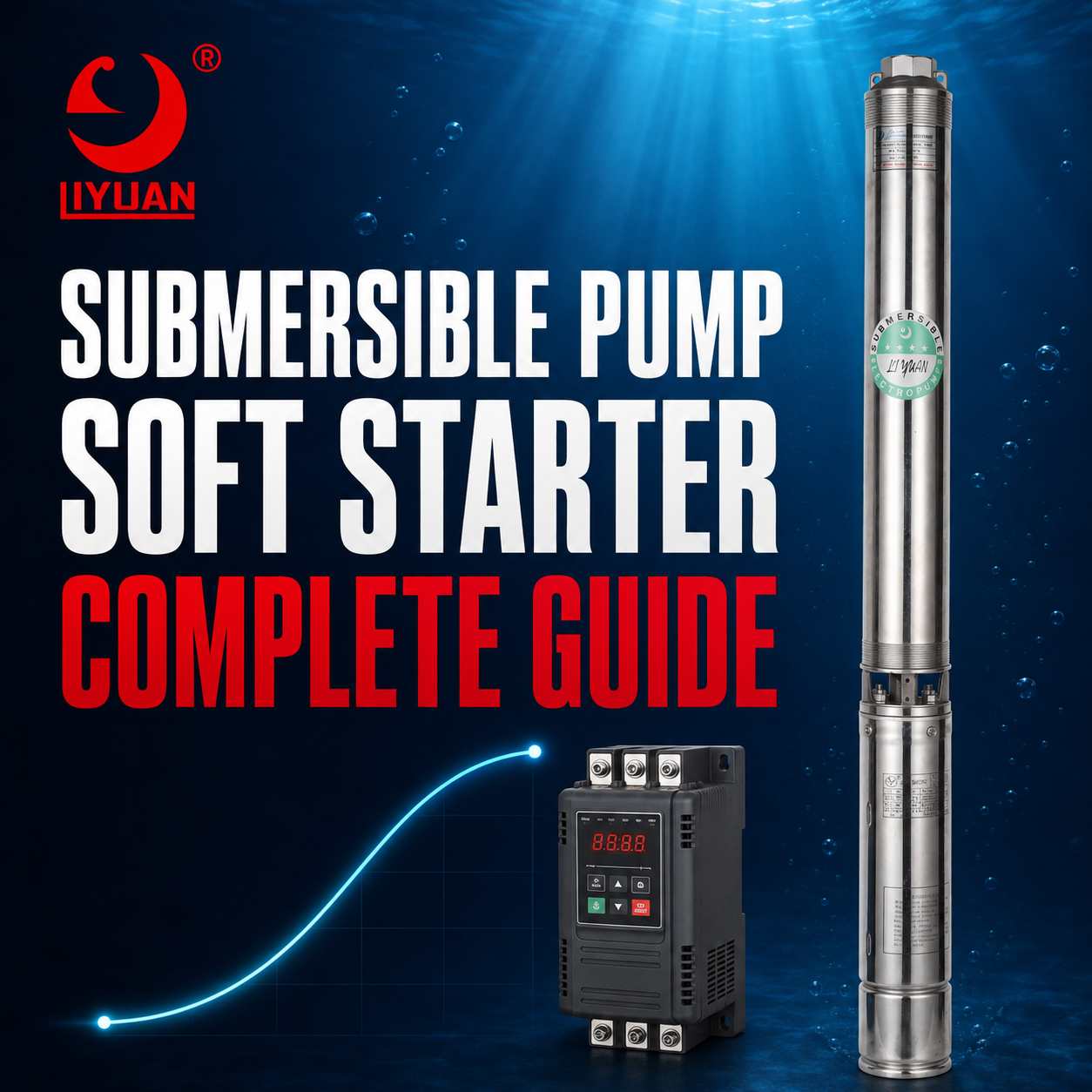
Submersible Pump Soft Starter: Complete Guide
A Submersible Pump Soft Starter Gradually Increases Motor Voltage During Startup, Reducing Starting Current, Voltage Drop, Mechanical Shock, And Pressure Surges.
It Can Also Control Motor Deceleration During Stopping. This Function Helps Reduce Water Hammer In Long Pipelines And High-Pressure Pumping Systems.
A Soft Starter Is Particularly Suitable For Three-Phase Deep Well Pumps That Always Operate At Full Speed But Require A Smoother Start And Stop.
However, The Soft Starter Must Match The Motor Current, Supply Voltage, Starting Time, Starting Frequency, Ambient Temperature, And Required Protection Functions.
What Is A Submersible Pump Soft Starter?
A Submersible Pump Soft Starter Is An Electronic Motor Controller That Regulates The Voltage Supplied To A Pump Motor During Starting And Stopping.
Most Soft Starters Use Silicon-Controlled Rectifiers, Also Called SCRs, To Control Electrical Power.
During Startup, The Device gradually increases Motor Voltage. This Allows The Motor To Accelerate More Smoothly Than A Direct-On-Line Starter.
After The Motor Reaches Full Speed, An Internal Or External Bypass Contactor Usually Connects The Motor Directly To The Power Supply.
The Bypass Contactor Reduces:
- Heat Generation
- Electrical Losses
- SCR Operating Time
- Control-Panel Cooling Requirements
- Continuous Stress On Electronic Components
During Stopping, The Soft Starter Can Gradually Reduce Motor Torque Or Voltage. This Helps Control The Reduction In Pump Flow And Pipeline Pressure.
Why Does A Submersible Pump Need A Soft Starter?
A Deep Well Motor Can Draw Several Times Its Normal Running Current During A Direct Start.
High Starting Current Can Create:
- Supply Voltage Drop
- Generator Instability
- Transformer Stress
- Contactor Wear
- Cable Heating
- Mechanical Shock
- Sudden Pipeline Pressure
- Water Hammer
- Pump Shaft Stress
- Coupling Wear
A Soft Starter Limits The Starting Current And Controls Motor Acceleration.
This Is Particularly Valuable For:
- High-Power Deep Well Pumps
- Long Submersible Cable Runs
- Weak Electrical Networks
- Generator-Powered Pump Systems
- Long Discharge Pipelines
- High-Pressure Water Systems
- Frequent Pump Starting
- Industrial Water Supply
- Municipal Pump Stations
- Agricultural Irrigation Systems
Correct Starting Control Can Extend The Service Life Of The Submersible Pump Motor And Other System Components.
How Does A Submersible Pump Soft Starter Work?
Initial Voltage
When The Start Command Arrives, The Soft Starter Applies A Selected Initial Voltage Or Starting Torque.
This Initial Level Must Be High Enough To Begin Turning The Motor And Pump.
If The Initial Setting Is Too Low, The Motor May Remain Stationary While Drawing High Current. This Condition Can Overheat The Windings.
If The Setting Is Too High, The Motor May Start Too Abruptly. The System Will Lose Many Of The Benefits Of Soft Starting.
Acceleration Ramp
The Soft Starter Then Increases Voltage Over A Preset Time.
As Voltage Increases, The Motor Develops More Torque And Accelerates Toward Full Speed.
The Ramp Time Should Allow Smooth Acceleration Without Keeping The Motor At Reduced Speed For Too Long.
Current Limiting
Many Soft Starters Allow The Installer To Set A Maximum Starting Current.
When The Motor Reaches That Limit, The Starter Controls Voltage To Prevent Current From Increasing Further.
However, Motor Torque Falls Significantly When Voltage Is Reduced. An Extremely Low Current Limit May Prevent The Pump From Accelerating.
The Current Limit Must therefore balance:
- Available Supply Capacity
- Motor Starting Torque
- Pump Load
- Acceptable Starting Time
- Motor Thermal Capacity
Full-Speed Operation
After The Motor Reaches Full Speed, The Bypass Contactor Closes.
The Motor Then Operates At Normal Supply Frequency And Approximately Full Supply Voltage.
Unlike A VFD, A Typical Soft Starter Does Not Continuously Change Motor Speed During Normal Operation.
Controlled Stopping
When The Stop Command Arrives, The Soft Starter Can Gradually Reduce Motor Torque.
The Pump Flow And Discharge Pressure decrease More Smoothly Than They Would During An Immediate Stop.
This Function Can Reduce Water Hammer, Check-Valve Shock, And Pipeline Vibration.
What Are The Main Benefits Of A Pump Soft Starter?
Reduced Starting Current
A Soft Starter Limits The Current Drawn During Motor Acceleration.
This Can Reduce Stress On:
- Transformers
- Generators
- Power Cables
- Contactors
- Circuit Breakers
- Distribution Networks
However, It Does Not Completely Eliminate Starting Current. The Power Source Must Still Provide Enough Current And Torque To Accelerate The Motor.
Reduced Voltage Drop
Large Motors Can Cause A Noticeable Voltage Drop When Started Directly.
This Drop May Affect Lighting, Controllers, Computers, And Other Motors Connected To The Same Network.
A Soft Starter Reduces The Current Peak And Helps Maintain A More Stable Supply.
Reduced Mechanical Stress
Controlled Acceleration Reduces Sudden Torque Applied To:
- Motor Shafts
- Pump Shafts
- Couplings
- Impellers
- Bearings
- Check Valves
- Pipeline Supports
Reduced Mechanical Shock Can Improve Pump Reliability.
Reduced Water Hammer
Water Hammer Occurs When Water Velocity Changes Too Quickly.
It Can Produce:
- Pressure Surges
- Pipe Movement
- Valve Noise
- Check-Valve Damage
- Joint Leakage
- Pipeline Failure
- Pump Vibration
A Controlled Soft Stop Can Reduce The Speed At Which Water Flow Falls.
Schneider Electric Explains That Controlled Motor Deceleration Can Reduce The Risk Of Water Hammer In Pump Applications.
However, A Soft Starter Cannot Correct Every Water-Hammer Problem. Pipeline Design, Valve Selection, Air Chambers, Pressure Tanks, And Check-Valve Location Also Affect Pressure Surges.
Longer Contactor Life
A Direct-On-Line Starter Must Repeatedly Switch High Starting Current.
Reducing That Current Can decrease Contact Wear And Extend Contactor Service Life.
Improved System Monitoring
Advanced Soft Starters Can Display:
- Motor Current
- Supply Voltage
- Starting Time
- Motor Load
- Phase Conditions
- Fault History
- Number Of Starts
- Operating Hours
This Information Makes Preventive Maintenance And Fault Diagnosis Easier.
Submersible Pump Soft Starter Vs. Direct-On-Line Starter
A Direct-On-Line Starter Connects The Motor Directly To Full Supply Voltage.
It Is Simple, Compact, And Cost-Effective. However, It Produces High Starting Current And Rapid Acceleration.
| Feature | Soft Starter | Direct-On-Line Starter |
|---|---|---|
| Starting Current | Reduced And Adjustable | High |
| Acceleration | Controlled | Immediate |
| Stopping | Controlled Or Coast-To-Stop | Coast-To-Stop |
| Water-Hammer Reduction | Available | Limited |
| Mechanical Stress | Lower | Higher |
| Cost | Higher | Lower |
| Setup | Requires Parameter Configuration | Relatively Simple |
| Motor Protection | Often Integrated | Usually Requires Separate Devices |
A Direct-On-Line Starter May Be Suitable For A Small Motor On A Strong Electrical Network.
A Soft Starter Is Often More Suitable For Larger Motors, Weak Networks, Generators, And Long Pipelines.
Submersible Pump Soft Starter Vs. VFD
A Soft Starter And A Variable Frequency Drive Perform Different Functions.
A Soft Starter Controls Motor Voltage Primarily During Starting And Stopping.
A VFD Controls Both Voltage And Frequency, Allowing Continuous Motor-Speed Adjustment.
| Feature | Soft Starter | VFD |
|---|---|---|
| Controlled Starting | Yes | Yes |
| Controlled Stopping | Yes | Yes |
| Continuous Speed Control | No | Yes |
| Pressure Control | Limited | Excellent |
| Flow Adjustment | Limited | Excellent |
| Electrical Complexity | Lower | Higher |
| Harmonic Generation | Mainly During Starting | Continuous During Operation |
| Motor Cable Considerations | Standard Motor-Frequency Supply | PWM Output Requires Additional Evaluation |
| Energy Savings At Reduced Flow | Limited | Potentially Significant |
| Typical Cost | Lower | Higher |
Choose A Soft Starter When The Pump Normally Runs At Full Speed And Only Requires Smooth Starting And Stopping.
Choose A VFD When The System Requires:
- Variable Flow
- Constant Pressure
- Changing Water Demand
- Slow-Fill Control
- Energy Optimization
- Remote Speed Adjustment
- Process Control
An Energy Efficient Submersible Pump Should Be Selected According To Its Complete Operating Profile, Not Only Its Starting Method.
Soft Starter Vs. Star-Delta Starter
A Star-Delta Starter Reduces Starting Current By Initially Connecting The Motor Windings In A Star Configuration.
After Acceleration, The Starter Changes The Motor Connection To Delta.
The Transition Can Produce A Current And Torque Disturbance.
A Soft Starter Provides A More Continuous Acceleration Profile And Does Not Require The Same Motor-Terminal Arrangement.
However, Compatibility Depends On:
- Motor Winding Connections
- Available Motor Leads
- Supply Voltage
- Motor Nameplate
- Control-Panel Design
Many Deep Well Motors Have Limited Accessible Leads. Therefore, Star-Delta Starting May Not Be Practical For Every Submersible Motor.
Which Pump Applications Benefit From Soft Starting?
Deep Well Water Supply
Large Deep Well Submersible Motors Can Produce Significant Starting Current.
Soft Starting Reduces Electrical Stress And Helps Stabilize The Supply Network.
Agricultural Irrigation
Irrigation Pumps Often Use Long Power Cables And Long Water Pipelines.
A Soft Starter Can Reduce Generator Loading, Pipeline Shock, And Check-Valve Impact During Start And Stop.
Municipal Water Systems
Municipal Systems Require High Reliability And Controlled Pressure.
Soft Starters Can Provide Fault Monitoring, Motor Protection, Communication, And Controlled Stopping.
Industrial Water Supply
Industrial Facilities Often Operate Multiple Motors On The Same Distribution Network.
Reducing The Starting Current Of A Large Pump Can Prevent Voltage Disturbances That Affect Other Equipment.
High-Head Pumping
A High Head Submersible Pump Can Produce High Pipeline Pressure.
A Carefully Configured Soft Stop Can Reduce Sudden Pressure Changes. However, The Pipeline And Check Valve Must Also Be Designed For The Maximum System Pressure.
Generator-Powered Pumps
A Soft Starter Can Reduce The Starting Current Required From A Generator.
However, The Generator Must Still provide Stable Voltage, Stable Frequency, And Sufficient Starting Capacity.
Can A Soft Starter Be Used With A Single-Phase Pump?
Most Industrial Soft Starters Are Designed For Three-Phase Squirrel-Cage Induction Motors.
Single-Phase Motors May Use Internal Starting Components, Start Capacitors, Run Capacitors, Or External Control Boxes. These Components Can Make Standard Soft-Starter Operation Incompatible.
Some Manufacturers Offer Controllers Specifically Designed For Certain Single-Phase Motors. However, Compatibility Must Be Confirmed Before Installation.
Never Connect A Standard Three-Phase Soft Starter To A Single-Phase Motor.
The Single Phase Submersible Pump Vs. Three Phase Pump Guide Explains The Main Power-Supply And Control Differences.
How To Select A Submersible Pump Soft Starter
Check The Motor Rated Current
Select The Soft Starter Primarily According To Motor Full-Load Current, Not Only Motor Power.
Two Motors With The Same Kilowatt Rating Can Have Different Rated Currents.
The Starter’s Rated Current Must Meet Or Exceed The Application Requirement After Considering Derating.
Confirm Supply Voltage
The Main Circuit Voltage Range Must Match The Motor And Electrical Supply.
The Control Voltage Must Also Match The Available Control Circuit.
Check:
- Main Supply Voltage
- Control Supply Voltage
- Frequency
- Number Of Phases
- Grounding System
- Auxiliary Power Requirements
Consider Starting Frequency
Frequent Starts Generate Additional Heat Inside The Soft Starter And Motor.
Provide The Manufacturer With:
- Starts Per Hour
- Starting Time
- Running Time
- Stop Time
- Time Between Starts
- Expected Daily Cycles
A Starter Suitable For Occasional Starting May Require Derating In A High-Cycle Application.
Consider Starting Load
Centrifugal Pumps Usually Require Less Starting Torque Than Crushers, Conveyors, Or Positive-Displacement Machines.
However, Pump Conditions Can Increase Starting Torque.
Examples Include:
- A Jammed Impeller
- Sand Accumulation
- Tight Bearings
- A Damaged Shaft
- Incorrect Assembly
- High Mechanical Friction
The Soft Starter Must Allow Enough Torque To Accelerate The Pump safely.
Check Ambient Temperature
A Control Panel Installed In Direct Sunlight Can Become Much Hotter Than The Outside Air.
High Temperature Reduces The Current Capacity Of Electronic Components.
Consider:
- Maximum Ambient Temperature
- Solar Exposure
- Enclosure Ventilation
- Cooling Fans
- Air Conditioning
- Panel Location
- Internal Heat Sources
Check Installation Altitude
High Altitude Reduces Air Density And Cooling Performance.
Soft-Starter Manufacturers May Require Current Derating Above A Specified Altitude.
Check Enclosure Protection
The Panel Enclosure Must Match The Installation Environment.
Potential Hazards Include:
- Rain
- Dust
- Condensation
- Corrosive Chemicals
- High Humidity
- Insects
- Direct Sunlight
- Flooding
An Outdoor Pump Panel May Require A Weather-Resistant Enclosure, Anti-Condensation Heater, Ventilation, Or Cooling System.
Confirm Protection Functions
Not Every Soft Starter Includes Complete Motor And Pump Protection.
Check Whether The Starter Provides:
- Electronic Overload
- Underload Protection
- Dry-Run Protection
- Undervoltage Protection
- Overvoltage Protection
- Phase-Loss Protection
- Phase-Reversal Protection
- Voltage-Imbalance Protection
- Current-Imbalance Protection
- Locked-Rotor Protection
- Ground-Fault Protection
- Excessive-Cycle Protection
- SCR Overtemperature Protection
Additional Relays Or Sensors May Be Required.
How Should A Soft Starter Be Sized?
The Starter Manufacturer Should Confirm The Final Selection.
Provide At Least The Following Information:
- Motor Power
- Motor Rated Current
- Motor Voltage
- Motor Frequency
- Service Factor
- Starting Method
- Pump Type
- Starting Time
- Starts Per Hour
- Ambient Temperature
- Installation Altitude
- Cable Length
- Generator Or Transformer Capacity
- Required Protection Functions
- Enclosure Type
Do Not Select The Starter Only By Matching The Motor’s Kilowatt Or Horsepower Rating.
Current, Duty Cycle, Temperature, And Starting Conditions Can Change The Required Starter Size.
Important Soft-Starter Settings
Motor Rated Current
Enter The Motor Nameplate Current Accurately.
This Value Affects Electronic Overload Protection And Other Calculations.
An Incorrect Current Setting Can Cause Nuisance Trips Or Inadequate Motor Protection.
Initial Voltage Or Starting Torque
Set Enough Initial Torque To Begin Motor Rotation Promptly.
A Setting That Is Too Low Can Produce A Long Stall. A Setting That Is Too High Can Produce A Sudden Start.
Start Ramp Time
The Start Ramp Should Be Long Enough To Reduce Mechanical Shock But Short Enough To Prevent Excessive Motor Heating.
The Correct Time Depends On:
- Motor Power
- Pump Load
- Current Limit
- Supply Strength
- Cable Length
- Motor Thermal Capacity
Current Limit
The Current Limit Should Reduce The Peak Without Preventing Acceleration.
Monitor Actual Starting Current And Acceleration Time During Commissioning.
Kick-Start Function
A Kick Start Applies A Brief Higher-Torque Pulse At The Beginning Of Startup.
It May Help A Load With High Initial Friction.
However, A Centrifugal Pump That Requires A Kick Start May Have A Mechanical Problem. Inspect The Pump Before Increasing This Setting.
Stop Ramp Time
The Stop Ramp Controls How Gradually The Motor Slows.
A Ramp That Is Too Short May Not Reduce Water Hammer.
A Ramp That Is Too Long Can Allow Unwanted Flow Conditions Or Motor Heating.
Observe System Pressure During Commissioning And Adjust The Ramp According To The Pipeline response.
Overload Trip Class
The Overload Trip Class Determines How Quickly The Protection Reacts To Excessive Current.
The Correct Class Depends On Motor Thermal Characteristics And Starting Time.
Follow The Motor Manufacturer’s Requirements.
Restart Delay
A Restart Delay Prevents Immediate Restarting After A Fault Or Power interruption.
It Can Allow:
- The Motor To Cool
- The Well To Recover
- Pipeline Pressure To Stabilize
- Generator Voltage To Recover
- Fault Conditions To Clear
Dry-Run Recovery Time
A Deep Well Pump May Require Time For The Water Level To Recover After A Dry-Run Fault.
Automatic Restart Should Have A Limited Number Of Attempts. Unlimited Cycling Can Damage The Pump And Motor.
Does A Soft Starter Save Energy?
A Soft Starter Primarily Reduces Starting Stress. It Does Not Normally Produce Significant Continuous Energy Savings When The Pump Runs At Full Speed.
After The Bypass Contactor Closes, The Motor Operates Directly From The Power Supply.
Energy Savings Usually Come From:
- Correct Pump Selection
- Efficient Motor Design
- Correct Operating Point
- Low-Friction Pipework
- Proper Valve Selection
- Reduced Cable Loss
- Variable-Speed Operation When Demand Changes
- Regular Maintenance
A VFD May Save Energy When It reduces Pump Speed During Periods Of Lower Flow Demand.
Does A Soft Starter Protect Against Dry Running?
Some Advanced Pump Soft Starters Include Dry-Run Or Underload Protection. Basic Models May Not.
Dry Running Can Produce A Lower Motor Load Because The Pump Is Moving Less Water.
Therefore, Standard Overload Protection May Not Detect It.
Possible Dry-Run Detection Methods Include:
- True-Power Monitoring
- Undercurrent Monitoring
- Power-Factor Monitoring
- Water-Level Electrodes
- Float Switches
- Pressure Sensors
- Flow Sensors
The Franklin Electric IPS-RV Pump Soft Starter Combines Soft Starting With Dry-Run, Voltage, Phase, Overload, Locked-Rotor, And Ground-Fault Protection.
Does A Soft Starter Prevent Water Hammer?
A Correctly Configured Soft Stop Can Reduce Water Hammer, But It Cannot Guarantee Complete Elimination.
Water Hammer Also Depends On:
- Pipeline Length
- Pipe Diameter
- Water Velocity
- Static Head
- Check-Valve Type
- Check-Valve Location
- Valve Closing Speed
- Pressure Tank Size
- Air Chambers
- Pipeline Elasticity
- System Elevation
ABB States That Torque-Controlled Pump Stopping Can Help Reduce Pressure Surges And Water Hammer In Pump Systems.
A Hydraulic Engineer Should Evaluate Systems With Long Pipelines, High Flow, Or High Static Head.
Common Soft-Starter Faults
Motor Fails To Start
Possible Causes Include:
- Insufficient Initial Torque
- Current Limit Set Too Low
- Missing Phase
- Incorrect Wiring
- Low Supply Voltage
- Locked Pump
- Incorrect Control Signal
- Failed Contactor
- Active Protection Fault
Starting Time Is Too Long
Possible Causes Include:
- Ramp Time Set Too Long
- Current Limit Set Too Low
- Low Supply Voltage
- Excessive Pump Friction
- Incorrect Starter Size
- Undersized Generator
- Mechanical Obstruction
Starter Trips On Overload
Possible Causes Include:
- Incorrect Motor Current Setting
- Excessive Starting Time
- Frequent Starts
- Pump Mechanical Resistance
- Excessive Hydraulic Load
- Low Voltage
- Phase Imbalance
- Incorrect Overload Class
Starter Reports Phase Loss
Check:
- Supply Fuses
- Circuit Breaker Contacts
- Contactor Poles
- Cable Connections
- Generator Output
- Transformer Connections
- Motor Conductors
SCR Overtemperature Fault
Possible Causes Include:
- Excessive Starting Frequency
- Blocked Ventilation
- Failed Cooling Fan
- High Ambient Temperature
- Undersized Starter
- Excessive Starting Time
- Failed Bypass Contactor
Water Hammer Remains After Adjustment
Check:
- Soft-Stop Mode
- Stop Ramp Time
- Check-Valve Operation
- Pipeline Supports
- Water Velocity
- Air Chambers
- Pressure Tanks
- Valve Closing Characteristics
The Best Setting Must Be Determined From Actual System Pressure And Flow Behavior.
How To Install A Pump Soft Starter
Only Qualified Electrical Personnel Should Install And Commission The Equipment.
The Installation Should Include:
- Confirm The Motor And Starter Ratings.
- Verify Supply Voltage And Phase Sequence.
- Install Short-Circuit Protection.
- Install An Approved Disconnect.
- Size Power Cables Correctly.
- Connect Grounding And Bonding.
- Verify Control Wiring.
- Configure Motor Parameters.
- Test Without Automatic Restart.
- Measure Starting Voltage And Current.
- Confirm Correct Motor Rotation.
- Monitor Acceleration Time.
- Test Protection Functions.
- Observe Pipeline Pressure During Stopping.
- Record Final Settings.
The Soft Starter Should Form Part Of A Properly Designed Submersible Pump Control System.
How To Troubleshoot A Repeated Soft-Starter Trip
Record The Fault Code
Do Not Reset The Device Before Recording The Fault Information.
Record:
- Fault Code
- Motor Current
- Supply Voltage
- Starting Time
- Running Time
- Pump Pressure
- Water Level
- Number Of Starts
- Ambient Temperature
Measure All Three Supply Voltages
Measure Voltage Before Starting, During Acceleration, And At Full Load.
A Severe Starting Drop May Indicate A Weak Supply, Undersized Generator, Long Cable, Or Poor Connection.
Measure All Three Motor Currents
Compare Current Between Phases And With The Motor Nameplate.
Unequal Current Can Indicate:
- Voltage Imbalance
- Loose Connections
- Damaged Cable
- Winding Problems
- Incorrect Starter Operation
Inspect The Bypass Contactor
A Failed Bypass Contactor Can Leave Current Flowing Through The SCRs During Continuous Operation.
This Can Cause Excessive Heat And A Starter Overtemperature Fault.
Check The Pump Mechanically
A Jammed Impeller, Sand Accumulation, Tight Bearing, Bent Shaft, Or Damaged Coupling Can Prevent Normal Acceleration.
The How To Check A Submersible Pump Motor Guide Provides Additional Electrical Testing Information.
Review Protection Settings
Confirm:
- Motor Current
- Starting Ramp
- Current Limit
- Overload Class
- Voltage Limits
- Phase-Imbalance Limit
- Restart Delay
- Maximum Starts
- Dry-Run Threshold
Never Increase Protection Limits Merely To Stop Nuisance Trips.
Frequently Asked Questions
What Does A Submersible Pump Soft Starter Do?
It Gradually Controls Motor Voltage Or Torque During Starting And Stopping. This Reduces Starting Current, Voltage Drop, Mechanical Shock, And Water Hammer.
Can A Soft Starter Control Pump Speed?
A Typical Soft Starter Does Not Provide Continuous Speed Control. Use A VFD When The Application Requires Adjustable Flow Or Constant Pressure.
Is A Soft Starter Suitable For Every Submersible Pump?
No. The Motor Type, Voltage, Current, Number Of Phases, Starting Duty, And Manufacturer Requirements Must Be Compatible.
Can A Soft Starter Work With A Generator?
Yes, If The Generator Has Enough Capacity And Stable Voltage And Frequency. The Soft Starter Can Reduce Starting Current, But It Cannot Correct An Undersized Or Unstable Generator.
Does A Soft Starter Need A Bypass Contactor?
Many Modern Soft Starters Include A Built-In Bypass. Other Models Require An External Contactor. Follow The Manufacturer’s Wiring Instructions.
Can A Soft Starter Replace A Circuit Breaker?
No. The Installation Still Requires Correct Short-Circuit And Branch-Circuit Protection.
Can A Soft Starter Replace A Motor Overload Relay?
Some Models Include Electronic Motor Overload Protection. Basic Models May Require A Separate Overload Device.
Why Does The Motor Hum Without Starting?
The Initial Torque Or Current Limit May Be Too Low. Low Voltage, Phase Loss, Or A Mechanically Locked Pump Can Also Cause This Problem.
Can A Soft Starter Reduce Water Hammer?
A Controlled Soft Stop Can Reduce Water Hammer. However, Pipeline Design, Check Valves, Water Velocity, And Pressure-Control Components Also Affect The Result.
How Long Should The Starting Ramp Be?
There Is No Universal Setting. The Motor Should Accelerate Smoothly Without Remaining At Reduced Speed Long Enough To Overheat.
Choose A Reliable Pump Starting Solution From Liyuan
Liyuan Manufactures Deep Well Pumps, Submersible Motors, Solar Pump Systems, And Control Solutions For Agricultural, Commercial, Municipal, And Industrial Applications.
A Complete Starting Solution Can Be Selected According To:
- Pump Flow
- Total Dynamic Head
- Motor Power
- Rated Current
- Supply Voltage
- Cable Length
- Generator Capacity
- Starting Frequency
- Pipeline Design
- Required Protection Functions
Providing Complete Operating Data Helps Liyuan Match The Pump, Motor, Cable, Soft Starter, And Control Panel Correctly.
Conclusion
A Submersible Pump Soft Starter Reduces Starting Current, Voltage Drop, Mechanical Shock, And Pipeline Pressure Surges.
It Is Most Suitable For Three-Phase Pumps That Normally Run At Full Speed But Need Controlled Starting And Stopping.
Correct Selection Requires More Than Matching Motor Power. The Installer Must Evaluate Rated Current, Voltage, Starting Time, Starts Per Hour, Ambient Temperature, Cable Length, Power-Supply Capacity, And Protection Requirements.
A Soft Starter Should Be Configured With Accurate Motor Data And Tested Under Actual Pumping Conditions.
When Correctly Selected And Commissioned, It Can Protect The Motor, Reduce Water Hammer, Improve System Reliability, And Extend The Service Life Of The Complete Deep Well Pumping System.
Email:Liyuan@liyuan-pump.com
WhatsApp:+86 181-2828-2767