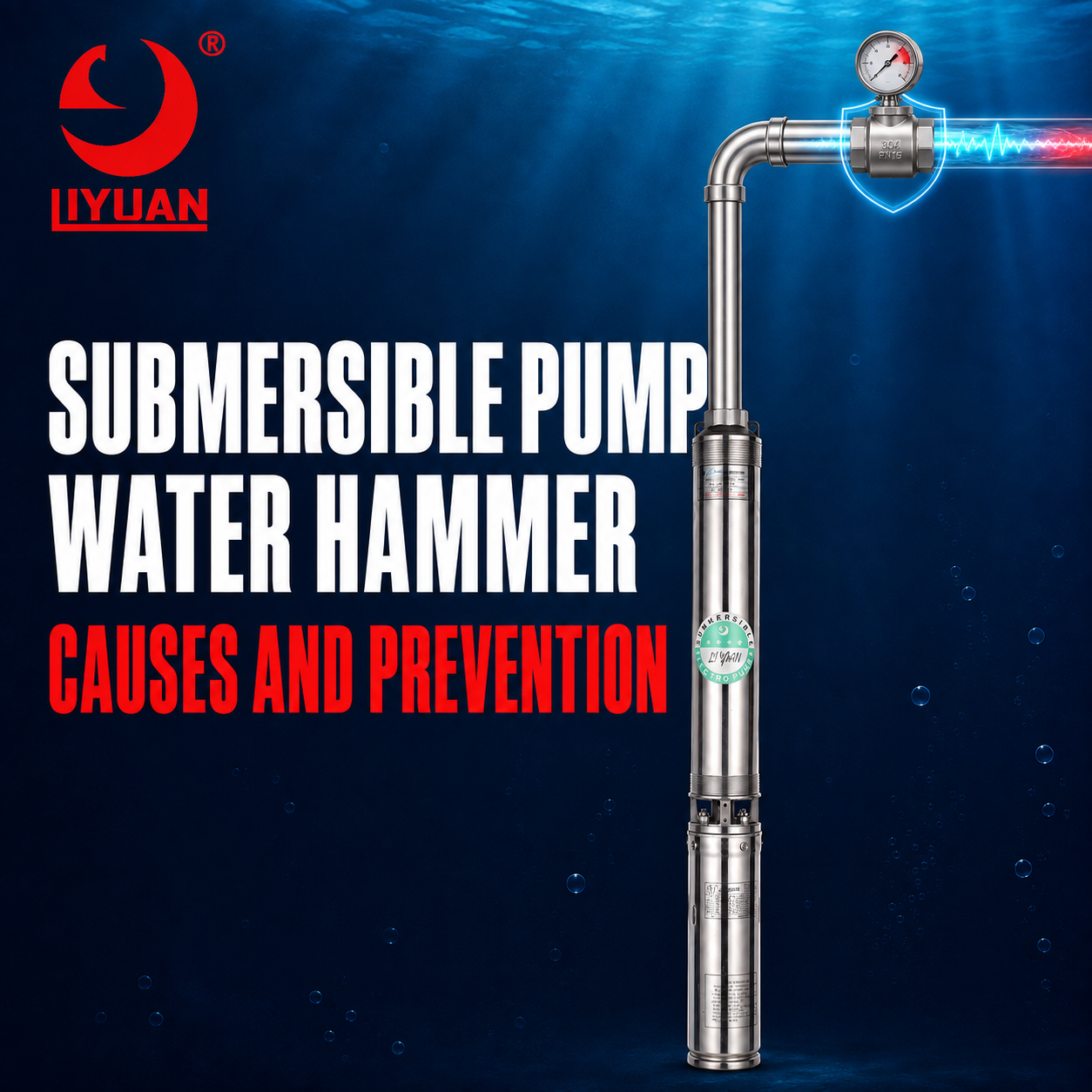
Submersible Pump Water Hammer: Causes And Prevention Guide
Submersible Pump Water Hammer Occurs When Water Velocity Changes Suddenly, Creating A Pressure Wave That Travels Through The Pipeline.
The Pressure Wave Can Damage Pump Components, Check Valves, Drop Pipes, Pressure Tanks, Gauges, Fittings, And Pipeline Joints.
Common Causes Include Sudden Pump Stopping, Rapid Valve Closure, Check-Valve Slam, Air Pockets, Column Separation, Incorrect Valve Location, And Poorly Configured Starting Equipment.
The Best Prevention Method Depends On Pipeline Length, Flow Velocity, Static Head, Pump Inertia, Valve-Closing Time, Pipe Material, And System Layout.
What Is Submersible Pump Water Hammer?
Water Hammer Is A Hydraulic Pressure Surge Caused By A Rapid Change In Water Velocity.
When A Pump Starts, Stops, Or Changes Speed, Water Inside The Pipeline must accelerate or decelerate.
If This Change Happens Too Quickly, The Water’s Momentum Produces A Pressure Wave.
The Wave Travels Through The Pipeline Until It Reaches:
- A Closed Valve
- A Check Valve
- A Pressure Tank
- A Pipe Bend
- A Pump
- A Change In Pipe Diameter
- A Reservoir
- Another Hydraulic Boundary
The Wave Can Reflect Back And Forth Several Times.
Operators May Hear A Loud Bang, Knocking Sound, Or Repeated Vibration.
However, Not Every Pressure Surge Produces A Noticeable Sound. A System Can Experience Damaging Transient Pressure Without Obvious Noise.
How Does Water Hammer Develop?
Water Moving Through A Pipeline Has Momentum.
When The Flow Stops Suddenly, That Momentum Cannot Disappear Immediately. It Converts Into Pressure And Elastic Deformation Of The Water And Pipe.
The Basic Pressure Change Can Be Estimated With The Joukowsky Relationship:
ΔP = ρ × A × ΔV
Where:
- ΔP Represents Pressure Change
- ρ Represents Fluid Density
- A Represents Pressure-Wave Speed
- ΔV Represents Change In Water Velocity
A Larger Velocity Change Can Produce A Larger Pressure Surge.
However, Real Pump Systems Require More Detailed Analysis because they include:
- Pump Inertia
- Valve Movement
- Pipe Elasticity
- Air Pockets
- Elevation Changes
- Multiple Reflections
- Cavitation
- Column Separation
- Branch Pipelines
- Pressure-Control Devices
Engineers Should Use Hydraulic Transient Analysis For Long, High-Flow, Or High-Pressure Pipelines.
What Causes Submersible Pump Water Hammer?
Sudden Pump Stopping
When A Running Pump Stops, Forward Water Velocity Begins To decrease.
A Sudden Electrical Power Failure Can Stop Motor Torque Immediately. The Water Column May Continue Moving Due To Momentum.
Pressure Can Fall Near The Pump And Rise Elsewhere In The Pipeline.
Depending On The System, Flow May Reverse Before A Check Valve closes.
Rapid Pump Starting
A Large Pump That Starts Directly At Full Voltage Can Accelerate Water Quickly.
The Rapid Flow Increase Can Produce A Positive Pressure Surge.
The Risk Becomes Greater When The System Has:
- A Long Pipeline
- A High-Flow Pump
- A Large Motor
- A Closed Or Partially Closed Valve
- Trapped Air
- High Static Pressure
- Multiple Check Valves
Check-Valve Slam
Check-Valve Slam Occurs When Reverse Flow Develops Before The Valve closes.
The Valve Disc Then Closes rapidly against the moving water.
This Sudden Flow Interruption Creates A Pressure Wave And A Loud Impact.
A Poorly Selected Submersible Pump Check Valve Can Cause Repeated Water-Hammer Events.
Leaking Check Valve
A Leaking Check Valve Allows Water To Flow Back Toward The Well After The Pump Stops.
The Pipeline May Partially Drain Or Develop A Low-Pressure Area.
When The Pump Starts Again, Water Moves Rapidly Into The Empty Or Partially Empty Section.
The Moving Water Column Can Strike A Closed Valve Or Stationary Water Column And Create A Severe Pressure Surge.
Incorrect Check-Valve Location
Incorrect Valve Placement Can Allow A Partial Vacuum Or Separated Water Column To Form.
Grundfos Notes That Certain Well Installations Can Experience Water Hammer From Check-Valve Location Or Leakage.
Valve Requirements Depend On Pump Design, Well Depth, Drop-Pipe Length, Local Codes, And Manufacturer Instructions.
Do Not Add Multiple Check Valves Without Evaluating Their Hydraulic Interaction.
Rapid Valve Closure
A Fast-Closing Discharge Valve Can Stop Water Velocity abruptly.
Common Examples Include:
- Solenoid Valves
- Zone Valves
- Automatic Irrigation Valves
- Quick-Closing Ball Valves
- Emergency Shutoff Valves
- Actuated Process Valves
The Faster The Closure Relative To The Pipeline’s Wave-Travel Time, The Greater The Potential Pressure Surge.
Air Pockets
Air Can Accumulate At High Points, Pipe Bends, Or Poorly Vented Sections.
Compressed Air Can Expand And Collapse As Pressure Changes.
A Moving Water Column May strike a trapped air pocket or force it through the system.
This Can Create:
- Pressure Fluctuation
- Flow Interruption
- Vibration
- Noise
- Unstable Check-Valve Operation
Water-Column Separation
If Pressure Falls To A Very Low Level, The Water Column Can Separate.
Vapor Cavities Or Voids May Form Inside The Pipeline.
When The Separated Columns Rejoin, Their Collision Can Produce A Severe Pressure Spike.
Column Separation Is Particularly Dangerous In Pipelines With:
- Large Elevation Changes
- High Flow Velocity
- Sudden Pump Shutdown
- Long Downhill Sections
- Inadequate Air Valves
Excessive Water Velocity
Higher Water Velocity means greater momentum.
An Undersized Pipeline Increases Velocity And Friction Loss.
Therefore, Pipe Diameter Affects Both Normal Efficiency And Transient Pressure.
A High Flow Deep Well Pump Requires Careful Pipeline Sizing And Surge Evaluation.
Long Pipelines
A Longer Pipeline Contains A Larger Moving Water Mass.
It Also Provides More Distance For Pressure Waves To Travel And Reflect.
Long Agricultural, Municipal, Mining, And Industrial Pipelines often require dedicated transient analysis.
High Static Head
High-Elevation Water Systems Already Operate Under Significant Static Pressure.
A Water-Hammer Surge Adds To Normal Operating Pressure.
The Combined Pressure Can Exceed The Rating Of:
- Pipes
- Flanges
- Fittings
- Pressure Tanks
- Check Valves
- Gauges
- Pump Components
A High Head Submersible Pump Should Be Installed With Correctly Rated Hydraulic Components.
Incorrect Soft-Starter Settings
A Soft Starter Can Reduce Starting And Stopping Shock.
However, An Incorrect Ramp May Produce Poor Results.
A Starting Ramp That Is Too Short Can Accelerate Water Too Quickly.
A Stopping Ramp That Is Too Short May Not Reduce The Pressure Surge.
A Ramp That Is Too Long Can also create unstable check-valve behavior in certain systems.
Incorrect VFD Settings
A VFD Can Control Pump Acceleration And Deceleration.
However, Incorrect Settings Can Cause:
- Rapid Speed Changes
- Pressure Overshoot
- PID Oscillation
- Sudden Sleep-Mode Stopping
- Rapid Restarting
- Check-Valve Instability
The Drive Settings Must Match The Pump Curve And Pipeline Response.
What Damage Can Water Hammer Cause?
Drop-Pipe Damage
Repeated Pressure Waves Can Loosen Threaded Joints, Stress Couplings, And Crack Weak Pipe Sections.
A Severe Surge Can Separate A Drop Pipe And Allow The Pump To Fall Deeper Into The Well.
Check-Valve Failure
Valve Slam Can Damage:
- Valve Discs
- Springs
- Hinges
- Seals
- Seats
- Retaining Components
A Damaged Valve Then Creates More Reverse Flow And Stronger Future Surges.
Pump Damage
Pressure Waves Can Apply Abnormal Hydraulic Loads To:
- Impellers
- Diffusers
- Pump Shafts
- Couplings
- Bearings
- Pump Bowls
Repeated Surges Can Reduce Pump Service Life.
Motor-Thrust Damage
Rapid Pressure And Flow Changes Can alter axial thrust inside a multistage pump.
Abnormal Upthrust Or Downthrust Can Stress The Motor Thrust Bearing.
Pressure-Tank Damage
Transient Pressure Can Exceed The Normal Cut-Out Pressure.
Repeated Surges May Stress:
- Tank Shell
- Bladder
- Diaphragm
- Connections
- Tank Tee
- Relief Valve
A Pressure Tank Should Never Serve As The Only Protection Against Severe Hydraulic Transients.
Pipeline And Fitting Failure
Water Hammer Can Cause:
- Burst Pipes
- Cracked Fittings
- Flange Leakage
- Joint Separation
- Pipe-Support Failure
- Seal Damage
- Instrument Failure
Pressure-Gauge Damage
A Standard Gauge May Not Respond Fast Enough To Display The Highest Transient Pressure.
Repeated Pulses Can Damage The Gauge Mechanism.
A Transient Pressure Recorder May Be Required For Accurate Diagnosis.
Common Signs Of Water Hammer
Possible Symptoms Include:
- Loud Banging After Pump Shutdown
- Repeated Knocking In The Pipeline
- Sudden Pipe Movement
- Check-Valve Impact Noise
- Pressure-Gauge Needle Jumping
- Repeated Pipe Leakage
- Broken Fittings
- Damaged Pressure Switches
- Premature Check-Valve Failure
- Pump Movement Inside The Well
- Vibration During Starting
- Unexplained Pressure-Tank Damage
- Sudden Pressure Loss Followed By A Surge
The Timing Of The Noise Provides An Important Clue.
Noise During Startup May Indicate A Partially Empty Pipe Or Air Pocket.
Noise During Shutdown May Indicate Flow Reversal Or Check-Valve Slam.
Water Hammer Vs. Cavitation
Water Hammer And Cavitation Are Different Hydraulic Problems.
| Feature | Water Hammer | Cavitation |
|---|---|---|
| Main Cause | Rapid Flow-Velocity Change | Local Pressure Falls Below Vapor Pressure |
| Typical Sound | Bang Or Knock | Crackling Or Gravel-Like Noise |
| Main Location | Pipeline, Valves, And Pump | Pump Impeller Or Low-Pressure Area |
| Damage | Pressure Surge And Structural Stress | Pitting, Erosion, And Vibration |
| Common Trigger | Fast Stop Or Valve Closure | Insufficient Inlet Pressure Or Flow Restriction |
Water-Column Separation Can Involve Vapor Formation And Later Produce A Water-Hammer Surge when the columns rejoin.
Therefore, Some Systems Can Experience Both Problems.
Water Hammer Vs. Air In The Pipeline
Trapped Air Can Produce Noise And Pressure instability, But Not Every Air-Related Noise Is Classical Water Hammer.
Air-Related Symptoms May Include:
- Sputtering Faucets
- Irregular Flow
- Gurgling
- Pressure Fluctuation
- Pump-Loss-Of-Prime Symptoms
- Vibration At High Points
Air Pockets Can Also Contribute To Hydraulic Transients.
Install Air-Release And Vacuum Valves Only After A Qualified Engineer Evaluates Their Location And Size.
How To Prevent Submersible Pump Water Hammer
Select The Correct Pump
An Oversized Pump Can Produce Excessive Flow And Velocity.
Select The Pump According To:
- Required Flow
- Total Dynamic Head
- Well Capacity
- Pipe Diameter
- Normal Demand
- Maximum Pressure
- Pumping Water Level
Correct Submersible Pump Selection Reduces The Need For Excessive Throttling And Rapid Control Changes.
Size The Pipeline Correctly
The Pipeline Should Limit Water Velocity And Friction Loss To Appropriate Design Values.
The Correct Diameter Depends On:
- Flow Rate
- Pipe Material
- Pipeline Length
- Pressure Rating
- Elevation
- Transient Conditions
- Local Standards
A Larger Pipe Can Reduce Normal Velocity, But Engineers must still evaluate transient behavior.
Use A Suitable Check Valve
Check-Valve Selection Should Consider:
- Normal Flow
- Minimum Flow
- Reverse Velocity
- Closing Speed
- Orientation
- Pressure Rating
- Water Quality
- Installation Location
- Maintenance Access
A Non-Slam Or Spring-Assisted Valve May close before significant reverse flow develops.
However, The Fastest-Closing Valve Is Not Automatically The Best Choice. Valve Dynamics Must Match The System.
Install Check Valves Correctly
Follow The Pump And Valve Manufacturer’s Requirements For:
- Valve Quantity
- Spacing
- Location
- Orientation
- Pressure Rating
- Installation Depth
- Pipe Support
Too Many Valves Can Create Trapped Water Sections And Complex Pressure reflections.
Use Controlled Pump Starting
A Soft Starter Or VFD Can Reduce Rapid Flow Acceleration.
The Starting Time Should Allow The Pump To Build Flow Smoothly Without Keeping The Motor At Reduced Speed Too Long.
Use Controlled Pump Stopping
Torque-Controlled Or Speed-Controlled Stopping Can Reduce Flow More Gradually.
ABB Explains That Its Pump Soft Starters Use Torque Control To Reduce Water Hammer During Pump Stopping.
However, Electronic Control Cannot Provide A Controlled Stop During Every Power Failure.
Critical Systems May Need Additional Hydraulic Protection.
Install A Surge Vessel
A Surge Vessel Contains Compressed Air Or Gas Separated From Water By A Bladder Or Diaphragm.
It Can Absorb Excess Pressure Or Supply Water When Pressure falls.
Surge Vessels Require Correct:
- Volume
- Precharge
- Pressure Rating
- Connection Size
- Installation Location
- Maintenance
A Normal Residential Pressure Tank May Not Have Enough Capacity For A Large Pipeline Surge.
Install Air And Vacuum Valves
Air-Release Valves Remove Accumulated Air During Operation.
Vacuum Valves Admit Air When Internal Pressure Falls Too Low.
Combination Air Valves Can Perform Both Functions.
Incorrect Sizing Or Location Can Make Transient Conditions Worse. Therefore, Engineers Should Model Large Systems Before Installation.
Use Slow-Closing Valves
Slower Valve Closure Reduces The Rate Of Flow Change.
Possible Solutions Include:
- Controlled Electric Actuators
- Hydraulic Dashpots
- Multi-Stage Valve Closure
- Adjustable Solenoid-Valve Timing
- Slow-Closing Check Valves
Valve-Closing Time Should Match The Hydraulic characteristics of the pipeline.
Install Pressure-Relief Or Surge-Anticipation Valves
A Pressure-Relief Valve Opens When Pressure Exceeds Its Setpoint.
A Surge-Anticipation Valve Can Respond To A Pressure Drop Associated With Pump Shutdown And Open Before The Returning High-Pressure Wave Arrives.
These Valves Require:
- Correct Sizing
- Reliable Discharge Routing
- Periodic Testing
- Suitable Pressure Settings
- Maintenance Access
Reduce Pump Speed Gradually
A VFD Can reduce speed according to a programmed deceleration ramp.
The Drive Can Also Stage Multiple Pumps To Avoid Sudden Flow Changes.
However, Minimum Motor Speed And Cooling Requirements Still Apply.
Control Multiple Pumps Sequentially
Starting Or Stopping Several Pumps Simultaneously Can Produce A Large Flow Change.
A Pump Controller Can:
- Start Pumps Sequentially
- Stop Pumps Sequentially
- Add Time Delays
- Alternate Lead Pumps
- Limit Pressure Change
- Match Demand Gradually
Support The Pipeline Properly
Pressure Surges Create Dynamic Forces At:
- Pipe Bends
- Tees
- Valves
- Reducers
- Dead Ends
- Elevation Changes
Correct Anchors, Guides, And Supports Prevent Excessive Movement.
Why A Soft Starter Cannot Solve Every Water-Hammer Problem
A Soft Starter Can Control Motor Torque During Normal Starting And Stopping.
However, It Cannot Automatically Correct:
- Check-Valve Leakage
- Poor Valve Location
- Trapped Air
- Column Separation
- Undersized Pipework
- Sudden Utility Power Failure
- Rapid Downstream Valve Closure
- Incorrect Pipeline Supports
A Complete Solution Requires Both Electrical And Hydraulic Analysis.
Why A VFD Cannot Solve Every Water-Hammer Problem
A VFD Can Control Pump Speed During Planned Operation.
However, It May Stop Quickly During:
- Power Failure
- Ground Fault
- Short Circuit
- Emergency Shutdown
- Drive Fault
- Motor Fault
During These Events, The System May Still experience a severe transient.
Consider Surge Vessels, Air Valves, Check-Valve Design, Or Emergency Power When The Application Is Critical.
How To Diagnose Water Hammer
Record When The Noise Occurs
Determine Whether The Event Occurs During:
- Pump Starting
- Pump Stopping
- Valve Opening
- Valve Closing
- Power Failure
- Zone Change
- Pressure-Switch Operation
- VFD Speed Change
Measure Normal Operating Conditions
Record:
- Pump Flow
- Discharge Pressure
- Motor Frequency
- Motor Current
- Valve Position
- Tank Pressure
- Water Level
- Pumping Water Level
Use A Fast Pressure Recorder
A Standard Gauge May Miss A Short-Duration Surge.
Use A Pressure Transducer And Data Logger With A Suitable Sampling Rate.
Install Sensors At Important Locations Such As:
- Pump Discharge
- Pipeline High Point
- Check Valve
- Pressure Tank
- Remote Pipeline End
- Major Valve
Inspect Check Valves
Check For:
- Leakage
- Worn Springs
- Damaged Discs
- Incorrect Orientation
- Loose Internal Parts
- Delayed Closure
- Excessive Closing Speed
- Incorrect Valve Size
Check For Pipeline Drainage
Determine Whether The Drop Pipe Or Discharge Pipeline Remains Full After Shutdown.
A Pressure Drop Without Water Demand May Indicate:
- Leaking Check Valve
- Pipeline Leak
- Failed Pressure Tank
- Faulty Isolation Valve
Inspect Air-Valve Operation
Confirm That Air And Vacuum Valves Are:
- Correctly Located
- Correctly Sized
- Free From Blockage
- Properly Maintained
- Rated For System Pressure
Review Control Parameters
Check:
- Start Ramp
- Stop Ramp
- Current Limit
- VFD Acceleration
- VFD Deceleration
- PID Settings
- Sleep Mode
- Restart Delay
- Valve Timing
- Pump Sequencing
Perform Hydraulic Transient Analysis
A Professional Model Can Simulate:
- Pump Trip
- Power Failure
- Valve Closure
- Check-Valve Behavior
- Air-Valve Operation
- Surge-Vessel Performance
- Column Separation
- Maximum And Minimum Pressure
The Model Should Use Accurate Pump Curves, Pipeline Data, Valve Characteristics, And Operating Conditions.
Water-Hammer Prevention For Residential Wells
Residential Systems Should Check:
- Pressure-Tank Precharge
- Pressure-Switch Settings
- Tank Drawdown
- Check-Valve Condition
- Pipe Support
- Flow Velocity
- Rapid-Closing Valves
- Electronic Controller Settings
A Waterlogged Pressure Tank Can Increase Pump Cycling And Pressure instability.
Water-Hammer Prevention For Agricultural Irrigation
Agricultural Systems Often Include Long Pipelines And Rapidly Operating Zone Valves.
Important Measures Include:
- Sequential Zone Operation
- Slow Valve Closure
- Correct Pipe Diameter
- Pump-Speed Control
- Surge Protection
- Air-Valve Installation
- Pressure Monitoring
- Check-Valve Maintenance
The Agricultural Applications Of Deep Well Submersible Pumps Guide Explains Additional Irrigation Requirements.
Water-Hammer Prevention For Municipal Systems
Municipal And Industrial Pipelines Require A Formal Transient Study When Failure Could Cause Major Damage Or Service Interruption.
Engineers Should Evaluate:
- Simultaneous Pump Trips
- Utility Power Failure
- Emergency Valve Closure
- Maximum Surge Pressure
- Minimum Transient Pressure
- Pump Restart Sequence
- Backup Power
- Surge-Vessel Capacity
- Air-Valve Performance
- Pipeline Pressure Class
How To Maintain A Surge-Control System
A Preventive Maintenance Program Should Include:
- Testing Check Valves
- Inspecting Surge Vessels
- Checking Vessel Precharge
- Testing Relief Valves
- Cleaning Air Valves
- Reviewing VFD Fault Logs
- Testing Soft-Starter Operation
- Recording Pressure Transients
- Inspecting Pipe Supports
- Checking Flange Bolts
- Inspecting Pipeline Leakage
- Reviewing Pump Performance
The Electric Submersible Pump Maintenance Guide Provides Additional Pump-System Maintenance Recommendations.
Information Required For Water-Hammer Analysis
Provide The Following Information To The Pump Or Hydraulic Engineer:
- Pump Model
- Pump Curve
- Motor Power
- Normal Flow
- Maximum Flow
- Total Dynamic Head
- Pipeline Length
- Internal Pipe Diameter
- Pipe Material
- Pipe Wall Thickness
- Pipeline Elevation Profile
- Valve Types
- Valve-Closing Times
- Check-Valve Characteristics
- Pressure-Tank Data
- Surge-Vessel Data
- Air-Valve Locations
- Pump Starting Method
- Pump Stopping Method
- Multiple-Pump Sequence
- Minimum Operating Pressure
- Maximum Allowable Pressure
- Power-Failure Conditions
Accurate Data Produces A More Reliable Hydraulic Model.
Frequently Asked Questions
What Causes Water Hammer In A Submersible Pump System?
Common Causes Include Sudden Pump Stopping, Rapid Valve Closure, Check-Valve Slam, Leaking Check Valves, Trapped Air, And Water-Column Separation.
Can Water Hammer Damage A Submersible Pump?
Yes. It Can Damage Impellers, Diffusers, Shafts, Bearings, Couplings, Drop Pipes, Valves, And Motor Thrust Components.
Why Does My Well Pipe Bang When The Pump Stops?
Flow May Reverse Before The Check Valve closes. The valve can then slam against the moving water and create a pressure surge.
Why Does The Pipe Bang When The Pump Starts?
The Pipeline May Have Drained Partially, Developed A Vacuum, Or Contained Trapped Air. The Incoming Water Column May Hit A Closed Valve Or Stationary Water.
Can A Pressure Tank Stop Water Hammer?
A Properly Sized Tank Can Cushion Small Pressure changes. A severe transient may require a dedicated surge vessel or other protection.
Will A Soft Starter Eliminate Water Hammer?
It Can Reduce Starting And Stopping Surges. However, It Cannot Correct Check-Valve Leakage, Trapped Air, Poor Pipeline Design, Or Every Power-Failure Event.
Can A VFD Prevent Water Hammer?
A VFD Can Control Pump Acceleration And Deceleration. Additional Hydraulic Protection May Still Be Required.
Is Water Hammer The Same As Cavitation?
No. Water Hammer Results From Rapid Flow-Velocity Change. Cavitation Results When Local Pressure Falls Low Enough For Vapor Bubbles To Form.
Can Adding More Check Valves Prevent Water Hammer?
Not Always. Incorrect Quantity Or Placement Can Create Trapped Sections And More Complex Pressure Waves.
How Can I Measure A Water-Hammer Pressure Spike?
Use A Fast Pressure Transducer And Data Logger. A Standard Mechanical Gauge May Not Capture The Maximum Transient Pressure.
Choose A Reliable Deep Well Pump Solution From Liyuan
Liyuan Manufactures Deep Well Pumps, Submersible Motors, Solar Pump Systems, And Control Solutions For Residential, Agricultural, Commercial, Municipal, And Industrial Applications.
A Complete Pump System Should Match:
- Pump Flow
- Total Dynamic Head
- Pipeline Diameter
- Motor Power
- Starting Method
- Check Valves
- Pressure Tanks
- Surge Protection
- Control Equipment
Understanding How A Submersible Pump Works Helps Buyers Coordinate The Pump With The Complete Hydraulic System.
Conclusion
Submersible Pump Water Hammer Is A Pressure Surge Caused By A Rapid Change In Water Velocity.
Common Causes Include Sudden Pump Stopping, Fast Valve Closure, Check-Valve Slam, Trapped Air, Column Separation, And Incorrect Starting Or Stopping Controls.
A Soft Starter Or VFD Can Reduce Planned Starting And Stopping Surges. However, These Devices Cannot Correct Every Hydraulic Problem.
Long, High-Flow, Or High-Pressure Pipelines Should Use Professional Transient Analysis To Determine Maximum And Minimum Pressure.
Correct Pump Selection, Pipeline Sizing, Check-Valve Design, Surge Protection, Control Settings, And Regular Maintenance Can Protect The Pump And Extend The Service Life Of The Complete Water System.
Email:Liyuan@liyuan-pump.com
WhatsApp:+86 181-2828-2767