Types Of Well Pumps: How To Choose The Right System
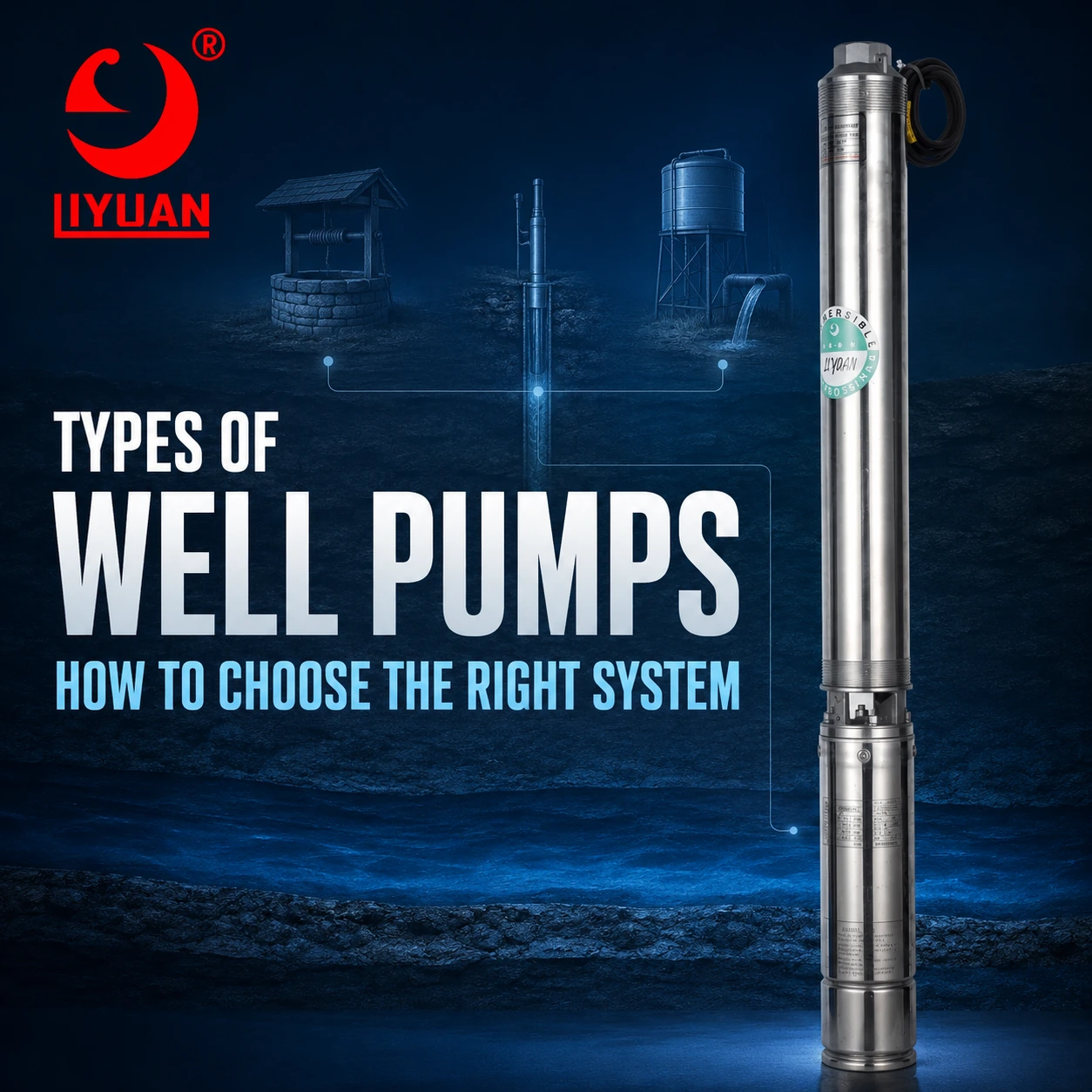
The main types of well pumps are shallow-well jet pumps, deep-well jet pumps, submersible well pumps, vertical lineshaft turbine pumps, and manual hand pumps. However, most homes and small farms choose among the first three. Large irrigation, municipal, and industrial wells may also require a vertical turbine system.
Therefore, choose the pump type from the lowest dynamic water level, required flow, total dynamic head, well construction, power supply, and maintenance plan. Do not select from total drilled well depth or motor horsepower alone.
Quick Comparison Of Well Pump Types
| Pump Type | Pump And Motor Location | Typical Water-Access Method | Best Starting Application | Main Limitation |
|---|---|---|---|---|
| Shallow-well jet pump | Above ground | Surface ejector and suction pipe | Stable water level close to surface | Limited effective suction lift |
| Deep-well jet pump | Pump above ground; ejector below water | Drive and return flow through twin-pipe or packer system | Existing deep-well jet installations | Recirculating drive flow and more hydraulic components |
| Submersible well pump | Pump and motor below water | Multistage pump pushes water up one drop pipe | Deep wells, boreholes, homes, farms, commercial supply | Downhole service requires pulling the assembly |
| Vertical lineshaft turbine pump | Driver above ground; bowls below water | Long shaft drives submerged turbine bowls | High-flow irrigation, municipal, and industrial wells | Alignment, shaft, column, and installation complexity |
| Hand well pump | Manual drive at surface; cylinder arrangement varies | Lever or hand-powered displacement | Emergency, backup, and low-volume supply | Low output and manual labor |
In other words, this table identifies the hydraulic configuration. Voltage, solar power, generator supply, VFD control, and pressure-tank design form a separate selection layer.
How Should Well Pumps Be Classified?
Many pages mix pump design, power source, and application into one list. For example, they describe submersible pumps, irrigation pumps, solar pumps, and stainless steel pumps as four equal categories. However, those terms answer different questions.
Use this structure instead:
Hydraulic And Installation Type
This describes how the pump reaches the water and where its driver sits:
- Shallow-well jet
- Deep-well jet
- Submersible well pump
- Vertical lineshaft turbine
- Manual displacement pump
Power Source
This describes what runs the pump:
- Single-phase AC
- Three-phase AC
- Solar DC
- Solar with inverter
- Generator
- Diesel or engine drive where applicable
- Manual human power
Control Method
This describes how the system responds to demand:
- Pressure switch
- Fixed-speed level control
- VFD constant-pressure control
- Tank-filling control
- Solar controller
- PLC or remote monitoring
Construction And Water Compatibility
This describes whether the selected pump survives the actual water:
- Cast iron or stainless steel
- Clean-water or sand-resistant hydraulics
- Standard or high-temperature motor
- Standard or corrosion-resistant materials
This layered classification prevents buyers from comparing terms that are not true alternatives.
Type 1: Shallow-Well Jet Pump
First, a shallow-well jet pump sits above ground. Its centrifugal pump, nozzle, and venturi create the pressure difference that moves water through a suction pipe.
This arrangement normally uses one pipe between the pump and the water source.
When A Shallow-Well Jet Pump Fits
It can be a practical choice when:
- The pumping water level remains close to the pump
- Suction piping is short and correctly sized
- Every suction connection remains airtight
- Required flow and pressure fit the complete curve
- The pump has a dry, ventilated, freeze-protected location
- Easy access to the motor and pump body matters
What Limits A Shallow-Well Jet Pump?
The important value is effective suction lift, not total well depth.
Effective suction lift = Vertical lift to pumping water level + Suction-pipe friction loss
Goulds Water Technology specifies a 25-foot maximum suction lift for the shallow-well configurations covered by its manual. It also states that the limit includes vertical lift and suction-pipe friction. Other products and conditions may differ, so always use the exact curve and manual. See the Goulds jet-pump technical instructions.
Altitude, water temperature, fittings, small pipe, filters, and air leaks can reduce practical performance. Therefore, a nominal depth label does not prove the pump will meet the required flow and pressure.
Type 2: Deep-Well Jet Pump
Next, a deep-well jet system keeps the centrifugal pump and motor above ground but places the ejector below the water level.
The pump sends part of its discharge water down to the ejector. The nozzle and venturi then entrain additional well water, and the combined flow returns to the surface.
Common arrangements include:
- Twin-pipe ejector system
- Packer system for a compatible well casing
- Convertible jet pump with a model-specific deep-well kit
When A Deep-Well Jet Pump Fits
It may remain a sensible option when:
- The well already has a serviceable twin-pipe or packer installation
- Above-ground motor access is a high priority
- Local technicians support the specific ejector system
- Flow and pressure remain inside the complete pump-and-ejector curve
- The well casing matches the selected jet assembly
What Limits A Deep-Well Jet Pump?
The system recirculates part of the water to power the ejector. It also depends on additional downhole piping, a matched nozzle and venturi, and correct pressure control.
Therefore, do not compare a deep-well jet pump with a submersible pump by horsepower. Instead, compare delivered flow, final pressure, electrical input, installation cost, and service requirements at the same duty point.
The detailed submersible pump vs jet pump comparison explains the conversion and life-cycle differences without repeating them here.
Type 3: Submersible Well Pump
In contrast, a submersible well pump places both the sealed motor and the pump below the pumping water level. Most deep-well models use multiple impellers and diffusers in series to generate the required head.
Then, water enters near the pump intake and moves upward through one drop pipe. Meanwhile, an electrical cable supplies the downhole motor.
When A Submersible Well Pump Fits
It is usually the leading candidate when:
- The dynamic water level is too deep for a shallow-well jet
- Water level changes significantly during pumping or by season
- The system needs higher flow or head
- Quiet operation matters
- Priming reliability is important
- Surface space is limited
- The borehole is narrow but deep
- Residential, agricultural, commercial, or community supply needs continuous performance
Main Advantages
- No long suction line to maintain under vacuum
- No surface priming procedure during normal operation
- Broad multistage head and flow ranges
- Low surface noise
- Compact downhole installation
- Compatibility with pressure switches, level controls, solar controllers, and VFDs
Main Limitations
- Service normally requires pulling the pump, cable, and drop pipe
- The motor needs correct cooling and submergence
- Well diameter limits pump outside diameter
- Sand, corrosion, hot water, or poor chemistry require suitable materials
- Cable length and voltage drop affect motor performance
- An oversized pump can overpump the well
The submersible pump range covers different diameters, hydraulic families, motors, and control options. However, final selection must use a pump curve rather than a general product category.
Type 4: Vertical Lineshaft Turbine Pump
For larger duties, a vertical lineshaft turbine pump places one or more turbine bowls below the water level while the motor or engine remains above ground. A long vertical shaft transmits power through the column to the bowl assembly.
For example, these pumps serve larger applications such as:
- Municipal water supply
- Large irrigation districts
- Industrial raw-water systems
- High-flow agricultural wells
- Rivers, lakes, sumps, and intake structures
When A Lineshaft Turbine Fits
It becomes a serious candidate when:
- Flow demand is beyond ordinary residential well-pump ranges
- An above-ground motor or engine drive is required
- The well is straight enough for shaft alignment
- The owner wants access to the surface driver
- The project has engineering, installation, and maintenance support
Lineshaft Turbine Vs Submersible Turbine
These are both vertical turbine arrangements, but the motor location differs.
A submersible turbine uses a submerged motor below the pump bowls. A lineshaft turbine uses a surface driver and a long shaft.
Franklin Water notes that well alignment, required flow, motor cooling, installation, maintenance, and backup-drive requirements can determine which design fits. Its comparison also explains why a top-feeding well may need a cooling sleeve around a submersible motor, while a lineshaft arrangement has a different cooling structure. See the Franklin lineshaft and submersible turbine comparison.
Do not assume that every high-flow well needs a lineshaft pump. Modern submersible turbines also cover substantial flow and head ranges. The manufacturer should compare both curves and the full installation.
Type 5: Hand Well Pump
For backup or low-volume service, a hand well pump uses manual mechanical force instead of an electric motor. Depending on the design, a lever, piston, rod, or downhole cylinder moves water toward the surface.
It can be useful for:
- Emergency water access
- Remote cabins
- Low-volume livestock watering
- Backup during power failure
- Monitoring or low-demand wells
However, output depends on pump design, cylinder depth, handle force, operator effort, and water level. A manual pump is not a direct replacement for a high-flow electric irrigation or household pressure system.
Check sanitary wellhead design carefully. An incorrectly installed backup pump can introduce contamination, interfere with existing equipment, or compromise the well seal.
Is A Solar Well Pump A Separate Pump Type?
Not necessarily.
By contrast, “solar well pump” usually describes the energy system rather than one hydraulic design. A solar installation may use:
- DC submersible borehole pump
- AC submersible pump with solar inverter
- Surface pump for a shallow source
- Solar array plus controller and storage tank
- Hybrid solar, grid, or generator supply
Grundfos lists solar water-pumping systems that can use renewable-energy submersible pumps with inverter capability for solar, wind, or AC supply. This illustrates why solar belongs in the power-and-control layer, not automatically in a list of hydraulic pump types. See the Grundfos solar pumping systems.
Therefore, the pump still needs the correct flow and head at the available solar input. Panel wattage alone does not select the pump.
Is A Borehole Pump Different From A Submersible Well Pump?
In many international markets, “borehole pump” refers to a slim, multistage submersible pump designed for a drilled groundwater well.
The terms often overlap:
- Borehole pump
- Deep-well submersible pump
- Submersible well pump
- Water-well pump
However, suppliers may also use “borehole pump” for vertical turbine bowl assemblies with either a submersible motor or lineshaft driver. Therefore, confirm the motor location, outside diameter, discharge connection, and complete configuration instead of relying on the name.
Well Depth Is Not The Same As Pumping Water Level
The drilled well can extend far below the water surface. Nevertheless, pump selection depends more directly on the lowest dynamic water level and the required discharge condition.
For example:
- Total well depth: 80 meters
- Static water-level depth: 7 meters
- Dynamic water-level depth at design flow: 16 meters
- Pump setting depth: 35 meters
The water does not need to be lifted from the 80-meter well bottom. The pumping lift starts from the dynamic water level, while the remaining depth provides pump setting space and water storage subject to well construction.
The U.S. Geological Survey defines drawdown as the difference between the water level before pumping and the water level during pumping. Moreover, USGS groundwater guidance explains that excessive pumping can lower water levels and reduce well output. See the USGS groundwater explanation.
Consequently, use an extended pumping test when seasonal or long-duration demand can move the water level substantially.
How To Choose Between The Types Of Well Pumps
Step 1: Measure Water Levels And Well Yield
First, collect:
- Static water level
- Dynamic water level at a measured flow
- Drawdown
- Pumping-test duration
- Recovery after shutdown
- Lowest seasonal water level
- Sustainable well yield
The pump must not continuously remove water faster than the well can supply it.
Step 2: Define Required Flow
Next, determine the realistic peak demand for:
- Household fixtures
- Irrigation zones
- Livestock tanks
- Commercial processes
- Municipal storage
- Fire or emergency duty where separately governed
Do not add every connected outlet if they will not operate simultaneously. Conversely, do not use only average daily consumption when the system must meet a higher short-term demand.
The submersible pump flow-rate calculation explains peak demand and sustainable well yield.
Step 3: Calculate Total Dynamic Head
Then, for a submersible well system:
TDH = Pumping lift + Elevation difference + Required pressure head + Friction loss
Use the lowest expected pumping water level for maximum design head. Also check minimum head because a higher water level can move the pump to a higher-flow operating point.
For a jet pump, use the complete manufacturer curve for the chosen shallow or deep-well ejector configuration.
The total dynamic head calculation provides the pressure and friction formulas.
Step 4: Check Well Construction
Afterward, confirm:
- Casing inside diameter
- Screen position
- Open-hole interval
- Total well depth
- Sediment depth
- Well deviation
- Existing one-pipe, twin-pipe, or packer system
- Pump-setting clearance
- Wellhead and pitless-adapter layout
A pump that meets the hydraulic duty can still be impossible to install in the available casing.
Step 5: Select Power And Control
After choosing the hydraulic type, next determine:
- Voltage
- Frequency
- Single-phase or three-phase supply
- Solar or generator compatibility
- Fixed-speed or VFD operation
- Pressure-switch or level control
- Dry-run and overload protection
- Required starts per hour
The single-phase vs three-phase pump comparison helps match the motor to the site supply.
Step 6: Verify Water Quality And Duty
Finally, check:
- Sand and silt
- Chlorides and salinity
- pH
- Iron and manganese
- Water temperature
- Dissolved gas
- Required operating hours
- Starts per hour
- Continuous or intermittent duty
Finally, verify the full pump curve, motor power, permitted operating range, maximum pressure, and material compatibility.
Selection Examples
Residential Well With A Falling Water Level
Assume:
- Total well depth: 60 meters
- Dynamic water level: 18 meters
- Required flow: 3 cubic meters per hour
- Required TDH: 65 meters
- Casing inside diameter: 125 millimeters
A shallow-well jet pump is not the logical choice because the pumping water level is well beyond the common shallow suction configuration. A deep-well jet may be technically possible with the correct ejector system, but a 4-inch submersible well pump is usually the more direct candidate if its outside diameter, curve, and cooling requirements fit.
Shallow Rural Well With Easy Pump-House Access
Assume:
- Total well depth: 30 meters
- Dynamic water level: 4 meters
- Effective suction lift including friction: 5 meters
- Modest household demand
- Protected pump house
A shallow-well jet pump may be practical even though the drilled well extends to 30 meters. The deciding value is the effective suction lift and required curve—not the total depth.
High-Flow Municipal Or Irrigation Well
Assume:
- Required flow: 600 cubic meters per hour
- Long annual operating hours
- Three-phase power
- Engine-driven emergency backup under consideration
- Large, straight well casing
The engineer should compare a submersible turbine with a vertical lineshaft turbine. Flow, head, efficiency, well alignment, cooling, driver arrangement, installation cost, and maintenance access may all affect the decision.
Common Well Pump Selection Mistakes
Choosing From Total Well Depth
Total depth does not equal pumping lift. Use the dynamic water level and complete system head.
Treating Solar As The Hydraulic Type
Solar describes the energy source and controller. The system still needs a suitable surface or submersible pump curve.
Choosing By Horsepower
Two pumps with the same motor power can produce very different flow and head.
Comparing Maximum Flow With Maximum Head
Maximum flow and shut-off head occur at different points. Compare both pumps at the required duty point.
Ignoring Well Yield
No pump type can sustainably extract more water than the aquifer and well construction provide.
Assuming The Most Powerful Type Is Best
Oversizing can cause excessive drawdown, sand production, high current, short cycling, pressure problems, and energy waste.
Ignoring Service Strategy
A surface motor is easier to reach, but a jet system can still have downhole ejector or foot-valve components. A submersible needs pulling equipment, while a lineshaft system requires shaft and alignment maintenance.
Frequently Asked Questions
What Are The Three Main Types Of Residential Well Pumps?
They are shallow-well jet pumps, deep-well jet pumps, and submersible well pumps. The correct choice depends mainly on pumping water level, required flow and head, existing well construction, and maintenance priorities.
What Type Of Pump Is Best For A Deep Well?
A submersible well pump is usually the leading choice for modern deep residential, agricultural, and commercial wells. Deep-well jet and vertical turbine systems remain valid in specific applications.
What Type Of Pump Is Best For A Shallow Well?
A shallow-well jet pump is often practical when effective suction lift remains inside the model’s permitted range. A submersible pump can also work if the well has adequate diameter, depth, cooling, and submergence.
Are All Well Pumps Submersible?
No. Jet pumps and lineshaft turbine drivers operate above ground. Hand pumps also use surface mechanical input. Only submersible configurations place the motor below the water level.
Is A Jet Pump A Centrifugal Pump?
Yes. A jet-pump system combines a centrifugal pump with a nozzle-and-venturi ejector. The ejector can sit at the surface or inside the well depending on the configuration.
Is A Solar Well Pump Always Submersible?
No. Many solar borehole systems use submersible pumps, but shallow sources may use surface pumps. Solar describes the power system rather than one universal pump design.
Which Well Pump Is Most Efficient?
Efficiency depends on the exact pump, flow, head, operating point, motor, piping, and control method. Compare manufacturer input-power data at the same delivered duty point.
Can A Larger Pump Increase Well Yield?
No. A larger pump can increase short-term extraction and drawdown, but it cannot increase aquifer recharge or repair a restricted well screen.
Final Answer
The main types of well pumps serve different water levels, flow ranges, well structures, and maintenance strategies:
- Use a shallow-well jet pump when effective suction lift stays within the exact model’s limit.
- Use a deep-well jet pump when a matched downhole ejector system fits the well and duty.
- Use a submersible well pump for most deeper boreholes, higher head, quiet operation, and reduced priming risk.
- Compare vertical lineshaft and submersible turbines for large irrigation, municipal, and industrial duties.
- Use a hand pump for low-volume or emergency supply.
Then select the power source and control method as a separate layer.
For accurate selection, send Liyuan Pump the well diameter, total depth, static and dynamic water levels, required flow, outlet pressure, pipe details, water quality, voltage, frequency, phase, and daily operating hours. Liyuan can confirm the appropriate pump type and select the hydraulic curve, motor, materials, cable, controls, and protection for the actual duty point.
Email:Liyuan@liyuan-pump.com
WhatsApp:+86 181-2828-2767