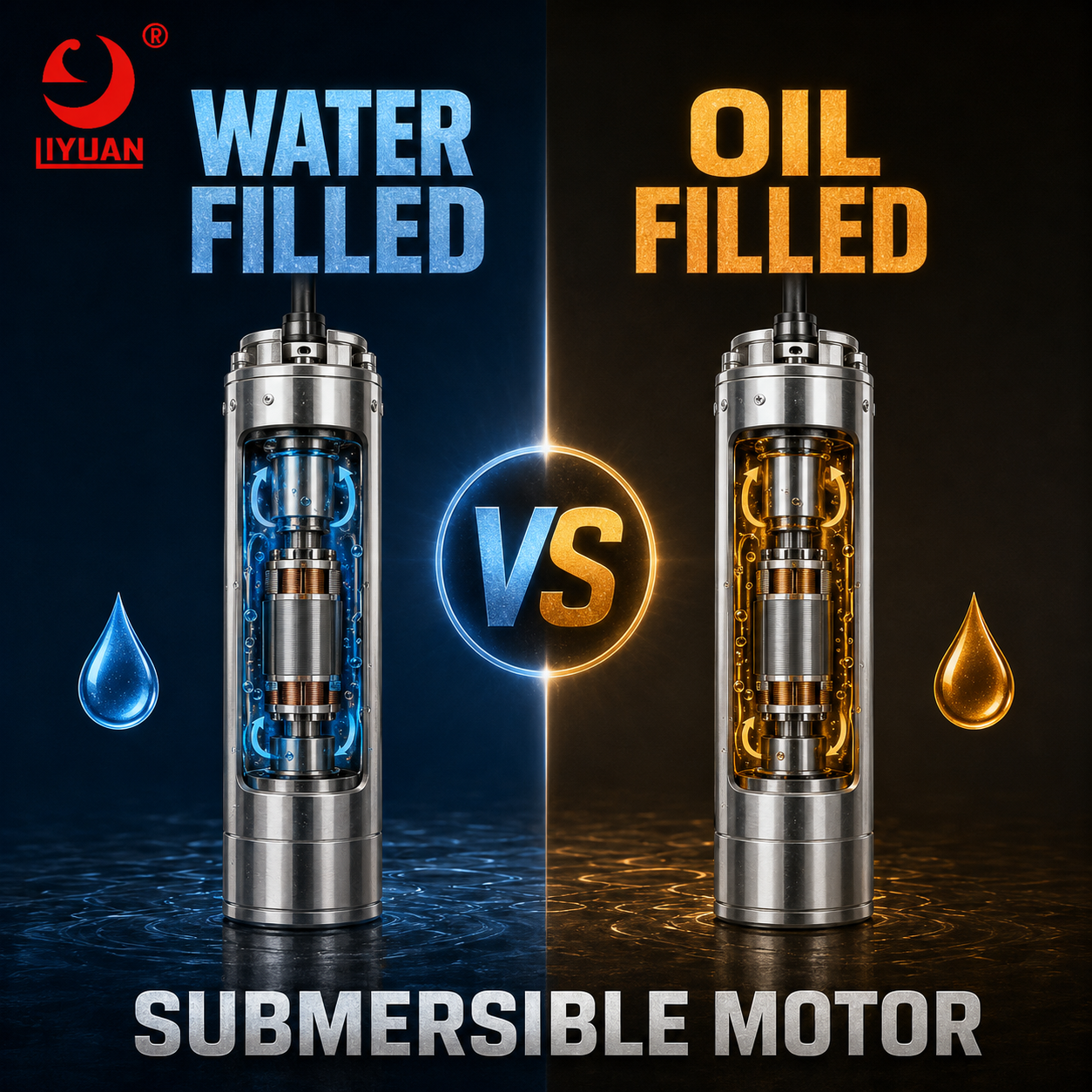
Water Filled Submersible Motor Vs Oil Filled Motor
A Water Filled Submersible Motor Offers Clean Cooling And Rewindable Construction, While An Oil Filled Motor Provides Sealed Lubrication And Compact Operation.
However, Neither Design Is Automatically Better For Every Project. Buyers Must Compare Motor Size, Water Quality, Temperature, Maintenance, Installation Depth, Environmental Requirements, And Operating Hours.
What Is A Water Filled Submersible Motor?
A Water Filled Submersible Motor Contains Clean Water Or A Manufacturer-Approved Water-Based Fluid Inside Its Motor Housing.
The Internal Fluid Helps:
- Cool The Windings
- Lubricate Bearings
- Transfer Heat
- Balance Internal Pressure
- Support Continuous Operation
Many Larger Water-Filled Motors Use Rewindable Windings. Therefore, Qualified Service Centers Can repair the stator after an electrical failure.
Learn More About The General Motor Structure In What Is A Submersible Motor?.
What Is An Oil Filled Submersible Motor?
An Oil Filled Submersible Motor Contains A Manufacturer-Approved Oil Or Dielectric Fluid.
The Internal Fluid Lubricates Bearings And Transfers Heat From The Motor Components To The Outer shell.
Oil-Filled Motors Commonly Use A Fully Sealed Rotor Structure.
Potential Features Include:
- Stable Internal Lubrication
- Compact Construction
- Smooth Bearing Operation
- Pressure-Balancing Device
- Sealed Motor Housing
- Good Heat Transfer
- Factory-Filled Design
The Exact Oil Type Must Match The Motor, Water Application, Temperature, And Local regulations.
Main Differences
| Feature | Water Filled Motor | Oil Filled Motor |
|---|---|---|
| Internal Fluid | Water Or Water-Based Fluid | Approved Oil Or Dielectric Fluid |
| Bearing Lubrication | Water-Lubricated | Oil-Lubricated |
| Common Construction | Rewindable Or Encapsulated | Often Sealed |
| Repairability | Often Higher | Model-Specific |
| Drinking Water Use | Suitable With Approved Fluid | Requires Approved Non-Toxic Fluid |
| Low-Temperature Storage | May Need Antifreeze Protection | Depends On Oil Type |
| High-Temperature Use | Special Design Required | Special Design Required |
| Maintenance | Fluid And Winding Inspection | Seal And Oil Inspection |
| Common Applications | Deep Wells And Large Systems | Residential And Agricultural Wells |
Actual Performance Depends On The Manufacturer’s Design.
How A Submersible Motor Works
The Motor Converts Electrical Energy Into Mechanical Rotation.
The Main Components Include:
- Stator
- Rotor
- Motor Shaft
- Radial Bearings
- Thrust Bearing
- Mechanical Seal
- Pressure Diaphragm
- Power Cable
- Internal Cooling Fluid
- Stainless Steel Shell
The Shaft Connects To The Pump. As The Shaft Rotates, It Drives The Pump Impellers.
The Deep Well Submersible Motors Guide Explains Motor Construction And Deep-Well Applications.
Internal Cooling Fluid Vs External Cooling Water
Internal Motor Fluid And External Well Water Perform Different Functions.
The Internal Fluid:
- Removes Heat From Windings
- Lubricates Internal Bearings
- Transfers Heat To The Motor Shell
- Helps Balance Internal Pressure
The External Water:
- Flows Across The Motor Shell
- Carries Heat Away From The Motor
- Maintains A Safe Operating Temperature
Therefore, A Water-Filled Or Oil-Filled Motor Still Needs Adequate External Cooling.
How Water Filled Motors Manage Heat
Heat Moves From The Motor Windings Into The Internal Water-Based Fluid.
The Fluid Transfers Heat To The Stainless Steel Motor Shell. Then, Well Water Flowing Across The Motor Removes The Heat.
A Water-Filled Motor May overheat if external cooling flow is insufficient.
This Problem Can Occur When:
- The Borehole Is Too Large
- The Motor Operates In A Tank
- Water Enters Above The Motor
- The Pump Is Installed Horizontally
- The Pump Runs Below Minimum Flow
- The Water Temperature Is High
- Mineral Scale Covers The Motor
A Cooling Sleeve Can Direct Water Across The Motor.
Grundfos Explains How A Submersible Motor Cooling Jacket Maintains Water Flow Around The Motor Surface.
How Oil Filled Motors Manage Heat
The Internal Oil Absorbs Heat From Windings, Bearings, And Rotor components.
It Then Transfers This Heat To The Motor Housing. External Water Carries The Heat Away.
Oil Type Affects:
- Heat Transfer
- Lubrication
- Seal Compatibility
- Low-Temperature Performance
- Fluid Expansion
- Environmental Suitability
Never Replace Motor Oil With An Unapproved Product.
Incorrect Oil Can Damage Insulation, seals, bearings, and pressure-balancing components.
Bearing Lubrication
Water-Lubricated Bearings
Water-Filled Motors Commonly Use Water-Lubricated Radial And Thrust Bearings.
The Internal Fluid Creates A Lubricating Film Between Moving Surfaces.
Water-Lubricated Bearings Require:
- Clean Internal Fluid
- Correct Filling Level
- Suitable Bearing Materials
- Proper Motor Orientation
- Adequate Thrust Capacity
Franklin Electric Describes Water-Lubricated Radial And Thrust Bearings In Its 10-Inch Rewindable Submersible Motor.
Oil-Lubricated Bearings
Oil-Filled Motors Use Oil To Reduce Friction And Carry Heat from bearing surfaces.
Oil Can Provide Stable Lubrication. However, Seal Integrity Remains Critical.
A Damaged Seal Can Allow Water To Enter Or Oil To Escape.
Rewindable Vs Encapsulated Construction
Internal Fluid Type Does Not Always Determine Whether A Motor Is Rewindable.
However, Larger Water-Filled Motors Commonly Use Rewindable Construction.
Rewindable Motor
A Rewindable Motor Allows A Qualified Technician To Remove And Replace The Stator Windings.
Potential Advantages Include:
- Field Repair
- Lower Replacement Cost
- Longer Equipment Life
- Voltage Customization
- Easier Large-Motor Service
However, Rewinding Requires Correct Materials, equipment, and test procedures.
Encapsulated Motor
An Encapsulated Motor Seals The Windings Inside A Resin Or Protective material.
Potential Advantages Include:
- Strong Moisture Protection
- Compact Construction
- Consistent Factory Production
- Reduced Routine Internal Service
However, Winding Repair May Be Difficult Or Uneconomical.
Pressure Compensation
Water Pressure Increases With Installation Depth.
At The Same Time, Internal Motor Fluid Expands As Temperature rises.
A Pressure-Balancing Diaphragm Helps Equalize Pressure Between The Motor Interior And Surrounding Water.
A Suitable System Can:
- Reduce Seal Stress
- Allow Fluid Expansion
- Compensate For Installation Depth
- Protect Motor Components
- Reduce Water Entry Risk
Inspect The Diaphragm During Motor Service.
Environmental And Drinking Water Considerations
Submersible Motors Often Operate In Drinking-Water Wells.
Therefore, Internal Fluids And Motor Materials Must Suit The Application.
A Water-Filled Motor May Use:
- Clean Water
- Water And Propylene Glycol
- Approved Water-Based Coolant
- Manufacturer-Specified Antifreeze Fluid
An Oil-Filled Motor Should Use A Non-Toxic, Application-Approved Oil When Operating In Potable Water.
Buyers Should Request:
- Fluid Specification
- Safety Data
- Drinking Water Approval
- Material Certification
- Seal Specification
Do Not Assume That Every Motor Fluid Is Suitable For Potable Water.
Low-Temperature Storage Protection
Pure Water Can Freeze And Expand.
Therefore, Water-Filled Motors Stored In Cold Environments May Require An Approved Antifreeze mixture.
Important Factors Include:
- Minimum Storage Temperature
- Fluid Concentration
- Manufacturer Approval
- Corrosion Protection
- Seal Compatibility
- Drinking Water Suitability
Some Manufacturers Use Water-Soluble Fluid With Frost Protection. However, The Temperature Rating Varies By Product.
Oil-Filled Motors Also Have Storage Limits. Cold Oil Can Become More Viscous And Affect Startup.
High-Temperature Applications
Both Water-Filled And Oil-Filled Motors Require Special Design For Hot Water.
High Temperature Can Affect:
- Winding Insulation
- Bearing Lubrication
- Mechanical Seals
- Cable Insulation
- Internal Fluid
- Elastomers
- Motor Power
- Service Life
Some Specialized Water-Soluble-Coolant Motors Support Elevated Water temperatures when minimum cooling flow is maintained.
For Example, Franklin Electric Publishes Application-Specific Limits For Its High-Temperature Submersible Motors.
Always Follow The Selected Motor’s Written Rating.
Motor Efficiency
Internal Fluid Type Is Only One Factor Affecting Efficiency.
Motor Efficiency Also Depends On:
- Electromagnetic Design
- Copper Winding Quality
- Core Materials
- Rotor Construction
- Motor Load
- Voltage Balance
- Power Factor
- Bearing Friction
- Cooling Conditions
Compare Official Motor Efficiency Data At The Required Load.
Do Not Assume That Every Water-Filled Motor Is More Efficient Than Every Oil-Filled Motor.
Copper Vs Aluminum Windings
Copper Windings Usually Provide Lower Electrical Resistance Than Aluminum Windings Of Similar Size.
Potential Copper Benefits Include:
- Lower Electrical Loss
- Better Heat Transfer
- Compact Winding Design
- Strong Continuous-Duty Performance
- Stable Starting Torque
However, Motor Efficiency Depends On The Complete electromagnetic design.
Request Winding Material And Efficiency Data Before Ordering.
Thrust Bearing Capacity
A Multistage Deep Well Pump Creates Axial Thrust.
The Motor’s Thrust Bearing Must Support This Load.
Thrust Capacity Depends On:
- Motor Size
- Pump Stages
- Operating Head
- Flow Rate
- Pump Design
- Starting Conditions
- Installation Orientation
An Undersized Thrust Bearing Can Wear Quickly Even When The Motor Power Appears Correct.
Sand Protection
Sand Can Damage The Motor Seal, Shaft, And Bearings.
Sand-Protection Features May Include:
- Sand Slinger
- Mechanical Seal
- Labyrinth Structure
- Silicon Carbide Seal Faces
- Protected Bearing System
- Replaceable Wear Components
Water-Filled And Oil-Filled Motors Both Require Protection In Sandy wells.
A Sand-Resistant Pump Cannot Correct A Damaged Well Screen Or Excessive Pumping Rate.
Water Filled Motor Applications
Water-Filled Motors Commonly Serve:
- Deep Water Wells
- Municipal Water Supply
- Agricultural Irrigation
- Industrial Water Transfer
- Mining
- Groundwater Remediation
- Large-Diameter Boreholes
- Continuous-Duty Pumping
- High-Power Pump Systems
Larger Rewindable Motors Can Reduce Lifecycle Cost where local repair capability is available.
Oil Filled Motor Applications
Oil-Filled Motors Commonly Serve:
- Residential Wells
- Small Agricultural Systems
- Commercial Water Supply
- Compact Borehole Pumps
- Livestock Watering
- Storage Tank Filling
- General Clean-Water Pumping
Actual Application Suitability Depends On Motor Size, fluid approval, water temperature, and well conditions.
Four-Inch Submersible Motors
Four-Inch Motors Commonly Power Residential, agricultural, and light commercial pumps.
They Can Use:
- Single-Phase Power
- Three-Phase Power
- Water-Filled Construction
- Oil-Filled Construction
- Encapsulated Windings
- Rewindable Windings
Review Liyuan Pump’s 4-Inch Submersible Motor Guide For More Selection Information.
Six-Inch And Larger Motors
Larger Motors Usually Support Higher Flow, higher head, and longer operating hours.
Common Applications Include:
- Municipal Wells
- Large Irrigation Systems
- Industrial Water Supply
- Mining
- Construction Dewatering
- Community Water Systems
Larger Motors May Provide:
- Rewindable Construction
- Replaceable Bearings
- Temperature Sensors
- High Thrust Capacity
- Star-Delta Starting
- VFD Compatibility
- Custom Voltage
Explore The 6-Inch Submersible Motor Guide For More Details.
Single-Phase Vs Three-Phase Options
Water-Filled And Oil-Filled Motors May Be Available In Single-Phase Or Three-Phase configurations.
Single-Phase Motors Suit:
- Homes
- Small Farms
- Lower-Power Pumps
- Locations Without Three-Phase Power
Three-Phase Motors Suit:
- Higher Power
- Continuous Operation
- VFD Control
- Irrigation
- Industrial Water
- Municipal Wells
Electrical Phase And Internal Fluid Type Represent Separate selection decisions.
Can A VFD Control Both Motor Types?
A VFD Can Control Compatible Three-Phase Water-Filled Or Oil-Filled Motors.
However, Confirm:
- Minimum Frequency
- Maximum Frequency
- Voltage
- Motor Current
- Cable Length
- Cooling Flow
- Insulation Compatibility
- VFD Switching Frequency
Low Motor Speed Can Reduce Cooling flow around the motor.
Therefore, The Manufacturer Must Approve The Minimum Operating Speed.
Maintenance Requirements
Water Filled Motor Maintenance
Maintenance May Include:
- Check Internal Fluid Level
- Test Fluid Condition
- Inspect Winding Insulation
- Check Bearings
- Inspect Mechanical Seals
- Examine The Pressure Diaphragm
- Test Cable Insulation
- Measure Winding Resistance
- Check Thrust Bearing Wear
Oil Filled Motor Maintenance
Maintenance May Include:
- Inspect Oil Level
- Check Oil Color
- Look For Water Contamination
- Inspect Mechanical Seals
- Examine The Diaphragm
- Test Insulation Resistance
- Check Bearings
- Inspect Cable Entry
- Check For Oil Leakage
Follow The Electric Submersible Pump Maintenance Guide To Improve Reliability.
Common Motor Failure Causes
Both Motor Types Can Fail Because Of:
- Dry Running
- Insufficient Cooling
- Low Voltage
- High Voltage
- Phase Loss
- Phase Imbalance
- Frequent Starting
- Excessive Thrust
- Sand Damage
- Seal Failure
- Cable Damage
- Incorrect Fluid
- Motor Overload
Internal Fluid Selection Cannot Correct Poor Electrical Or Hydraulic conditions.
Electrical Protection
A Complete Motor Control System Should Include:
- Overload Protection
- Short-Circuit Protection
- Dry-Run Protection
- Overvoltage Protection
- Undervoltage Protection
- Surge Protection
- Temperature Protection
- Water-Level Protection
Three-Phase Systems Should Also Include:
- Phase-Loss Protection
- Phase-Reversal Protection
- Phase-Imbalance Protection
How To Choose Between Water And Oil
Choose A Water-Filled Motor When:
- Rewindable Construction Is Important
- The Project Uses A Large Motor
- Drinking-Water Compatibility Matters
- Local Repair Support Is Available
- Long-Term Serviceability Is Required
- Municipal Or Industrial Operation Is Planned
Choose An Oil-Filled Motor When:
- Compact Sealed Construction Is Preferred
- The Application Uses A Smaller Pump
- Approved Oil Suits The Water System
- Factory-Sealed Operation Is Required
- Local Conditions Match The Motor Rating
Always Compare The Complete Technical Specification.
Information To Send The Manufacturer
Provide:
- Required Motor Power
- Pump Flow And Head
- Motor Diameter
- Voltage
- Frequency
- Single-Phase Or Three-Phase Power
- Installation Depth
- Water Temperature
- Water Chemistry
- Sand Content
- Daily Operating Hours
- Starts Per Hour
- VFD Requirements
- Drinking-Water Requirements
- Repairability Requirements
Complete Information Helps The Manufacturer Recommend The Correct Motor.
Why Choose Liyuan Pump?
Liyuan Pump Has Manufactured Submersible Motors And Pumps Since 1992.
Available Capabilities Include:
- Water-Filled Submersible Motors
- Oil-Filled Submersible Motors
- Rewindable Motor Designs
- 4-Inch To 12-Inch Motor Options
- Single-Phase And Three-Phase Models
- 50Hz And 60Hz Motors
- Customized Voltage
- Stainless Steel Construction
- High-Temperature Options
- VFD-Compatible Solutions
- OEM And Custom Engineering
Buyers Can Review Liyuan Pump’s Submersible Motor Manufacturer Guide Before Requesting A Customized Quotation.
Frequently Asked Questions
Is A Water Filled Submersible Motor Better?
It Can Offer Clean Internal Cooling, water-lubricated bearings, and rewindable construction. However, The Best Choice Depends On The Application.
Is An Oil Filled Motor Safe For Drinking Water?
Only When The Manufacturer Uses An Approved Non-Toxic Fluid And Provides Suitable Drinking-Water Compliance.
Can A Water Filled Motor Freeze?
Yes, If The Internal Fluid Lacks Suitable Frost Protection. Follow The Manufacturer’s Storage Requirements.
Can Both Motor Types Be Repaired?
Many Water-Filled Motors Are Rewindable. Oil-Filled Motor Repairability Depends On Their Construction.
Which Motor Is Better For High Temperature?
Either Type Requires A Special High-Temperature Design. Compare The Written Temperature, cooling, cable, and duty ratings.
Do Both Motors Need External Water Flow?
Yes. External Water Flow Usually Carries Heat Away From The Motor Housing.
Can Both Motor Types Use A VFD?
Compatible Three-Phase Models Can Use A VFD When The Manufacturer Approves The Voltage, frequency, cooling, and cable conditions.
What Information Does Liyuan Pump Need?
Provide Motor Power, Voltage, Phase, Installation Depth, Water Temperature, Water Quality, Operating Hours, And VFD Requirements.
Conclusion
A Water Filled Submersible Motor Provides Strong Serviceability And Clean Internal Cooling, While An Oil Filled Motor Offers Compact Sealed Lubrication.
Therefore, Buyers Should Compare Motor Construction, Internal Fluid, Bearings, Cooling Flow, Water Quality, Repairability, And Operating Conditions.
For Water-Filled Or Oil-Filled Motor Selection, OEM Production, And Custom Engineering Support, Contact Liyuan Pump Through
Email:Liyuan@liyuan-pump.com
WhatsApp:+86 181-2828-2767