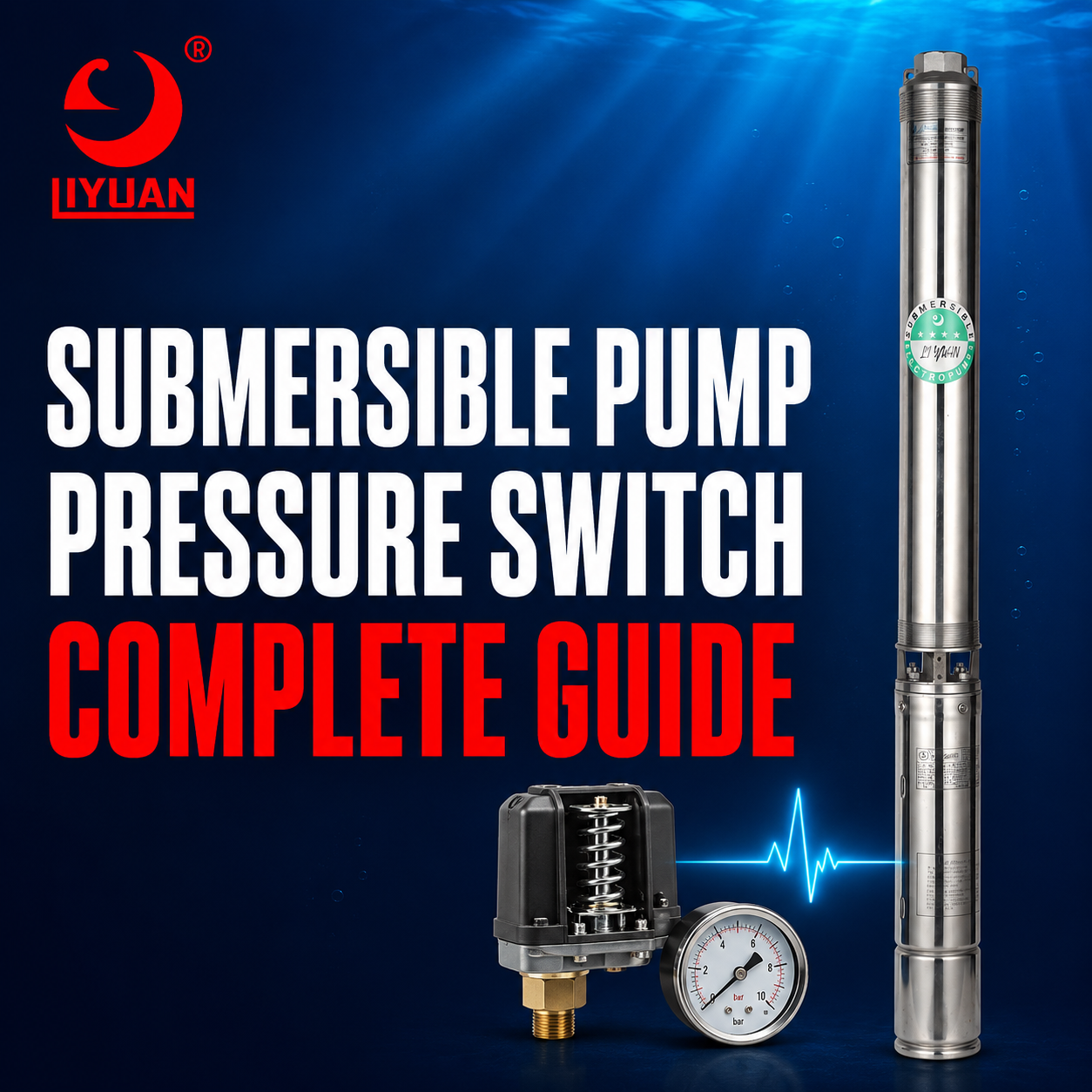
Submersible Pump Pressure Switch: Complete Guide
A Submersible Pump Pressure Switch Automatically Starts The Pump At A Low-Pressure Setpoint And Stops It At A Higher Setpoint.
It Works With A Pressure Tank, Check Valve, Gauge, And Electrical Control System To Maintain Water Pressure And Reduce Unnecessary Motor Starts.
Correct Selection Depends On System Pressure, Motor Current, Supply Voltage, Number Of Phases, Connection Size, Pressure Range, And Required Safety Functions.
Incorrect Adjustment Can Cause Low Water Pressure, Rapid Pump Cycling, Continuous Operation, Excessive Pipeline Pressure, Or Motor Damage.
What Is A Submersible Pump Pressure Switch?
A Submersible Pump Pressure Switch Is An Electromechanical Or Electronic Device That Monitors Water Pressure.
It Connects The Pump’s Electrical Control Circuit When Pressure Falls To The Cut-In Setting.
It Disconnects The Circuit When Pressure Rises To The Cut-Out Setting.
For Example, A 40/60 PSI Switch:
- Starts The Pump At Approximately 40 PSI
- Stops The Pump At Approximately 60 PSI
The Difference Between Cut-In And Cut-Out Pressure Is Called The Differential.
A Traditional Pressure Switch Usually Controls A Fixed-Speed Pump. A Variable-Speed System Normally Uses A Pressure Transducer And VFD Instead.
How Does A Pump Pressure Switch Work?
A Mechanical Pressure Switch Contains:
- Pressure-Sensing Diaphragm
- Springs
- Adjustment Nuts
- Mechanical Linkage
- Electrical Contacts
- Terminal Block
- Protective Cover
Water Pressure pushes Against The Diaphragm.
When Pressure Falls, Spring Force Moves The Mechanism And Closes The Electrical Contacts.
The Closed Contacts Start The Pump Directly Or Energize A Contactor.
As The Pump Fills The Pressure Tank, System Pressure increases.
When Pressure Reaches The Cut-Out Setting, The Mechanism Opens The Contacts And Stops The Pump.
The Cycle Repeats As Water Demand Changes.
What Are Cut-In And Cut-Out Pressure?
Cut-In Pressure
Cut-In Pressure Is The Pressure At Which The Switch Starts The Pump.
If Cut-In Pressure Is Too Low, Users May Experience Weak Water Flow Before The Pump Starts.
If Cut-In Pressure Is Too High, The Pump May Start More Frequently And The Tank May Provide Less Drawdown.
Cut-Out Pressure
Cut-Out Pressure Is The Pressure At Which The Switch Stops The Pump.
The Pump Must Be Able To Reach This Pressure At The Actual Well Depth And Flow Condition.
If The Cut-Out Setting Exceeds The Pump’s Capability, The Motor May Run Continuously.
Pressure Differential
The Differential Is The Difference Between Cut-Out And Cut-In Pressure.
For Example:
60 PSI Cut-Out − 40 PSI Cut-In = 20 PSI Differential
A Wider Differential Can Increase Tank Drawdown And Lengthen Pump Cycles.
However, It Also Creates A Larger Difference Between Minimum And Maximum User Pressure.
Common Pressure-Switch Settings
Typical Fixed-Speed Well Systems May Use:
| Switch Setting | Pump Starts At | Pump Stops At | Typical Application |
|---|---|---|---|
| 20/40 PSI | 20 PSI | 40 PSI | Low-Pressure Systems |
| 30/50 PSI | 30 PSI | 50 PSI | Traditional Residential Systems |
| 40/60 PSI | 40 PSI | 60 PSI | Higher Residential Pressure |
| 50/70 PSI | 50 PSI | 70 PSI | Higher-Pressure Applications |
These Values Are Examples, Not Universal Recommendations.
The Correct Setting Depends On:
- Pump Curve
- Well Depth
- Pumping Water Level
- Building Height
- Required Outlet Pressure
- Tank Rating
- Pipeline Rating
- Relief-Valve Rating
- Motor Power
- Pressure-Switch Rating
Never Increase Pressure Without Confirming That Every System Component Can Safely Handle The New Setting.
How Does The Pressure Switch Work With A Pressure Tank?
The Pressure Tank Stores Water Between Pump Cycles.
When A Faucet Opens, The Tank Initially Supplies Water. System Pressure Then falls from cut-out toward cut-in.
When Pressure Reaches Cut-In, The Switch Starts The Pump.
The Pump Supplies Current Demand And Refills The Tank.
When Pressure Reaches Cut-Out, The Switch Stops The Pump.
A Correctly Sized And Precharged Tank Reduces:
- Pump Cycling
- Motor Starts
- Pressure-Switch Operations
- Contactor Wear
- Check-Valve Movement
- Pressure Fluctuation
An Undersized Or Waterlogged Tank Can Make A Correctly Operating Switch Open And Close Too Frequently.
What Should Pressure Tank Precharge Be?
Many Traditional Well-Tank Manufacturers Recommend Setting Tank Precharge Approximately 2 PSI Below Pressure-Switch Cut-In.
Examples Include:
| Pressure-Switch Setting | Typical Tank Precharge |
|---|---|
| 20/40 PSI | 18 PSI |
| 30/50 PSI | 28 PSI |
| 40/60 PSI | 38 PSI |
| 50/70 PSI | 48 PSI |
Amtrol’s Well Tank Support Guide Provides The Same General Recommendation For Its Well Tanks.
However, Always Follow The Pressure-Tank And Pump-Control Manufacturer’s Instructions.
Measure Precharge Only After:
- Disconnecting Pump Power.
- Opening A Faucet Or Drain.
- Draining The Tank Completely.
- Confirming Water Pressure Is Zero.
- Measuring Air Pressure At The Tank Valve.
Checking Precharge While The Tank Contains Pressurized Water Gives An Incorrect Reading.
How Does A Pressure Switch Connect To A Submersible Pump?
The Wiring Method Depends On Motor Power, Voltage, Number Of Phases, Switch Rating, And Control Design.
Direct Motor Control
A Pressure Switch Can Directly Switch A Small Motor When Its Electrical Contacts Have The Correct Motor Rating.
The Switch Usually Connects And Disconnects The Power Conductors supplying the motor or control box.
Contactor Control
Larger Motors Often Use A Magnetic Contactor.
The Pressure Switch Controls The Low-Current Contactor Coil Instead Of Carrying Full Motor Current.
This Arrangement Reduces Electrical Stress On The Pressure-Switch Contacts.
Control Box Connection
A Three-Wire Single-Phase Motor Uses An External Control Box With Starting Components.
The Pressure Switch May Control Power To The Box Or A Contactor, Depending On The System Design.
An Electric Control Box For Submersible Pump Can Include Capacitors, Relays, Contactors, Overload Devices, And Other Protective Components.
VFD Control
A Conventional Pressure Switch Can Provide A Digital Start Signal To Some VFD Systems.
However, Constant-Pressure Control Normally Uses A Pressure Transducer That Sends A Continuous Analog Signal.
The VFD Adjusts Pump Speed Instead Of Simply Starting And Stopping At Two Pressure points.
Single-Phase Vs. Three-Phase Pressure-Switch Control
Single-Phase Pump
A Pressure Switch May Directly Control A Small Single-Phase Pump If The Switch Has The Correct Voltage And Motor-Current Rating.
Larger Single-Phase Motors May Require A Contactor.
Three-Phase Pump
A Standard Pressure Switch Should Not Usually Carry Three-Phase Motor Power Directly Unless It Is Specifically Designed And Rated For That Application.
Instead, The Pressure Switch Normally Controls A Three-Pole Contactor.
The Contactor Switches All Three Motor Phases.
Review The Single Phase Submersible Pump Vs. Three Phase Pump Guide Before Selecting The Pump-Control System.
Mechanical Pressure Switch Vs. Electronic Pressure Controller
Mechanical Pressure Switch
A Mechanical Switch Uses Springs, A Diaphragm, And Electrical Contacts.
Benefits Include:
- Simple Operation
- Low Cost
- Easy Replacement
- No Complex Programming
- Wide Availability
Possible Limitations Include:
- Contact Wear
- Limited Monitoring
- Fixed Or Limited Differential
- Lower Control Accuracy
- No Fault History
Electronic Pressure Controller
An Electronic Controller Uses A Pressure Sensor And Digital Electronics.
Depending On The Model, It May Provide:
- Adjustable Start Pressure
- Adjustable Stop Pressure
- Dry-Run Protection
- Digital Pressure Display
- Automatic Restart
- Cycle Protection
- Fault Codes
- Remote Alarm
- Flow Detection
Electronic Controllers Require Correct Programming And Reliable Power.
Pressure Transducer With VFD
A Pressure Transducer Produces A Continuous Signal, Commonly 4–20 mA Or 0–10 V.
The VFD Uses This Signal To Adjust Pump Speed.
This Method Provides More Stable Constant-Pressure Control Than A Basic On-And-Off Switch.
How To Select A Submersible Pump Pressure Switch
Confirm The Pressure Range
The Switch Must Operate Within The Required Cut-In And Cut-Out Range.
Check:
- Factory Pressure Setting
- Minimum Adjustment
- Maximum Adjustment
- Differential Range
- Maximum Allowable Pressure
- Proof Pressure
Do Not Select A Switch Only Because Its Factory Setting Appears Suitable.
Confirm The Electrical Rating
Check:
- Supply Voltage
- Motor Current
- Motor Horsepower
- Number Of Poles
- Number Of Phases
- Contact Rating
- Control-Circuit Voltage
- Starting Current
A Motor Can Draw Several Times Its Running Current During Startup.
Therefore, A General Resistive-Load Rating Does Not Automatically Equal A Suitable Motor Rating.
Confirm The Port Connection
Common Pressure-Switch Connections Include:
- Female Thread
- Male Thread
- Flange Connection
- Tank-Tee Connection
- Remote Sensing Tube
The Thread Type And Size Must Match The Water System.
Use Compatible Sealing Materials And Prevent Sealant From Blocking The Pressure Port.
Consider Water Quality
Sand, Iron, Scale, And Sediment Can Block The Pressure-sensing passage.
Dirty Water Applications May Require:
- Larger Sensing Ports
- Diaphragm Seals
- Remote Sensing Lines
- Periodic Cleaning
- Filtration
- Corrosion-Resistant Materials
A Sand Resistant Submersible Pump Can Improve Pump Reliability, But The Pressure-Sensing System Still Requires Protection From Sediment.
Select The Correct Enclosure
The Switch Enclosure Should Match The Installation Environment.
Consider:
- Indoor Or Outdoor Installation
- Rain
- Dust
- Humidity
- Condensation
- Corrosive Chemicals
- Insects
- Freezing Temperature
- Explosion Hazards
Never Assume A Standard Indoor Cover Provides Suitable Outdoor Protection.
Consider Low-Pressure Cutoff
Some Pressure Switches Include A Low-Pressure Cutoff Function.
This Function Opens The Contacts If Pressure Falls Significantly Below Normal Cut-In Pressure.
It May Help Protect Against:
- Broken Pipes
- Empty Water Sources
- Major Leaks
- Certain Dry-Run Conditions
However, It Is Not A Complete Replacement For Dedicated Dry-Run Protection.
For Certain Square D Pump Switches, Schneider Electric Explains That The Low-Pressure Cutoff Operates Below The Cut-In Setting. Exact Operation Varies By Product.
How To Adjust A Submersible Pump Pressure Switch
Only Qualified Personnel Should Adjust A Pressure Switch.
Always Disconnect Electrical Power And Verify The Circuit Is De-Energized Before Removing The Cover.
Identify The Adjustment Mechanism
Many Mechanical Switches Have:
- A Large Range Spring
- A Smaller Differential Spring
The Large Adjustment May Change Both Cut-In And Cut-Out Pressure.
The Smaller Adjustment May Change The Differential Or Cut-Out Pressure.
However, Switch Designs Vary. Always Read The Product Instructions.
Adjust In Small Steps
Avoid Large Adjustments.
After Every Change:
- Replace The Protective Cover.
- Restore Electrical Power.
- Open A Water Outlet.
- Record Cut-In Pressure.
- Allow The Pump To Run.
- Record Cut-Out Pressure.
- Repeat Several Cycles.
- Check For Stable Operation.
Schneider Electric Recommends Adjusting The Main Range Before The Differential On Its Square D 9013FSG Pressure Switch.
This Procedure Should Not Be Applied Automatically To Every Switch Model.
Confirm Pump Capability
The Pump Must Reach The New Cut-Out Pressure Without Operating Outside Its Safe Range.
A High Head Submersible Pump May Support Higher Pressure, But The Complete System Still Requires Verification.
Adjust Tank Precharge
If Cut-In Pressure Changes, The Pressure-Tank Precharge May also need adjustment.
Turn Off The Pump And Drain The Tank Completely Before Changing Precharge.
Why Does A Pump Pressure Switch Click Rapidly?
Rapid Clicking Or Chattering Can Result From:
- Waterlogged Pressure Tank
- Incorrect Tank Precharge
- Undersized Tank
- Blocked Pressure Port
- Loose Electrical Connections
- Low Supply Voltage
- Damaged Switch Mechanism
- Pressure Pulsation
- Failed Check Valve
- Poor Tank Location
Rapid Contact Movement Creates Electrical Arcing And Can Damage The Switch.
Do Not Replace The Switch Before Checking The Pressure Tank And Hydraulic System.
Why Does The Pump Start Too Frequently?
Frequent Starting May Result From:
- Small Tank Drawdown
- Damaged Tank Bladder
- Incorrect Precharge
- Leaking Pipeline
- Dripping Fixture
- Leaking Check Valve
- Incorrect Pressure Differential
- Excessive Water Demand
- Pressure-Switch Chatter
- VFD Sleep-Mode Problem
A Submersible Pump Check Valve Prevents Backflow When The Pump Stops.
If The Valve Leaks, Pressure Falls Even When No Water Is Being Used.
Why Does The Pump Run Continuously?
A Pump That Does Not Reach Cut-Out Pressure Will Continue Running.
Possible Causes Include:
- Cut-Out Setting Is Too High
- Pump Is Undersized
- Pumping Water Level Has Fallen
- Pump Impellers Are Worn
- Pipeline Is Leaking
- Check Valve Has Failed
- Pressure Port Is Blocked
- Pressure Switch Is Damaged
- Motor Rotation Is Incorrect
- Discharge Valve Is Open Too Far
- System Demand Exceeds Pump Flow
Continuous Operation Is Not Always A Pressure-Switch Fault.
Compare The Measured Flow And Head With The Pump Curve.
Why Does The Pump Not Start?
Possible Causes Include:
- No Electrical Power
- Open Circuit Breaker
- Blown Fuse
- Tripped Motor Overload
- Burned Pressure-Switch Contacts
- Low-Pressure Cutoff Is Active
- Failed Contactor
- Damaged Control Box
- Broken Cable
- Jammed Pump
- Pressure Remains Above Cut-In
The How To Check Submersible Pump Motor Guide Provides Additional Motor-Testing Information.
Why Are Pressure-Switch Contacts Burned?
Contact Damage Can Result From:
- Excessive Motor Current
- Incorrect Switch Rating
- High Starting Current
- Loose Terminals
- Frequent Cycling
- Low Voltage
- Contactor Coil Problems
- Moisture
- Corrosion
- Contact Chatter
Replacing Burned Contacts Without Correcting The Cause Can Lead To Repeated Failure.
Large Motors Should Use A Properly Rated Contactor Or Motor Starter.
Why Does Water Pressure Become Too High?
Possible Causes Include:
- Cut-Out Adjustment Is Too High
- Pressure Switch Fails To Open
- Pressure Port Is Blocked
- Contactor Is Welded Closed
- VFD Setpoint Is Incorrect
- Pressure Sensor Has Failed
- Control Wiring Is Incorrect
A Pressure-Relief Valve Provides Essential Backup Protection.
Never Depend Only On The Pressure Switch To Limit Maximum System Pressure.
How To Test A Pump Pressure Switch
Step 1: Inspect The System Safely
Disconnect Power Before Opening The Switch Cover.
Look For:
- Burned Contacts
- Loose Wires
- Corrosion
- Insects
- Moisture
- Damaged Springs
- Cracked Insulation
- Blocked Pressure Port
Step 2: Observe Cut-In Pressure
Restore Power With The Cover Installed.
Open A Faucet And Watch The Pressure Gauge.
Record The Pressure At Which The Pump Starts.
Step 3: Observe Cut-Out Pressure
Close The Water Outlet Or Reduce Demand.
Allow The Pump To Fill The Tank.
Record The Pressure At Which The Pump Stops.
Step 4: Compare Multiple Cycles
Repeat The Test Several Times.
The Cut-In And Cut-Out Values Should Remain reasonably consistent.
Large Changes May Indicate:
- Switch Wear
- Gauge Error
- Blocked Sensing Passage
- Pressure Pulsation
- Mechanical Damage
Step 5: Test Electrical Operation
A Qualified Technician Can Test Continuity And Voltage According To The Wiring Diagram.
Never Touch Live Terminals Or Bypass The Switch For Normal Operation.
Step 6: Inspect The Pressure Tank
Check Tank Precharge, Drawdown, And Bladder Condition.
A Tank Problem Can Create Symptoms That Appear To Come From The Switch.
How To Replace A Pressure Switch
Only Qualified Personnel Should Perform Electrical And Pressure-System Work.
A General Replacement Process Includes:
- Disconnect Electrical Power.
- Verify Zero Voltage.
- Close Required Isolation Valves.
- Drain Water Pressure.
- Photograph Existing Wiring.
- Label Every Conductor.
- Remove The Old Switch.
- Clean The Connection.
- Install The Correct Replacement.
- Reconnect Wiring According To The Diagram.
- Confirm Grounding.
- Check Tank Precharge.
- Restore Water And Power.
- Test Cut-In And Cut-Out Pressure.
- Inspect For Leaks.
Never Install A Replacement With A Lower Pressure Or Electrical Rating.
Pressure Switch Installation Mistakes
Common Installation Errors Include:
- Selecting An Incorrect Motor Rating
- Reversing Line And Load Connections
- Leaving Loose Terminals
- Blocking The Pressure Port With Sealant
- Installing The Switch Far From The Tank
- Using An Incorrect Pressure Range
- Omitting A Relief Valve
- Ignoring Tank Precharge
- Exposing An Indoor Switch To Rain
- Connecting A Large Motor Directly
- Failing To Ground The Enclosure
- Adjusting The Switch Without A Gauge
Correct Installation Should Follow The Switch, Pump, Motor, And Pressure-Tank Instructions.
How To Prevent Pressure-Switch Failure
A Preventive Maintenance Program Should Include:
- Recording Cut-In Pressure
- Recording Cut-Out Pressure
- Checking Tank Precharge
- Inspecting Electrical Terminals
- Checking For Contact Discoloration
- Cleaning The Pressure Passage
- Inspecting The Tank Tee
- Testing The Pressure Gauge
- Inspecting The Check Valve
- Checking The Relief Valve
- Monitoring Motor Starts
- Protecting The Switch From Moisture
The Electric Submersible Pump Maintenance Guide Provides Additional Recommendations For Pump-System Maintenance.
Pressure Switch Vs. Flow Switch
A Pressure Switch Responds To Water Pressure.
A Flow Switch Responds To Water Movement.
| Feature | Pressure Switch | Flow Switch |
|---|---|---|
| Main Measurement | Pressure | Flow |
| Typical Use | Start And Stop Well Pump | Confirm Water Movement |
| Pressure-Tank System | Common | Optional |
| Dry-Run Detection | Limited | Possible |
| Constant-Pressure Control | Basic On-And-Off | Not Sufficient Alone |
Some Electronic Pump Controllers Combine Pressure And Flow Detection.
Pressure Switch Vs. Level Switch
A Pressure Switch Controls The Pump According To Pipeline Pressure.
A Level Switch Controls The Pump According To Water Level In A Tank, Well, Or Reservoir.
A System May Use Both Devices.
For Example:
- Pressure Switch Controls Distribution Pressure
- Low-Water Level Switch Prevents Dry Running
- High-Tank Level Switch Prevents Overflow
Pressure Switch Vs. Pressure Transducer
A Pressure Switch Produces A Simple Open-Or-Closed Signal.
A Pressure Transducer Produces A Continuous Analog Or Digital Measurement.
| Feature | Pressure Switch | Pressure Transducer |
|---|---|---|
| Output | On Or Off | Continuous Signal |
| Typical Control | Fixed-Speed Pump | VFD Constant Pressure |
| Accuracy | Moderate | Higher |
| Setup | Simple | Requires Programming |
| Fault Monitoring | Limited | Advanced |
| Cost | Lower | Higher |
Select The Device According To The Required Control Strategy.
Information Required For Pressure-Switch Selection
Provide The Following Information To The Pump Or Control Supplier:
- Pump Model
- Motor Power
- Motor Rated Current
- Supply Voltage
- Number Of Phases
- Direct Or Contactor Control
- Desired Cut-In Pressure
- Desired Cut-Out Pressure
- Maximum System Pressure
- Pressure-Tank Size
- Pump Flow
- Total Dynamic Head
- Port Size
- Thread Standard
- Water Temperature
- Water Quality
- Indoor Or Outdoor Installation
- Low-Pressure Cutoff Requirement
- Local Electrical Standards
Complete Information Helps The Supplier Match The Switch, Tank, Contactor, Relief Valve, And Pump Correctly.
Frequently Asked Questions
What Does A Submersible Pump Pressure Switch Do?
It Starts The Pump When System Pressure Falls To Cut-In And Stops It When Pressure Reaches Cut-Out.
What Is A 40/60 Pressure Switch?
It Normally Starts The Pump At Approximately 40 PSI And Stops It At Approximately 60 PSI.
Can I Change A 30/50 Switch To 40/60?
Some Adjustable Switches Allow This Change. However, Confirm The Pump, Tank, Pipework, Relief Valve, And Electrical Equipment Ratings First.
Why Does My Pressure Switch Keep Clicking?
Common Causes Include A Waterlogged Tank, Incorrect Precharge, Blocked Pressure Port, Loose Wiring, Low Voltage, Or Damaged Contacts.
Can A Pressure Switch Run A Three-Phase Pump?
It Can Control The Coil Of A Proper Three-Phase Contactor. Direct Motor Control Requires A Switch Specifically Rated For The Application.
Does A Pressure Switch Protect Against Dry Running?
A Standard Pressure Switch Does Not Provide Reliable Dry-Run Protection. Some Models Include A Low-Pressure Cutoff, But Dedicated Pump Protection May Still Be Required.
How Do I Know If My Pressure Switch Is Bad?
Symptoms Include Burned Contacts, Failure To Start, Failure To Stop, Inconsistent Setpoints, Chattering, Or Visible Mechanical Damage.
What Causes A Pump To Run Past Cut-Out Pressure?
The Switch May Have A Blocked Port, Welded Contacts, Incorrect Adjustment, Or Mechanical Failure. A Welded Contactor Can also keep the pump running.
Should Tank Precharge Change When Cut-In Changes?
Usually Yes. Many Traditional Systems Use A Precharge Approximately 2 PSI Below Cut-In. Follow The Tank Manufacturer’s Instructions.
Can I Adjust A Pressure Switch While It Is Energized?
Do Not Remove The Cover Or Touch Adjustments Unless The Manufacturer’s Procedure Allows It And A Qualified Technician Uses Proper Electrical Safety Practices.
Choose A Reliable Pump Control Solution From Liyuan
Liyuan Manufactures Submersible Pumps, Deep Well Motors, Solar Pump Systems, And Control Solutions For Residential, Agricultural, Commercial, Municipal, And Industrial Applications.
A Complete Pressure-Control System Should Match:
- Pump Flow
- Total Dynamic Head
- Motor Power
- Supply Voltage
- Pressure Tank
- Pressure Switch
- Check Valve
- Relief Valve
- Control Box
- Protection Requirements
Providing Complete Operating Data Helps Liyuan Recommend A Reliable Pump And Control Solution.
Conclusion
A Submersible Pump Pressure Switch Automatically Starts And Stops A Fixed-Speed Pump According To Cut-In And Cut-Out Pressure.
The Switch Must Match The Required Pressure Range, Motor Current, Supply Voltage, Number Of Phases, Port Connection, And Installation Environment.
It Must also work correctly with the pressure tank, check valve, gauge, relief valve, And control equipment.
Before Adjusting Pressure, Confirm That The Pump Can Reach The New Cut-Out Setting And That Every Component Can Handle The Increased Pressure.
Correct Selection, Safe Wiring, Accurate Adjustment, And Regular Maintenance Help Stabilize Water Pressure, Reduce Pump Cycling, And Extend The Service Life Of The Complete Well System.
Email:Liyuan@liyuan-pump.com
WhatsApp:+86 181-2828-2767