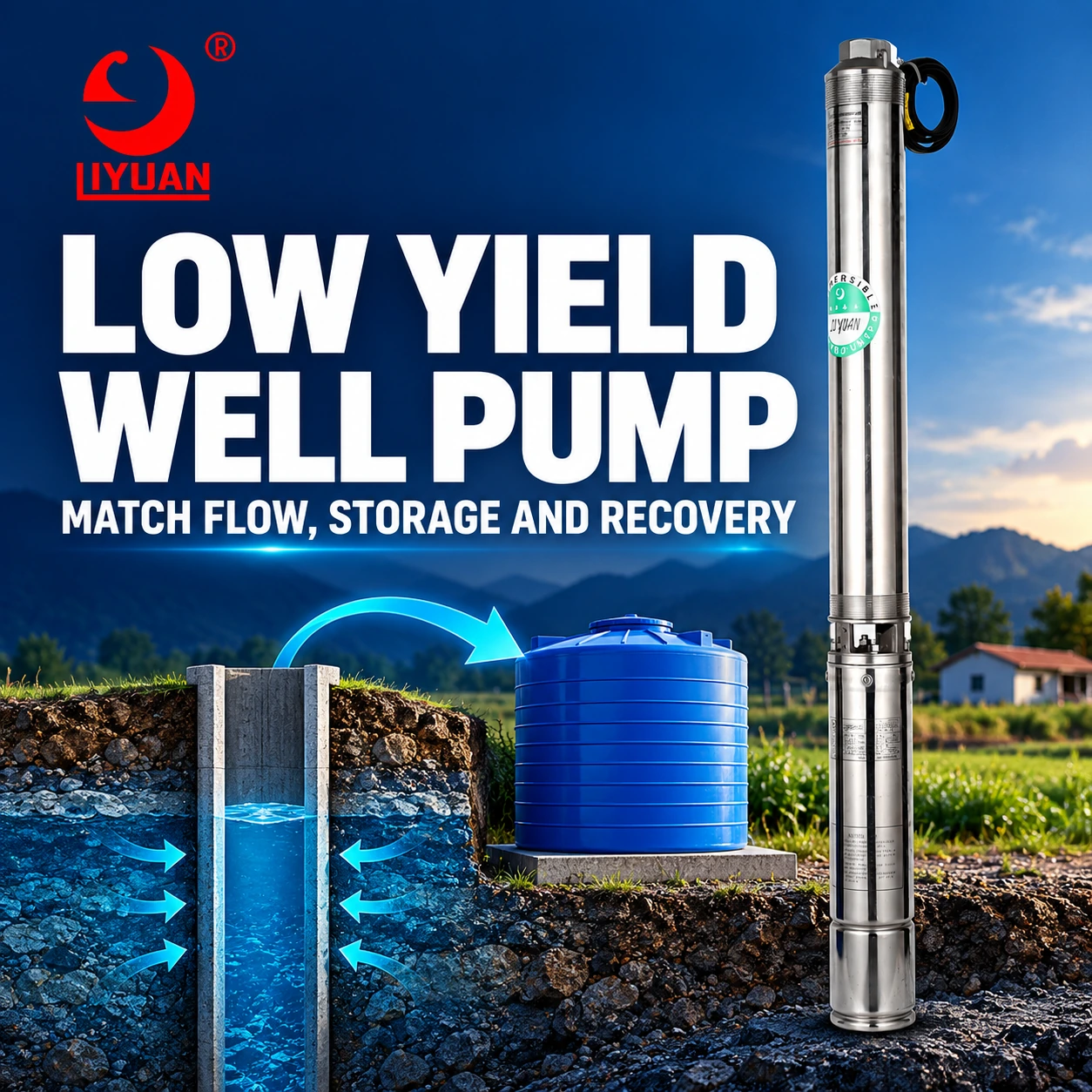
Low Yield Well Pump: Match Flow, Storage And Recovery
A Low Yield Well Pump Must Collect Water At A Rate And Schedule The Well Can Support While Meeting The Pump’s Own Operating Limits. When Household Demand Exceeds Well Production For Short Periods, Usable Storage Can Supply The Difference. A Larger Pump Cannot Resolve An Ongoing Shortage Of Source Water.
The Selection Depends On Four Quantities: Tested Well Yield, Usable Stored Water, Peak Demand And Total Daily Consumption. Horsepower Comes After Those Requirements And The Necessary Pumping Head Are Known.
Does Your Well Need A Different Pump Or More Storage?
Start By Establishing Why Water Delivery Falls. A Blocked Filter, Pipe Leak, Worn Pump Or Electrical Fault Can Reduce Delivery Even When The Well Contains Enough Water.
Weak Flow That Returns After A Rest Period Suggests A Supply Or Equipment-Recovery Issue, But Does Not Prove Low Well Yield. Have The Pumping Water Level, Discharge Flow And Equipment Condition Checked Together.
The Water Systems Council’s Low-Yielding Well Advice Recommends Establishing Water Level And Recovery Rate With A Well Contractor Before Selecting A Remedy.
Use These Distinctions When Reviewing The Results:
| Measurement | What It Answers | What It Does Not Establish |
|---|---|---|
| Sustained Test Flow And Pumping Water Level | How The Well Responds To Continued Withdrawal | Guaranteed Production In Every Season |
| Recovery Measurements After Pumping Stops | How Quickly Water Level Returns Under Test Conditions | A Constant Refill Rate At Every Water Level |
| Actual Pump Discharge Flow | How Fast The Pump Removes Water At That Duty Point | How Fast The Aquifer Replaces It |
| Peak Demand And Duration | How Much Water Must Be Delivered During A Busy Period | Total Daily Water Consumption |
A Short Bucket Test At A Faucet Measures Delivery At That Moment. It Does Not Establish Sustainable Well Yield.
Choose The Low Yield Well Pump Arrangement
The Well’s Stored Water Can Sometimes Cover Short Demand Peaks. In Other Installations, A Separate Storage Tank And Booster Provide A More Suitable Arrangement.
| Site Condition | Arrangement To Evaluate | Main Limitation |
|---|---|---|
| Adequate Daily Production And Enough Usable Water Stored In The Well | Direct Supply With Appropriate Pump Controls | Available Drawdown Must Cover The Demand Period |
| Adequate Daily Production But Insufficient Storage For Peaks | Well Pump, Atmospheric Storage Tank And Booster | Tank Must Refill Before Repeated Peaks Exhaust It |
| Insufficient Daily Production | Demand Reduction, Well Assessment Or Another Water Source | Additional Storage Only Delays Depletion |
Goulds Water Technology’s Water Products Technical Manual Discusses Both Water Stored In The Well And A Separate Tank With A Booster For Low-Yield Applications.
For A Two-Pump Arrangement, Assign Separate Duties. The Well Pump Collects Water From The Source. The Booster Delivers Stored Water At The Household’s Required Flow And Pressure.
Count Only The Usable Water In The Well
Total Well Depth Is Not The Usable Water Column. The Lower Operating Level Must Preserve Required Pump Submergence And Respect The Well’s Construction And Water-Producing Zones.
Lowering A Pump May Expose Additional Stored Water In Some Wells, But Does Not Automatically Increase Sustainable Yield. A Well Contractor Should Evaluate Clearances, Sediment, Cooling And Water Quality Before Changing Its Setting.
How To Size A Low Yield Well Pump
First Decide Whether The System Will Collect Water Continuously At A Modest Rate Or In Controlled Pumping Periods.
Continuous Collection
The Collection Rate Must Remain Within The Well’s Tested Sustainable Supply Under The Design Conditions. It Must Also Stay Inside The Pump Manufacturer’s Permitted Operating Range.
If The Well Supports Only 5 L/min, A Pump That Requires A Higher Minimum Flow Is Not A Suitable Continuous-Duty Choice At 5 L/min. Selecting It By Horsepower And Closing A Valve Does Not Resolve That Mismatch.
Controlled Pumping Periods
A Pump May Withdraw Water Faster Than The Well’s Instantaneous Inflow For A Limited Period By Using Stored Water In The Well. That Requires Verified Usable Storage, Suitable Stop And Restart Controls, And An Acceptable Motor Starting Frequency.
The Cycle-Average Collection Still Cannot Exceed Long-Term Source Availability. Do Not Set A Repeating Timer From A Guess About Recovery Or Use Repeated Dry Running As The Normal Collection Method.
Check The Full Head Range
Evaluate The Submersible Pump Performance Curve At Both High And Low Pumping Water Levels. Include Delivery Elevation, Pipe Losses And Any Required Discharge Pressure.
When A Well Pump Fills An Atmospheric Tank, The Separate Booster Usually Provides Household Pressure. Adding The Household Pressure Requirement To The Well Pump’s Duty Without Reviewing The Layout Can Lead To Excessive Head Selection.
Also Check Flow At The Highest Water Level, When Pumping Lift Is Lower. The Pump May Deliver More Water Than Expected And Deplete Available Well Storage Faster.
Low Yield Well Pump Storage Calculation
This Hypothetical Example Shows Why Tank Selection Must Include Both Demand Duration And Whether The Well Pump Will Be Running.
Assume:
- Confirmed Collection Flow While Running: 5 L/min.
- Household Peak Demand: 20 L/min.
- Peak Duration: 30 Minutes.
- Available Usable Tank Water At The Start: 500 L.
If Collection Continues Throughout The Peak:
Required Storage Contribution = (Demand − Collection Flow) × Time
Required Storage Contribution = (20 − 5) × 30 = 450 L
The Assumed 500 L Of Available Water Covers That Event With 50 L Remaining Above The Defined Lower Operating Limit.
Now Consider The Same Event During A Well-Recovery Pause:
Required Storage Contribution = 20 × 30 = 600 L
The Same Tank Inventory Is Now 100 L Short.
| Operating Condition | Peak Consumption | Water Collected During Peak | Storage Needed |
|---|---|---|---|
| Collection Runs Continuously | 600 L | 150 L | 450 L |
| Collection Is Paused | 600 L | 0 L | 600 L |
The Storage Requirement Depends On The Control Sequence, Not Just The Well’s Test Yield. If Pumping Is Intermittent, Use The Actual Collection Schedule In The Calculation.
Allow For Operating Levels And Reserve
A Tank’s Labelled Capacity Is Not Necessarily Its Available Inventory. Account For The Upper Fill Limit, Booster Low-Level Stop, Unusable Bottom Volume And Any Reserved Supply.
Also Check How Much Water Will Actually Be Present When A Peak Starts. A Tank That Can Hold Enough Water May Still Be Partly Empty After An Earlier Demand Event.
For Drinking-Water Service, Specify A Suitable Sanitary Storage System And Plan Its Access, Cleaning And Water Treatment With The Installer.
How Long Will The Storage Tank Take To Refill?
After The First Example, The System Must Replace 450 L. With Collection At 5 L/min And No Household Use:
Refill Time = 450 ÷ 5 = 90 Minutes
If Household Use Continues At 2 L/min:
Net Refill Rate = 5 − 2 = 3 L/min
Refill Time = 450 ÷ 3 = 150 Minutes
These Results Assume Uninterrupted Collection. Recovery Pauses Or A Lower Seasonal Yield Extend The Refill Time. Repeated Demand Peaks Must Be Evaluated As A Sequence, With The Remaining Inventory Carried Forward.
Check The Daily Water Balance
At 5 L/min, Four Hours Of Actual Collection Supplies:
5 × 60 × 4 = 1,200 L
If Daily Use Is Also 1,200 L, That Schedule Leaves No Allowance For Additional Consumption Or Missed Collection Time. Include Treatment Backwash, Irrigation And Other Scheduled Uses In The Demand Total.
Do Not Multiply A Brief Test Rate By 24 Hours And Treat The Result As Guaranteed Daily Production.
Will A Larger Pressure Tank Solve A Low-Yield Well Problem?
A Larger Pressure Tank Adds Some Usable Drawdown And Can Reduce Cycling. Its Nominal Volume Includes Compressed Air, So The Labelled Capacity Is Not The Water Available Between Pump Starts.
Use The Manufacturer’s Drawdown Table At The Intended Pressure Settings. Compare That Usable Volume With The Calculated Demand Deficit Before Choosing Between Additional Pressure Storage And An Atmospheric Tank With A Booster.
The Submersible Pump Pressure Tank Article Explains This Sizing Difference. Neither Tank Type Increases The Aquifer’s Water Production.
Low Yield Well Pump Controls Need Separate Stop Conditions
In A System With A Storage Tank And Booster, Specify These Functions Separately:
| Condition | Required Response |
|---|---|
| Well Reaches Its Defined Lower Operating Level | Stop The Well Pump And Allow Appropriate Recovery |
| Storage Tank Reaches Its Upper Fill Level | Stop Tank Filling |
| Storage Tank Reaches The Booster’s Lower Operating Level | Stop The Booster Before It Loses Adequate Supply |
| Demand Or Water Level Permits Restart | Restart According To The Approved Control Sequence |
An Ordinary Household Pressure Switch Does Not Measure Well Water Level. Select Suitable Submersible Pump Dry-Running Protection And Confirm How It Works With The Motor And Control Method.
For Example, Pentair’s Pentek Single-Phase Pump Protection Lists Dry-Well Protection Across Specified Motor Applications. Protection Compatibility Must Be Checked For The Exact Motor; A Device Name Alone Does Not Establish Suitability.
Can A Flow Restrictor Or VFD Make An Existing Pump Suitable?
Possibly, If The Revised Duty Remains Inside The Pump And Motor Limits. Verify Minimum Flow, Permitted Speed, Thrust, Motor Load And Cooling Before Selecting A Restrictor Or Drive.
Reduced Delivery Can Also Reduce Water Movement Around A Submersible Motor. Review The Submersible Motor Cooling System For The Actual Well Geometry And Collection Flow.
A Constant-Pressure Drive Can Regulate Delivery Pressure Within The System’s Capability. It Cannot Replace Missing Source Water Or Eliminate The Need For A Storage Calculation.
What Should A Low Yield Well Pump Quotation Include?
Provide The Well Test And Recovery Record, Seasonal Water-Level Information, Casing Diameter, Pump Setting, Existing Motor Details, Daily Consumption And Peak Demand Schedule. Include Tank Operating Levels And Pipe Details If Storage Is Proposed.
For A Liyuan Submersible Pump System Assessment, Request The Proposed Flow At Minimum And Maximum Head, The Permitted Operating Range, Motor Cooling Requirements And Collection-Control Method.
The Proposal Should Explain How Water Will Be Collected, Stored And Delivered Across A Complete Demand Cycle. Those Checks Establish Whether The Equipment Fits The Well More Reliably Than A Horsepower Recommendation Alone.
Email:Liyuan@liyuan-pump.com
WhatsApp:+86 181-2828-2767