ar Pump Inverter: PV Voltage, Motor Current And Sizing
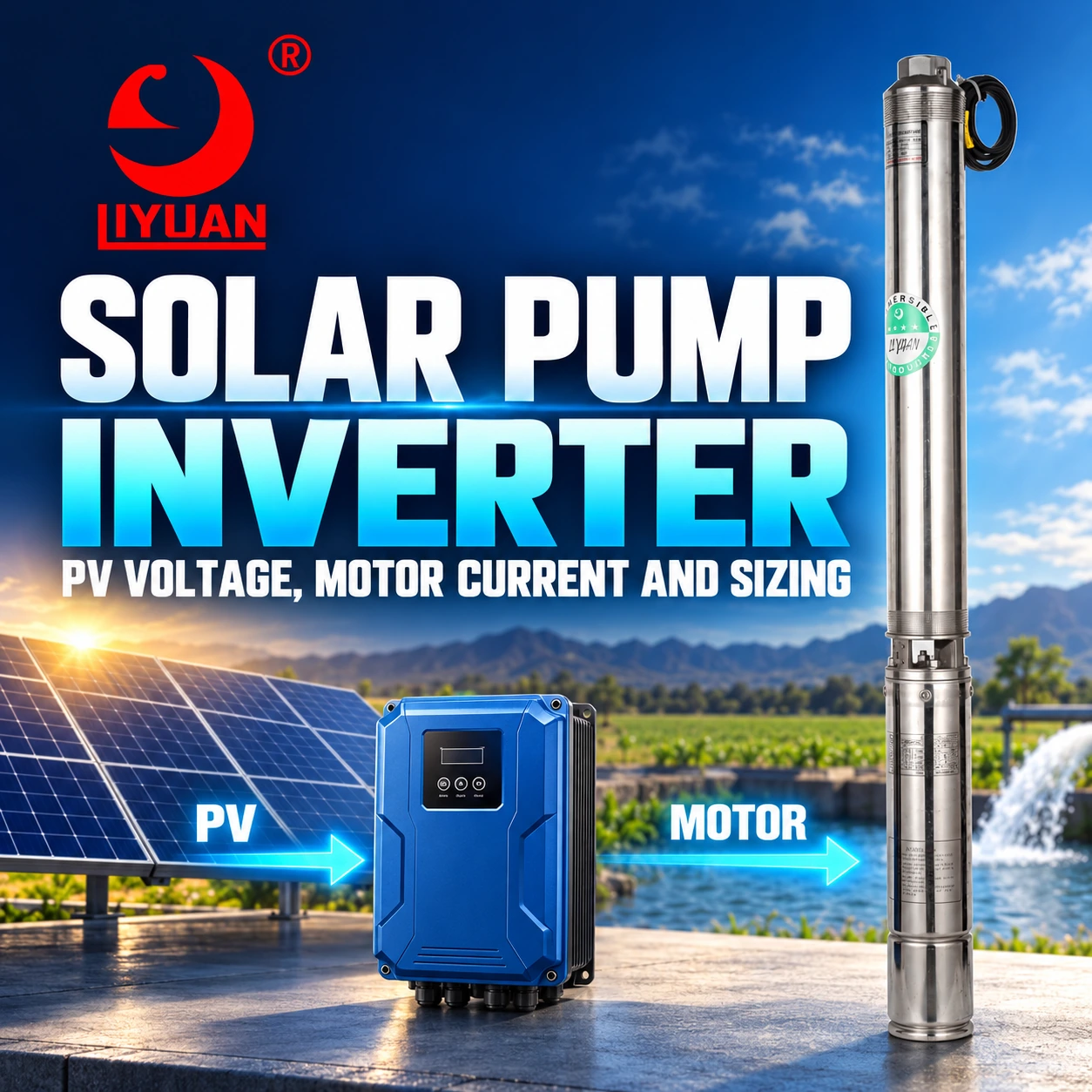
A Solar Pump Inverter Converts Photovoltaic DC Power Into Controlled AC Power For A Compatible Pump Motor. Selecting One Requires Three Separate Checks: The Motor Must Match Its Output, The Solar Array Must Match Its Input, And The Pump Must Deliver The Required Water At The Available Operating Speed.
Start With The Motor Nameplate And Pump Duty Point. A Matching kW Label Alone Does Not Establish Compatibility. Two Inverters With The Same Power Rating Can Have Different Output Currents, PV Voltage Limits And Supported Motor Types.
What Does A Solar Pump Inverter Do?
A Solar Pump Drive Adjusts Motor Frequency And Voltage As Available Solar Power Changes. Maximum Power Point Tracking, Or MPPT, Controls The Electrical Operating Point Of The PV Array To Extract Available Power.
The Drive May Also Provide Weak-Sunlight Sleep, Automatic Restart, Water-Level Inputs And Motor Protection. Confirm Which Functions Are Included In The Exact Model And Which Require Sensors Or Accessories.
These Equipment Categories Serve Different Purposes:
| Equipment | Main Function | Compatibility Question |
|---|---|---|
| Solar Pump Inverter | Operates A Supported Pump Motor From PV Power | Does It Support The Motor And The Proposed Array? |
| General-Purpose VFD | Controls Motor Speed From Its Approved Supply | Does Its Manufacturer Explicitly Approve Direct PV Operation? |
| Grid-Connected Solar Inverter | Supplies AC Energy To A Compatible Grid Connection | What Separate Equipment Controls And Protects The Pump? |
| Dedicated Solar Pump Controller | Operates A Specified Solar Motor Or Pump Family | Is This The Approved Controller For That Pump? |
An Accessible DC Bus On A General VFD Does Not Establish PV Compatibility. For Motor-Side Selection, The Variable Frequency Drive For Submersible Pump Article Explains Additional Drive And Motor Checks.
Match The Solar Pump Inverter To The Motor First
Record The Motor’s Rated Voltage, Phase, Frequency, Current, Power And Motor Type. Include The Existing Controller Model When Converting An Installed Pump.
Three-Phase AC Motors
Confirm That The Inverter Supports The Motor’s Voltage Class And Control Method. Its Available Continuous Output Current, After Applicable Derating, Must Meet The Motor Manufacturer’s Requirement.
Check Ambient Temperature, Altitude, Enclosure Ventilation And Motor-Cable Length. The Drive Supplier Should Specify Whether The Installation Requires An Output Reactor Or Filter.
Single-Phase And Permanent-Magnet Motors
Compatibility Depends On The Exact Combination. INVT’s GD100-PV Product Information Lists Support For Several Motor Voltage And Phase Categories Within That Product Family. That Does Not Make Every Variant Interchangeable.
A Capacitor-Start Single-Phase Motor Needs Explicit Drive Approval. A Brushless DC Or Permanent-Magnet Solar Pump May Require Its Own Matched Controller. Obtain The Approved Motor And Controller Combination Before Reusing Existing Equipment.
Read A Liyuan Solar Pump Inverter Specification Correctly
The Liyuan Submersible Pumps Catalog, Printed Page 21, Lists The WLD280 Solar Pump Inverter Family. Its Summary Shows DC Input Of 420–720 VDC And Three-Phase Output Of 0–380 V.
One Listed Model Provides A Useful Reading Example:
| Catalog Field | WLD280-4007 |
|---|---|
| Rated Output Power | 5.5 kW |
| Rated Input Current | 19.5 A |
| Rated Output Current | 14.0 A |
| Listed Motor Power | 5.5 kW |
The Motor-Side Current Figure Is 14.0 A. The 19.5 A Input Figure Must Not Be Used As The Motor Output Rating Or Assumed To Be The Maximum Permitted PV Short-Circuit Current.
Likewise, The Summary’s 420–720 VDC Entry Does Not Separately Identify Every PV Design Limit. Request The Exact Model Manual For Maximum Open-Circuit Voltage, MPPT Window, Startup Voltage And PV Current Limits. Confirm The Current Specification Revision Before Ordering.
Solar Pump Inverter PV Voltage: Three Different Limits
A Solar Array Must Satisfy More Than One Voltage Requirement:
| Parameter | What To Check | Consequence Of A Mismatch |
|---|---|---|
| Maximum Permissible PV Open-Circuit Voltage | Cold-Weather String Voc Remains Below The Hardware Limit | Overvoltage And Potential Equipment Damage |
| MPPT Operating Window | String Vmp Remains Within The Approved Range Across Operating Temperatures | Reduced Performance Or Unavailable Tracking |
| Startup Voltage | The Array Can Meet The Specified Starting Condition | The Drive May Stay Asleep Or Repeatedly Attempt To Start |
Startup Voltage Alone Does Not Prove That Enough Power Is Available To Pump Water. Also Confirm The DC Voltage Required To Produce The Motor Voltage And Speed Needed At The Design Duty Point.
For Crystalline-Silicon Modules, Cold Conditions Generally Increase Open-Circuit Voltage, While Hot Cells Reduce Operating Voltage. Use The Actual Module Datasheet And Site Design Temperatures.
Canadian Solar’s PV Module Installation Manual Explains Temperature Correction Of Voc And The Need To Keep String Voltage Within Equipment Limits. Modules In Series Increase Voltage; Parallel Strings Increase Current.
Solar Pump Inverter Sizing Example: When No String Length Fits
The Following Values Are Hypothetical. They Are Not WLD280 Specifications Or An Installation Recommendation.
Assume:
- Inverter Maximum PV Open-Circuit Voltage: 650 V.
- Required MPPT Operating Range: 400–600 V.
- Module Voc At 25°C: 50 V.
- Module Voc Temperature Coefficient: −0.30% Per °C.
- Lowest Design Temperature: −10°C.
- Estimated Module Vmp At The Hottest Design Cell Temperature: 35 V.
The Temperature Difference Is 35°C. Using The Assumed Coefficient, The Cold-Weather Voltage Increase Is:
35 × 0.30% = 10.5%
Therefore:
Cold Voc Per Module = 50 × 1.105 = 55.25 V
Compare Two Candidate String Lengths:
| Modules In Series | Cold String Voc | Hot String Vmp | Preliminary Result |
|---|---|---|---|
| 11 | 607.75 V | 385 V | Hot Vmp Falls Below 400 V |
| 12 | 663 V | 420 V | Cold Voc Exceeds 650 V |
Fewer Modules Further Reduce Hot Operating Voltage. More Modules Further Increase Cold Open-Circuit Voltage. Under These Assumptions, No Series Count Meets Both Requirements For Operation Throughout The Stated Temperature Range.
Adding An Identical Parallel String Does Not Resolve This Voltage Conflict. The Designer Must Revisit The Module Or Inverter Selection, Or Evaluate A Manufacturer-Approved Voltage-Conversion Arrangement.
A Combination That Passes These Two Checks Still Requires Startup, Current, Power, Tolerance And Installation Assessments. A Qualified PV Designer Should Complete Those Checks Using The Actual Equipment Manuals.
How Many Solar Panels Does The Pump Inverter Need?
Determine Electrical Compatibility Before Calculating Total Array Wattage. A Universal Rule Such As “Panel Power Equals Motor Power Multiplied By 1.5” Cannot Confirm A Complete Design.
Motor kW Usually Describes Mechanical Output. PV Nameplate kWp Describes Electrical Output Under Standard Test Conditions. Between Them Are Motor And Drive Losses, Temperature Effects, Shading, Cable Losses And Changing Irradiance.
Request A Daily Water-Delivery Estimate For The Required Season And Actual Total Dynamic Head. That Head Includes Pumping Lift, Delivery Elevation, Required Outlet Pressure And Friction Losses.
For An Illustrative Daily Requirement Of 30 m³ Over Six Actual Pumping Hours:
Required Average Flow = 30 ÷ 6 = 5 m³/h
Six Hours Of Daylight Does Not Necessarily Mean Six Hours At Rated Flow. Use The Submersible Pump Performance Curve And The Supplier’s Solar Pumping Calculation To Evaluate Delivery As Available Power Changes.
Why Can A Solar Pump Inverter Run Without Delivering Water?
At Reduced Speed, A Centrifugal Pump Produces Less Head. If Its Available Head Falls Below The System’s Static Lift And Pressure Requirement, The Motor Can Rotate Without Useful Delivery.
MPPT Cannot Remove That Hydraulic Threshold. ABB’s Solar Pump Drive Manual Describes Minimum-Speed Control Intended To Stop Operation Where Pump Capacity Becomes Very Low.
Set The Permitted Speed Range From Both Pump And Motor Requirements. At Low Flow, Check The Submersible Motor Cooling System: A Motor Can Be Underwater Without Receiving Enough Cooling Flow Along Its Surface.
Avoid Increasing Maximum Frequency To Recover Missing Water Output Unless The Pump And Motor Manufacturers Approve The Operating Point.
Solar Pump Controls: Tank Full And Well Empty Are Different
The Receiving Tank And The Water Source Need Different Stop Conditions:
- Tank-Full Control: Stops Filling When Storage Reaches Its Upper Limit.
- Source Low-Level Protection: Stops Pumping Before Inadequate Submergence Or Water Supply Causes Damage.
- Restart Logic: Allows Appropriate Tank Drawdown, Source Recovery Or Improved Sunlight Before Restarting.
Confirm Whether Dry-Run Detection Uses A Probe, Motor-Load Monitoring Or Another Method. Its Suitability And Settings Depend On The Pumping Arrangement. The Submersible Pump Dry-Running Protection Article Covers The Source-Protection Question In More Detail.
Can A Solar Pump Inverter Use Grid Or Generator Backup?
Some Models Accept Both PV And AC Supplies. Confirm Whether The Quoted Arrangement Provides Source Selection, Automatic Transfer Or Simultaneous Power Contribution.
“Hybrid” Alone Does Not Define Those Functions. Ask Which Changeover Components Are Required, Whether A Generator Is Supported, And How Restart Works After Transfer. AC Backup Capability Does Not Establish Permission To Export Power To The Grid.
For Nighttime Demand, Compare An Approved Backup Supply With Adequate Water Storage. A Standard Solar Pump Drive Should Not Be Assumed To Include Battery Charging Or Battery Management.
What To Send For A Solar Pump Inverter Quotation
Send The Following Information Together:
| Information | Selection Decision It Supports |
|---|---|
| Motor Nameplate And Existing Controller Photos | Motor Type, Voltage, Phase And Current Compatibility |
| Pump Model, Required Flow And Total Dynamic Head | Useful Operating Speed And Pump Duty |
| Daily Water Demand And Required Season | Solar Array And Storage Assessment |
| PV Module Datasheet And Proposed Array Layout | Voltage, Current And Power Compatibility |
| Site Location And Temperature Range | Solar Yield, Voltage Correction And Derating |
| Motor Cable Length And Installation Conditions | Output Treatment And Cooling Requirements |
| Tank Controls, Source Protection And Backup Preference | Sensors, Accessories And Control Functions |
For A Liyuan Solar Water Pump System Proposal, Ask For The Selected Pump, Motor, Inverter And PV Configuration To Be Identified Together. A Useful Quotation Should State Expected Water Delivery And The Conditions Behind It, Along With The Exact Equipment Ratings.
Email:Liyuan@liyuan-pump.com
WhatsApp:+86 181-2828-2767