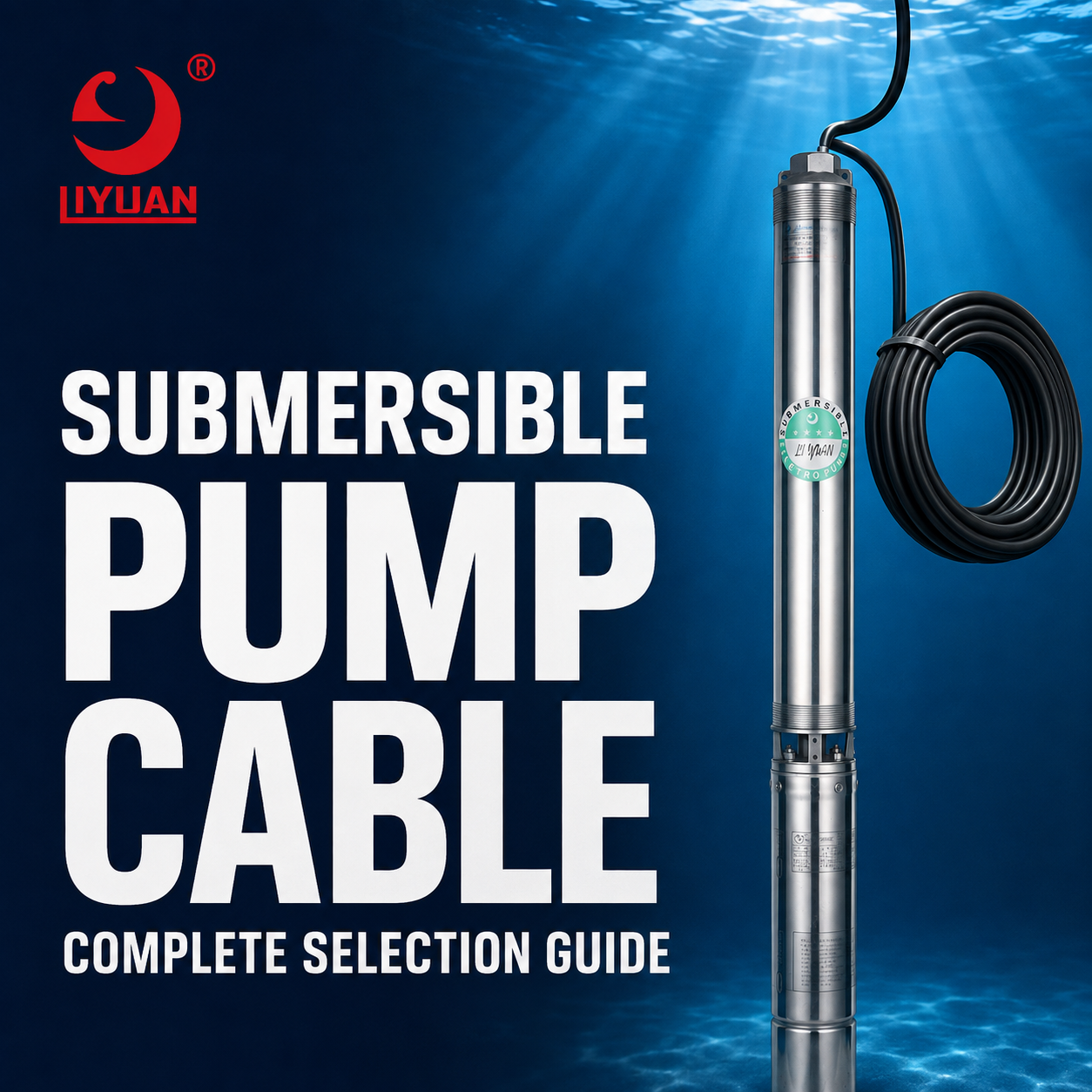
Submersible Pump Cable: Complete Selection Guide
A Submersible Pump Cable Must Carry The Motor’s Starting And Running Current While Remaining Waterproof At The Required Installation Depth. Correct Conductor Size, Insulation, Voltage Rating, And Splicing Help Prevent Low Voltage, Overheating, Ground Faults, And Motor Failure.
Cable Selection Should Consider Motor Power, Voltage, Phase, Rated Current, Cable Length, Water Temperature, Well Depth, Starting Method, And Local Electrical regulations.
An Undersized Cable May Reduce Voltage At The Motor. Meanwhile, An Incorrect Cable Joint Can Allow Water To Enter The Conductors. Both Problems Can Shorten The Service Life Of The Complete Pump System.
What Is A Submersible Pump Cable?
A Submersible Pump Cable Is An Electrical Cable Designed To Supply Power To A Motor Operating Underwater.
In A Deep-Well System, The Cable Runs From The Surface Control Equipment Down The Well To The Submersible Motor.
The Cable Must Withstand:
- Continuous Water Immersion
- Hydrostatic Pressure
- Motor Starting Current
- Electrical Voltage
- Water Temperature
- Mechanical Stress
- Abrasion
- Chemicals And Minerals
- Long Operating Hours
- Repeated Pump Installation And Removal
A Standard Indoor Electrical Cable Should Not Replace A Cable Specifically Approved For Submersible service.
Main Parts Of A Submersible Pump Cable
A Typical Cable Contains Several Protective Layers.
Conductor
The Conductor Carries Electrical Current.
Copper Is Commonly Used Because It Provides High Conductivity, Reliable Connections, And Good Mechanical performance.
Conductor Insulation
Each Individual Conductor Has An Insulating Layer. This Prevents Current From Flowing Between Conductors Or Into The Surrounding Water.
Outer Jacket
A Jacketed Cable Has An Additional Outer Cover Around The Insulated conductors.
The Jacket Protects Against:
- Abrasion
- Moisture
- Installation Damage
- Chemicals
- Mechanical Stress
Grounding Conductor
The Grounding Conductor Connects The Motor Housing To The Protective Grounding system.
It Provides A Low-Resistance Path For Fault Current And Helps Protective Equipment Disconnect The Power supply.
Cable Markings
Cable Markings May Identify:
- Conductor Size
- Number Of Conductors
- Voltage Rating
- Temperature Rating
- Insulation Material
- Manufacturer
- Certification Standard
- Water-Resistance Classification
Always Verify The Cable Markings Before Installation.
Submersible Motor Lead And Drop Cable
A Pump Installation Can Include Two Different Cable sections.
Motor Lead Cable
The Motor Lead Is The Short Cable Connected Directly To The Submersible motor.
It May Be Factory Installed And Sealed Through A Waterproof Motor connection.
Drop Cable
The Drop Cable Runs From The Motor Lead To The Surface Control Panel, Starter, Or Power supply.
A Waterproof Splice Connects The Motor Lead And Drop cable.
The Two Cables Must Be Compatible In:
- Conductor Size
- Voltage Rating
- Temperature Rating
- Insulation Material
- Number Of Conductors
- Current Capacity
- Installation Environment
The Splice Must Remain Waterproof At The Maximum Installation depth.
Flat Cable Vs Round Cable
Submersible Pump Cables Are Commonly Available In Flat And Round configurations.
Flat Submersible Cable
A Flat Cable Places The Conductors Side By Side.
Advantages Include:
- Compact Profile
- Easy Installation Beside The Riser Pipe
- Good Fit In Narrow Wells
- Reduced Interference With Cable Guards
Possible Limitations Include:
- Less Flexibility In Some Large Sizes
- Special Splicing Requirements
- Greater Sensitivity To Twisting
Round Submersible Cable
A Round Cable Places Conductors Inside A Circular Outer jacket.
Advantages Include:
- Strong Overall Mechanical Protection
- Good Flexibility In Many Sizes
- Convenient Cable-Gland Installation
- Availability In Jacketed Industrial Designs
Possible Limitations Include:
- Larger External Diameter
- More Space Required Between The Pump And Well Casing
The Correct Shape Depends On Well Clearance, Motor Connection, Cable Size, And installation method.
Jacketed Vs Unjacketed Cable
An Unjacketed Cable Uses Individually Insulated Conductors Without A Common Outer cover.
A Jacketed Cable Adds An Outer Protective layer.
Jacketed Cable Can Provide Better Protection Against Abrasion, Chemicals, And installation damage. However, It Has A Larger Overall Diameter.
Grundfos Notes In Its Submersible Cable Sizing Guide That Cable Configuration And Motor-Cable Construction Should Be Considered When Selecting The Drop cable.
For Tight Boreholes, The Available Space Between The Pump, Cable Guard, Riser Pipe, And Well Casing Must Be checked.
Common Cable Insulation Materials
Different Cable Materials Provide Different Levels Of Heat, Water, Chemical, And mechanical resistance.
PVC
PVC Is Economical And Widely Available.
It Can Be Suitable For Standard Clean-Water Applications When The Cable Has The Correct Submersible rating.
XLPE
Cross-Linked Polyethylene Offers Good Electrical Insulation, Heat Resistance, And moisture resistance.
It Is Commonly Used In Motor Leads And Industrial cable systems.
EPR
Ethylene Propylene Rubber Provides Strong Electrical Insulation And flexibility.
It Can Perform Well In Wet And Demanding environments.
EPDM
EPDM Offers Good Resistance To Water, Heat, And Certain chemicals.
However, Fluid Compatibility Must Always Be checked.
PE
Polyethylene Provides Good Moisture Resistance And Electrical properties.
The Complete Cable Construction Must Still Be Rated For Continuous submersion.
Material Names Alone Do Not Confirm Suitability. The Cable Must Have The Correct Voltage, Temperature, Water, And certification ratings.
How Many Conductors Does A Pump Cable Need?
The Required Number Of Conductors Depends On Motor Phase And starting design.
Two-Wire Single-Phase Motor
A Two-Wire Motor Commonly Requires:
- Two Power Conductors
- One Protective Grounding Conductor
The Starting Components Are Usually Located Inside The motor.
Three-Wire Single-Phase Motor
A Three-Wire Motor Commonly Requires:
- Three Motor Circuit Conductors
- One Protective Grounding Conductor
The Start Capacitor, Run Capacitor, And Relay May Be Located Inside An External Control box.
Three-Phase Motor
A Standard Three-Phase Motor Commonly Requires:
- Three Phase Conductors
- One Protective Grounding Conductor
Additional Conductors May Be Required For:
- Temperature Sensors
- Moisture Sensors
- Brake Systems
- Monitoring Devices
The Single Phase Submersible Pump Vs Three Phase Pump Guide Explains The Main Electrical Differences.
What Determines Cable Size?
Cable Size Refers To The Cross-Sectional Area Of Each conductor.
It May Be Expressed In:
- Square Millimeters
- American Wire Gauge
Cable Size Depends On Several factors.
Motor Rated Current
The Cable Must Carry The Motor’s Maximum expected operating current.
Starting Current
Direct-On-Line Starting Can Produce High Current For A Short period.
The Cable Must Allow The Motor To Develop Enough Starting torque.
Cable Length
Longer Cables Have More Electrical resistance.
Therefore, A Longer Installation Often Requires A Larger conductor.
Supply Voltage
The Same Motor Power Requires More Current At A Lower voltage.
For Example, A Low-Voltage Motor Usually Requires A Larger Cable Than A Higher-Voltage Motor Of Similar power.
Single-Phase Or Three-Phase Supply
Single-Phase And Three-Phase Circuits Use Different Voltage-Drop calculations.
Water Temperature
Higher Temperature Can Reduce The Current-Carrying Capacity Of Some cable constructions.
Starting Method
Direct-On-Line, Star-Delta, Soft Starter, And VFD Systems Have Different electrical characteristics.
Installation Method
Cable Grouping, Conduit, Surface Exposure, And Well Installation Can Affect cable selection.
What Is Cable Voltage Drop?
Voltage Drop Is The Reduction In Voltage Between The Power Source And The Motor terminals.
Every Cable Has Electrical Resistance. When Current Flows Through The Cable, Part Of The Supply Voltage Is lost.
Voltage Drop Increases When:
- Cable Length Increases
- Conductor Size Decreases
- Motor Current Increases
- Connections Become Loose
- Conductor Temperature Rises
- Conductor Material Has Higher Resistance
The Motor Must Receive Voltage Within Its Approved operating range.
Why Is Excessive Voltage Drop Dangerous?
Excessive Voltage Drop Can Prevent The Motor From Producing The Required torque.
Possible Results Include:
- Slow Starting
- Failure To Start
- Increased Motor Current
- Winding Overheating
- Contactor Chattering
- Control Box Failure
- Reduced Pump Output
- Frequent Overload Trips
- Shortened Motor Life
- Increased Energy Consumption
A Motor May Show Correct Supply Voltage At The Control Panel But Receive Insufficient Voltage At The Bottom Of The well.
Recommended Voltage Drop
Acceptable Voltage Drop Depends On The Motor Manufacturer, Starting Method, Electrical Code, And project requirements.
Many Deep-Well Cable Selection Tables Use A Controlled Voltage-Drop Range. The Official Grundfos Borehole Technical Guide Discusses Cable Calculations Based On Voltage Drops Between One And Three Percent.
This Range Should Not Be Applied Blindly To Every installation.
The Final Cable Must Satisfy:
- Manufacturer Requirements
- Local Electrical Regulations
- Starting-Torque Requirements
- Motor Voltage Limits
- Cable Ampacity
- Installation Conditions
When In Doubt, Selecting A Larger Cable Can Reduce Voltage Drop And Operating losses.
Basic Voltage-Drop Principle
Cable Voltage Drop Depends On Current, Resistance, And circuit configuration.
A Simplified Principle Is:
Voltage Drop = Current × Circuit Resistance
Cable Resistance Depends On:
Resistance = Conductor Resistivity × Cable Length ÷ Conductor Area
Therefore:
- Longer Cable Produces More Voltage Drop.
- Higher Current Produces More Voltage Drop.
- Larger Conductor Area Produces Less Voltage Drop.
For AC Motor Circuits, Power Factor And Cable Reactance May Also Need To Be included.
Manufacturer Cable Tables Or Professional Cable-Calculation Software Should Be Used For Final selection.
How To Measure Cable Length
The Required Cable Length Is Not Only The Well depth.
Include The Complete Distance From The Motor Connection To The Control equipment.
Possible Cable Sections Include:
- Motor Lead Length
- Underwater Drop Cable
- Wellhead Cable
- Cable From Wellhead To Control Panel
- Cable From Control Panel To Power Source
- Additional Routing Around Structures
Always Add A Practical Installation Allowance. However, Avoid Large Coils Of Unused Cable Because They Increase Cost, Resistance, And installation difficulty.
Cable Formulas Differ In How They Treat One-Way And Circuit Length. Follow The Selected Manufacturer Table Carefully To Avoid Counting The Distance twice.
How Cable Size Affects Energy Efficiency
A Cable Converts Part Of The Electrical Energy Into Heat.
The Basic Power-Loss Relationship Is:
Cable Power Loss = Current² × Resistance
A Larger Conductor Has Lower Resistance. Therefore, It Can Reduce Energy loss.
This Benefit Becomes More Important When:
- The Well Is Deep
- Motor Current Is High
- The Pump Operates Many Hours Per Day
- Electricity Prices Are High
- The Cable Will Remain In Service For Many Years
A Larger Cable Costs More Initially. However, It May Reduce Long-Term Electricity Cost And Improve Motor voltage.
An Energy Efficient Submersible Pump Should Be Combined With A Correctly Sized Cable. Otherwise, Cable Losses Can Reduce Overall system efficiency.
Cable Size And Starting Method
The Starting Method Affects Current And Voltage Drop.
Direct-On-Line Starting
Direct-On-Line Starting Applies Full Voltage To The Motor.
It Provides Strong Starting Torque But Can Produce High starting current.
Star-Delta Starting
Star-Delta Starting Reduces Initial Current And Torque.
The Motor Must Have The Correct Winding Leads And connection design.
Soft Starter
A Soft Starter Gradually Increases Motor Voltage.
Incorrect Settings Can Extend Acceleration Time And Increase Motor heating.
Variable-Frequency Drive
A VFD Controls Motor Frequency And Voltage.
Long Motor Cables Can Create Voltage Reflections, Electrical Noise, And Additional insulation stress.
The Cable, Grounding, Output Filter, And Maximum Lead Length Should Follow The VFD And motor manufacturer’s recommendations.
Selecting Cable For Solar Pumps
A Solar Pump System May Use DC Or AC power.
Cable Selection Must Consider:
- System Voltage
- Maximum Current
- Controller Output
- Cable Length
- Starting Method
- Solar Array Voltage
- Maximum Water Temperature
- Voltage Drop
- UV Exposure Above Ground
- Continuous Water Immersion Below Ground
Low-Voltage DC Systems Can Require Large Conductors Because Current May Be relatively high.
The Cable Between The Solar Panels And Controller May Require Different Ratings From The Submersible Cable Between The Controller And motor.
How To Make A Waterproof Cable Splice
The Cable Splice Is One Of The Most Critical Points In A Deep-Well installation.
A Reliable Splice Must Provide:
- Strong Electrical Contact
- Waterproof Insulation
- Mechanical Strength
- Pressure Resistance
- Correct Conductor Separation
- Long-Term Material Compatibility
Common Splicing Systems Include:
- Heat-Shrink Splice Kits
- Resin-Filled Splice Kits
- Molded Waterproof Connectors
- Manufacturer-Specific Plug Systems
Only Use A Splice Kit Approved For Submersible Pump cables.
Basic Cable Splicing Procedure
A Qualified Electrician Should Complete The Splice According To The Kit instructions.
A Typical Process Includes:
- Disconnect And Lock Out The Power Supply.
- Confirm The Cable And Motor Lead Sizes.
- Cut The Cable Ends Cleanly.
- Remove The Correct Length Of Insulation.
- Avoid Damaging The Copper Conductors.
- Install The Approved Crimp Connectors.
- Verify Mechanical Connection Strength.
- Position The Insulation Or Heat-Shrink Components.
- Seal Every Conductor Completely.
- Stagger Individual Connections When Required.
- Complete The Outer Jacket Seal.
- Allow Resin Or Adhesive To Cure.
- Test Continuity And Insulation Resistance.
- Inspect The Splice Before Lowering The Pump.
Never Use Standard Electrical Tape As The Only Waterproof protection.
Common Splicing Mistakes
Incorrect Crimp Size
An Oversized Connector Can Produce A Loose connection.
An Undersized Connector Can Damage The Conductors.
Incomplete Heating
Heat-Shrink Tubing Must Seal Evenly Without Burning The insulation.
Contaminated Surfaces
Water, Oil, Dirt, And Grease Can Prevent Adhesive From sealing.
Damaged Conductor Strands
Cutting Copper Strands Reduces The Conductor Area And Creates Local heating.
Unstaggered Connections
Placing Every Connector At The Same Position Can Create A Large, Rigid Splice.
Sharp Edges
Sharp Connector Edges Can Puncture The Insulation.
Insufficient Curing Time
Resin Or Adhesive Must Cure Before The Splice Enters the water.
Cable Installation Inside The Well
The Cable Should Run Along The Riser Pipe Without Carrying The Pump’s weight.
Recommended Practices Include:
- Secure The Cable At Regular Intervals.
- Use Suitable Cable Guards.
- Avoid Sharp Well-Casing Edges.
- Protect The Cable At Pipe Couplings.
- Keep The Cable Away From Rotating Components.
- Leave Controlled Slack Near Connections.
- Prevent Cable Twisting.
- Avoid Crushing The Cable With Clamps.
- Do Not Suspend The Pump By Its Power Cable.
- Protect The Cable At The Wellhead.
- Check Clearance Before Lowering The Pump.
The How To Install A Submersible Pump Guide Provides Additional Installation Steps.
Cable Selection For Sandy Wells
Sand Can Accumulate Around The Pump And Cable.
Movement Between Sand, Cable, Pump Housing, And Well Casing Can Wear The Outer jacket.
A Sandy-Well Installation May Require:
- Abrasion-Resistant Cable
- Strong Outer Jacket
- Effective Cable Guards
- Secure Cable Attachment
- Adequate Pump Clearance
- Proper Well Development
- Installation Above The Sediment Zone
Read The Sand Resistant Submersible Pump: Complete Guide For Additional Protection Methods.
Cable Selection For Hot Water
High Water Temperature Can Soften, Age, Or Deform Standard cable insulation.
A Hot-Water Cable Must Have A Suitable Continuous Temperature rating.
The Complete System Must Also Use Compatible:
- Motor Leads
- Cable Splice Materials
- Connectors
- Mechanical Seals
- Motor-Fill Fluid
- Control Sensors
- Wellhead Seals
The Hot Water Submersible Pump: Complete Selection Guide Explains Other High-Temperature selection requirements.
Cable Selection For Corrosive Water
Chemical Or Saline Water Can Damage Unsuitable Cable jackets and metal components.
Provide A Water Analysis When The Well Contains:
- Salt
- Chlorides
- Acids
- Alkalis
- Hydrocarbons
- Industrial Chemicals
- Wastewater Contaminants
The Cable Manufacturer Should Confirm Chemical Compatibility. A General Water-Resistant Cable May Not Be Suitable For Aggressive liquids.
Grounding And Electrical Protection
Proper Grounding Helps Protect People And equipment.
The Grounding Conductor Must Connect The Motor Housing To The System grounding point.
The Installation May Also Require:
- Circuit Breaker
- Motor Overload Protection
- Ground-Fault Protection
- Phase-Loss Protection
- Voltage-Imbalance Protection
- Surge Protection
- Dry-Run Protection
- Temperature Protection
- Lightning Protection
Protection Devices Must Match The Motor, Cable, Supply, And local regulations.
An Electric Control Box For Submersible Pump Can Integrate Starting And Motor-Protection functions.
How To Test A Submersible Pump Cable
Cable Testing Should Be Completed Before, During, And After installation.
Visual Inspection
Check For:
- Cuts
- Cracks
- Flattened Areas
- Abrasion
- Burn Marks
- Damaged Jacket
- Corroded Conductors
- Loose Connections
Continuity Test
A Continuity Test Confirms That Each Conductor Has A Complete electrical path.
Conductor Resistance Test
Resistance Measurements Can Identify Broken Strands, Poor Connections, Or conductor imbalance.
Insulation Resistance Test
An Insulation Tester Can Check For Leakage Between Conductors And ground.
Electronic Controllers, Capacitors, And VFDs Must Be Isolated Before Applying An Insulation-Test voltage.
Splice Test
Test The Cable Before And After Completing The Waterproof splice.
Installation Test
Measure Insulation Resistance As The Pump Is Lowered. This Can Help Identify Cable Damage At A Specific depth.
All Tests Should Follow Manufacturer Instructions And Applicable electrical safety procedures.
Common Cable Failure Causes
Undersized Conductor
The Cable Produces Excessive Voltage Drop And Heat.
Water Entering The Splice
Moisture Causes Corrosion, Leakage Current, And Ground faults.
Mechanical Abrasion
The Cable Rubs Against The Well Casing, Riser Pipe, Or pump.
Loose Connection
A Loose Connection Generates Local Heat And Voltage loss.
Excessive Temperature
High Water Or Conductor Temperature Damages Insulation.
Incorrect Cable Type
The Jacket Cannot Withstand Continuous Water immersion.
Lightning And Surge Damage
Voltage Surges Can Puncture Cable And Motor insulation.
Chemical Attack
Aggressive Water Damages The Cable jacket.
Incorrect VFD Application
Voltage Reflections And Harmonics Stress Long Motor cables.
Installation Damage
Sharp Edges, Excessive Pulling, Or Crushed Clamps Damage The insulation.
Warning Signs Of Cable Problems
Possible Cable-Failure Symptoms Include:
- Motor Fails To Start
- Low Voltage At The Motor
- Frequent Overload Trips
- Ground-Fault Trips
- Unbalanced Three-Phase Current
- Low Insulation Resistance
- Intermittent Operation
- Burned Cable Terminals
- Corroded Splice Connections
- Reduced Pump Output
- Unexpected Motor Heating
These Symptoms Can Also Result From Motor, Pump, Or Control-System problems. Therefore, The Complete Circuit Should Be tested.
How To Prevent Cable Failure
Use The Following Practices:
- Select A Cable Rated For Continuous Submersion.
- Size The Cable For Current And Voltage Drop.
- Use Copper Conductors When Specified.
- Install An Approved Waterproof Splice.
- Protect The Cable From Abrasion.
- Ground The Motor Correctly.
- Test The Cable Before Installation.
- Measure Insulation Resistance Regularly.
- Use Suitable Motor Protection.
- Avoid Excessive Cable Tension.
- Record Cable Size And Length.
- Follow The Manufacturer’s Cable Table.
The Electric Submersible Pump Maintenance Guide Provides Additional Maintenance recommendations.
Information Required For Cable Selection
Provide The Following Information To The Supplier:
- Motor Power
- Rated Voltage
- Frequency
- Single-Phase Or Three-Phase Supply
- Two-Wire Or Three-Wire Motor
- Rated Current
- Service-Factor Current
- Starting Method
- VFD Requirements
- Motor Lead Length
- Total Drop-Cable Length
- Well Depth
- Installation Depth
- Water Temperature
- Water Chemistry
- Cable Shape
- Jacket Requirement
- Required Certifications
- Local Electrical Standard
Without This Information, Accurate Cable Sizing Is Difficult.
Why Choose Liyuan Pump?
Liyuan Pump Has Manufactured Deep-Well Submersible Pumps And Motors Since 1992.
Our Product Range Includes 3-Inch To 10-Inch Submersible Pumps, Submersible Motors, Solar Pump Systems, Control Equipment, And Customized Water-Pumping solutions.
Liyuan Pump Can Help Customers Evaluate:
- Motor Power And Current
- Drop-Cable Size
- Installation Depth
- Voltage Drop
- Single-Phase And Three-Phase Connections
- Waterproof Splice Requirements
- Control Box Selection
- Hot-Water Applications
- Solar Pump Cable Requirements
- Pump And Motor Matching
Our Products Serve Residential, Agricultural, Industrial, And Municipal Water-Supply projects.
Explore Our Complete Submersible Pump Range Or Contact Liyuan Pump For Project-Specific Cable Selection.
Frequently Asked Questions
What Cable Is Used For A Submersible Pump?
Use A Cable Specifically Rated For Submersible Pump Service, Continuous Water Immersion, Required Voltage, Current, Temperature, And Installation depth.
How Do I Choose Submersible Pump Cable Size?
Use Motor Current, Voltage, Phase, Cable Length, Starting Method, Temperature, And Allowable Voltage Drop. Follow The Motor Manufacturer’s Cable table.
Can A Cable Be Too Large?
A Larger Cable Usually Reduces Voltage Drop And Energy loss. However, It Costs More, Requires More Space, And May Not Fit The Motor Connector Or Control equipment.
What Happens If The Cable Is Too Small?
An Undersized Cable Can Cause Excessive Voltage Drop, Slow Starting, Motor Overheating, Overload Trips, And Premature winding failure.
Can I Use A Standard Electrical Cable Underwater?
Only If The Cable Is Specifically Certified For The Required Continuous underwater application. Standard Indoor Cable Is Usually Unsuitable.
Does A Two-Wire Pump Use Only Two Conductors?
A Two-Wire Motor Commonly Uses Two Power Conductors Plus A Protective Grounding conductor.
Does A Three-Wire Pump Need A Control Box?
Many Three-Wire Single-Phase Motors Use An External Control Box Containing Starting components. Always Verify The Motor Wiring diagram.
Should The Pump Cable Be Grounded?
Yes. The Motor Housing And System Must Be Grounded According To Manufacturer Instructions And Local electrical regulations.
Can I Join Two Different Cable Sizes?
It May Be Possible When Both Sizes Meet Electrical Requirements And An Approved Splice Is used. However, The Smaller Cable Determines Part Of The Circuit’s Current And voltage-drop performance.
How Long Can A Submersible Pump Cable Be?
The Maximum Length Depends On Motor Power, Voltage, Current, Conductor Size, Phase, And allowable voltage drop. There Is No Universal Maximum Length.
Can A Cable Splice Remain Underwater?
Yes, If It Uses A Properly Installed And Approved Submersible Splice system.
How Often Should The Cable Be Tested?
Test Before Installation, After Splicing, During Installation, And During Scheduled maintenance. Test Again After Any Electrical Fault Or Pump removal.
Conclusion
A Submersible Pump Cable Must Deliver The Correct Voltage To The Motor While Remaining Waterproof, Mechanically Protected, And Electrically safe.
Motor Current, Cable Length, Conductor Size, Starting Method, Water Temperature, And Voltage Drop Must Be Evaluated together.
A Correctly Sized Cable And Professional Waterproof Splice Can Reduce Energy Loss, Prevent Motor Overheating, And Extend The Service Life Of The Complete Deep-Well Pump system.
Email:Liyuan@liyuan-pump.com
WhatsApp:+86 181-2828-2767